
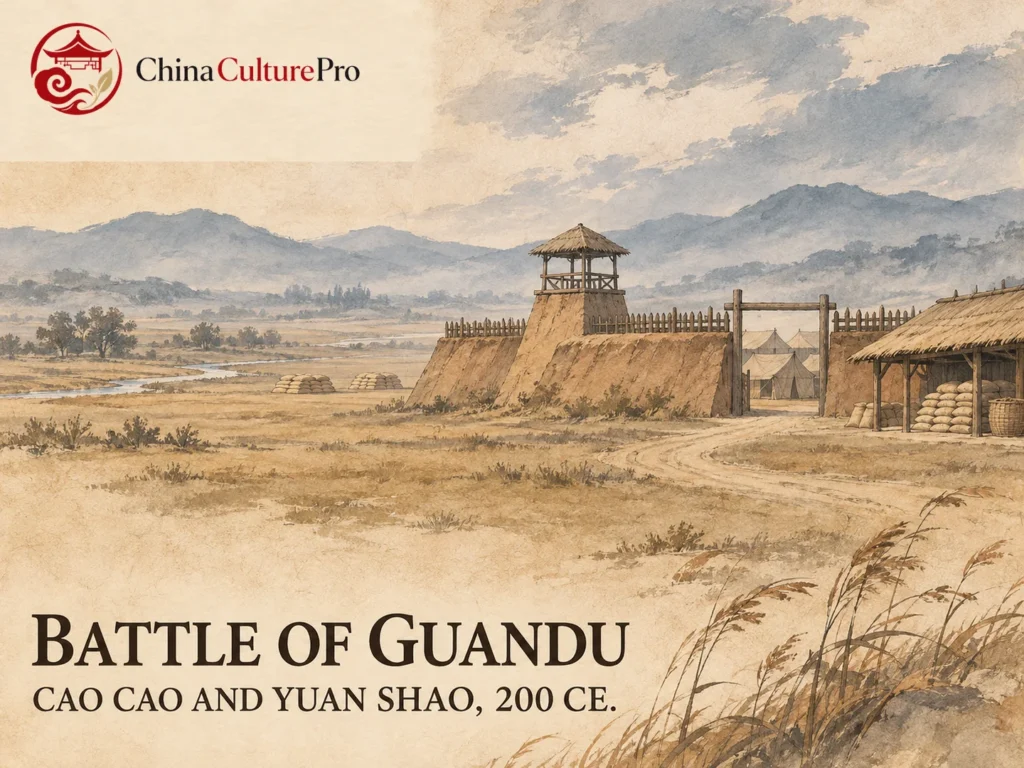

Quick Answer: What Happened at the Battle of Guandu?
The Battle of Guandu (官渡之战, Guāndù zhī zhàn) was a late Han victory in 200 CE for Cao Cao (曹操, Cáo Cāo) over Yuan Shao (袁绍, Yuán Shào). The armies fought near what is now Zhongmou in Henan. Cao Cao’s raid on supplies at Wuchao (乌巢, Wūcháo) helped break the standoff. [1][2][4]
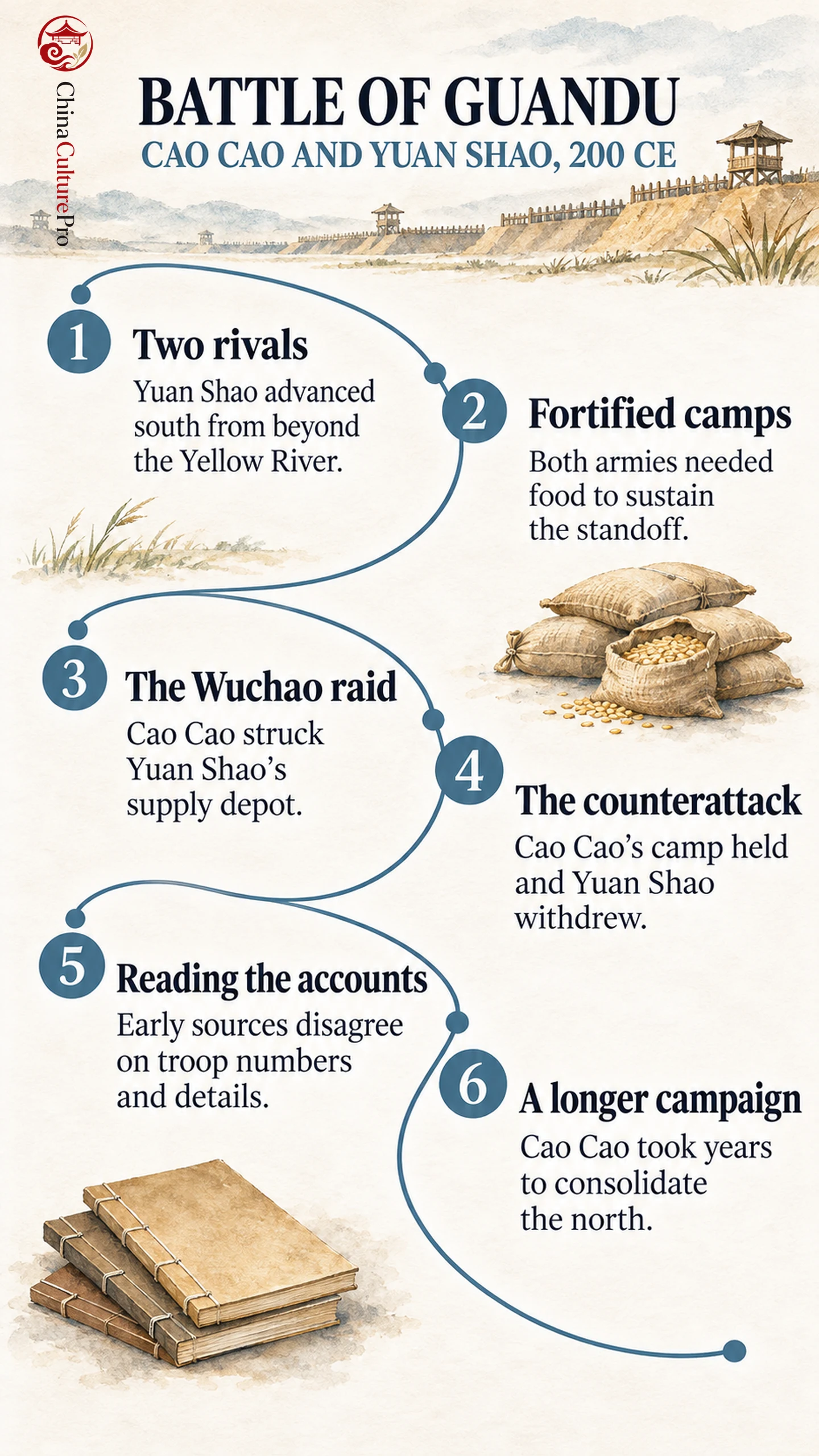
- Before the raid: Both sides fought around fortified positions and needed to keep their forces supplied.
- Turning point: Cao Cao attacked the supply depot while his main camp resisted Yuan Shao’s counterattack.
- Afterward: Yuan retreated. Cao Cao still had years of fighting ahead before taking control of his rival’s territories. [1][3][4]
Guandu changed who held the initiative in northern China. The Han court still existed after the battle. [4]
At Guandu, an army could hold its earthworks and still be in danger if it ran short of food. The last phase of the campaign exposed a different weakness. The concentration of grain at one depot gave an opponent a target.
Why Cao Cao and Yuan Shao Fought
Yuan Shao had built a base north of the Yellow River. After defeating Gongsun Zan (公孙瓒, Gōngsūn Zàn) in 199, he turned south against Cao Cao. Cao Cao had his own military base farther south and had brought Emperor Xian (汉献帝, Hàn Xiàndì) to Xu in 196, near modern Xuchang. With the emperor there, Cao Cao could invoke the authority of the Han dynasty in disputes with other regional commanders. [2][4]
The emperor’s presence gave Cao Cao a political advantage as he fought to keep his army supplied. Yuan Shao’s advance tested whether Cao Cao could hold the approaches to his base while protecting the resources that sustained his army. [1][4]
From the Yellow River to the Camps at Guandu
The Records of the Three Kingdoms (三国志, Sānguózhì) places fighting at Boma and Yanjin earlier in 200. These encounters took place before the final standoff near Guandu. Yuan continued south after his setbacks, and both sides eventually occupied fortified positions. Cao Cao’s base was closer, while Yuan’s troops relied on supplies brought along a longer route. [1][4]
At Boma, the annals describe Cao Cao feinting toward a crossing at Yanjin. After Yuan shifted part of his force to respond, Cao turned toward Boma and lifted the siege there. The maneuver mattered locally, but Yuan still crossed the Yellow River and continued the campaign. [1]
Cao Cao also felt the pressure of a long engagement. The annals describe troops under strain and the prospect of pulling back. Both armies could contest each other’s supplies, and Cao’s forces struck a transport convoy before the raid on the depot itself. The convoy and the depot were two targets in a broader struggle over whether the armies could keep fighting. [1][3][4]
What Happened at Wuchao
Xu You (许攸, Xǔ Yōu), formerly an adviser to Yuan Shao, defected and told Cao Cao about the supplies at Wuchao. Cao Cao left troops to hold his camp and took a detachment to strike the depot. The chronological account describes a night approach and the destruction of stored grain. [1][2][3]
Yuan Shao’s commanders faced two targets. They could try to save the depot or attack the camp while Cao Cao was away. The chronicle says Yuan sent a smaller force toward Wuchao and put more weight behind the attack on Cao Cao’s camp. The camp held, the depot was lost, and Yuan’s field army lost its supply position. [1][3]
The sources tie the loss of supplies to the defections of Zhang He (张郃, Zhāng Hé) and Gao Lan (高览, Gāo Lǎn) and to Yuan Shao’s retreat. Losing the grain made the standoff harder to sustain. The failure to take Cao Cao’s camp left Yuan without a success that could offset the blow. [1][2][3]
What the Historical Accounts Can Establish
Pei Songzhi (裴松之, Péi Sōngzhī) comments on the annals’ claim that Cao Cao had fewer than 10,000 men at Guandu. He questions whether so small a force could maintain comparable lines, raid supply movements and keep maneuvering against the much larger army described. His objection shows that skepticism about the headcounts exists inside the transmitted historical record. [1]
Pei flags another disagreement in the biography of Zhang He. The annals and Yuan Shao’s biography place the defections after news of the lost depot and before the army’s collapse. Zhang He’s biography instead has him defect after the collapse, fearing that a rival had turned Yuan against him. The contrast changes what a reader can infer about whether the defections caused the rout or followed it. [1][2][6]
The Romance of the Three Kingdoms (三国演义, Sānguó Yǎnyì) turns the same events into scenes of strategy and argument. It is a useful source for how the story was told later. A speech in its chapter about burning supplies cannot establish the exact words spoken in Yuan Shao’s camp. To reconstruct the military sequence, compare the annals and the chronicle before using the novel to study later portrayals. [1][3][5]
What Guandu Changed in Northern China
Yuan Shao survived Guandu and died in 202. His sons’ dispute over the succession opened new opportunities for Cao Cao. He pressed the advantage across several campaigns and broke his opponents’ hold on the northern plain. A further northern campaign against the Wuhuan followed in 207. [4]
That timeline is why the victory belongs at the beginning of a consolidation, with several years of campaigning still ahead. The contest for the north shaped the later Three Kingdoms, but Cao Cao and Yuan Shao met at Guandu while the Han emperor was still on the throne. [4]
FAQs About the Battle of Guandu
Who won the Battle of Guandu?
Cao Cao won. Yuan Shao withdrew after losing a key supply depot and failing to take Cao Cao’s camp. [1][3][4]
Was Guandu fought during the Three Kingdoms period?
Guandu belongs to the late Eastern Han wars. It took place in 200 CE, twenty years before Cao Pi replaced the Han and founded Wei. [4]
Where was Guandu?
The historic battlefield was south of the Yellow River, just north of present-day Zhongmou in Henan. Wuchao was the separate target of the supply raid. [3][4]
Sources
[1] Chen Shou, with annotations by Pei Songzhi. Records of the Three Kingdoms, Volume 1: Annals of Cao Cao
[2] Chen Shou. Records of the Three Kingdoms, Volume 6: Biography of Yuan Shao
[3] Sima Guang. Zizhi Tongjian, Volume 63
[4] Rafe de Crespigny. Wei, in The Cambridge History of China
[5] Luo Guanzhong, traditionally attributed. Romance of the Three Kingdoms, Chapter 30
[6] Chen Shou, with annotations by Pei Songzhi. Records of the Three Kingdoms, Volume 17: Biography of Zhang He