


Quick Answer: What Are the Six Summer Solar Terms?
Traditional summer contains six solar terms (节气, jiéqì), in the fixed order below. These Gregorian start dates are for 2027 in UTC+8; they are not permanent dates for every year.[1]
| Term: Chinese and pinyin | English name | 2027 start date, UTC+8 |
|---|---|---|
| Lixia (立夏, Lìxià) | Start of Summer | May 6 |
| Xiaoman (小满, Xiǎomǎn) | Grain Buds | May 21 |
| Mangzhong (芒种, Mángzhòng) | Grain in Ear | June 6 |
| Xiazhi (夏至, Xiàzhì) | Summer Solstice | June 21 |
| Xiaoshu (小暑, Xiǎoshǔ) | Minor Heat | July 7 |
| Dashu (大暑, Dàshǔ) | Major Heat | July 23 |
The dates identify astronomical transitions. They do not announce identical weather, crop maturity or community celebrations throughout China.
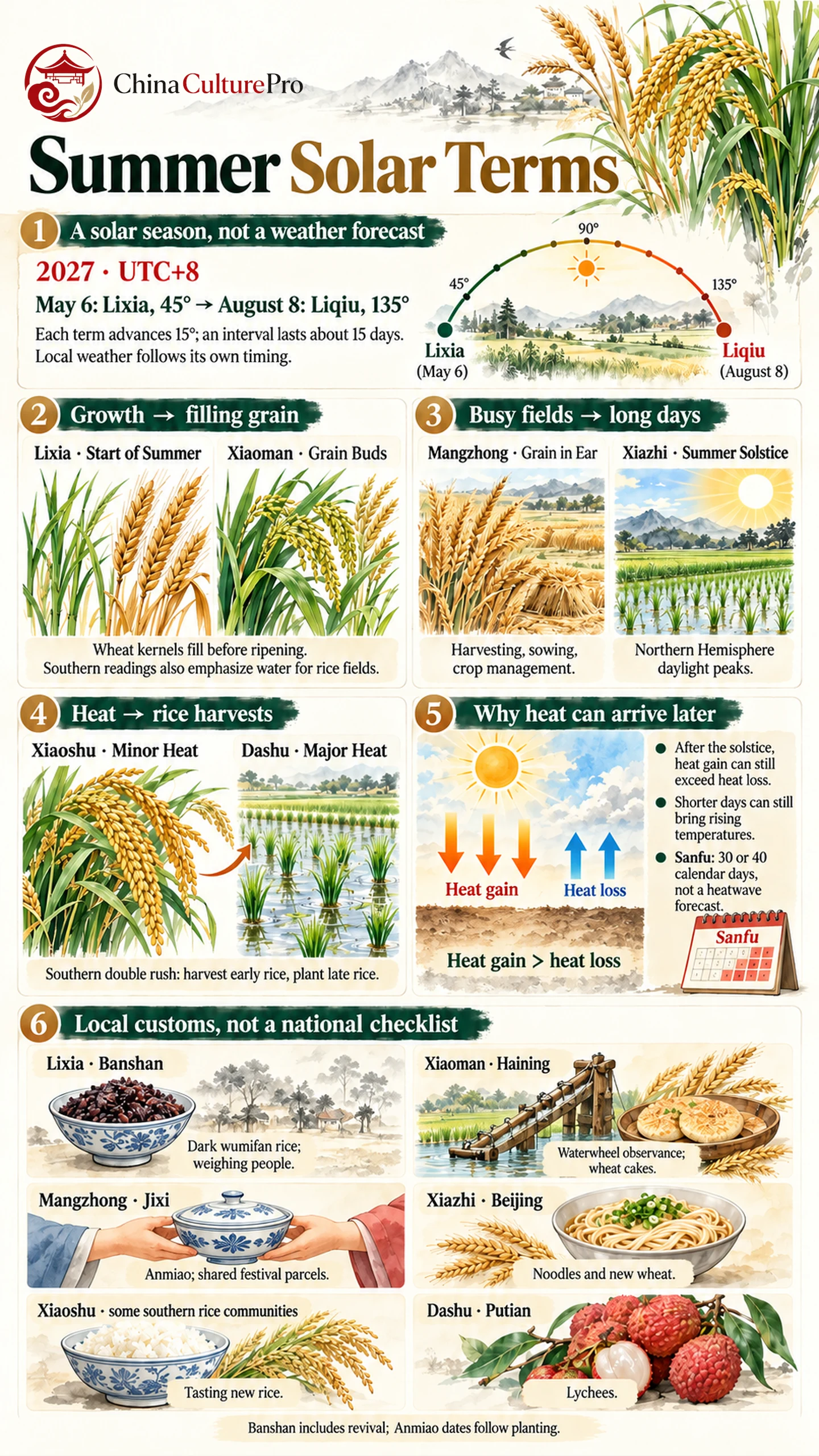
Summer in China brings more than rising temperatures. Wheat harvesting, rice planting and seasonal foods give the warmer months different meanings across the country. This guide explains six seasonal markers and their local traditions; the broader Chinese lunar calendar (农历, nónglì) explains how the lunar and solar parts work together.
Solar-Term Summer and Local Weather
Solar-term summer begins at Lixia, when the Sun reaches apparent ecliptic longitude 45°. It ends at Liqiu (立秋, Lìqiū), Start of Autumn, at 135°. In 2027, this summer runs from May 6 until the autumn marker on August 8, using UTC+8 dates. Dashu is therefore the last summer term, not the day summer immediately ends.[1][2]
Each successive term marks another 15° of solar longitude. A term can mean the precise entry instant or the interval from that instant until the next term, roughly fifteen days later. These intervals are not all exactly fifteen days long. UTC+8 specifies how the instant is displayed; an overseas calendar may show a different local date for the same event.[1][2]
Seasonal weather has different boundaries. Climate statistics often group June, July and August as Northern Hemisphere meteorological summer. Other definitions use observed temperatures or rainfall. None requires every Chinese region to become hot on Lixia: latitude, altitude, the sea and changing weather systems all affect local conditions.[3]
Heat, Harvests and the Meaning of Each Term
The names describe several kinds of seasonal change: growth, developing grain, agricultural work, daylight and heat. Read together, they show why summer can be a time of both harvest and planting.
Lixia and Xiaoman: Growth and Grain Filling
Lixia opens the traditional summer sequence. Its meaning is a seasonal beginning, rather than a claim that the hottest weather has arrived. The agricultural landscape is already active, but crops in different places are not at the same stage. A rice-growing district and a northern wheat district can be busy for different reasons.[2][4]
Xiaoman expresses a small or partial fullness. In northern wheat-growing areas, the important image is grain filling: kernels grow fuller before the crop is completely ripe. “Grain Buds” is a conventional English rendering, so avoid reading it as a literal reference to flower buds.[4]
Southern interpretations also connect fullness with rain and rising water. For rice-growing communities, enough water for the fields matters alongside the development of grain elsewhere. These are regionally grounded ways to understand the name, not a promise of rain or a nationwide harvest date.[4]
Mangzhong and Xiazhi: Busy Fields and Long Days
The mang in Mangzhong refers to the awns, or bristles, on cereal plants. The name brings attention to grain crops and timely agricultural work. Its English label, “Grain in Ear,” should not be narrowed to maize alone.[5]
Around this part of the year, wheat harvesting overlaps with sowing and the care of crops already growing. These are the three summer tasks (三夏, sānxià): summer harvesting, summer sowing and summer crop management. In parts of northern and central China, wheat fields give way to summer crops such as maize or soybeans, while rice-growing districts have their own planting and management schedules.[5][10]
Xiazhi marks a different kind of turning point. At solar longitude 90°, the Sun’s direct rays reach their northernmost annual position near the Tropic of Cancer. The Northern Hemisphere reaches its longest-daylight part of the year, after which daylight gradually decreases. This astronomical event is shared; the length of the day still depends on latitude.[2][7]
Xiaoshu and Dashu: Heat and Rice Harvests
Xiaoshu and Dashu put heat at the center of the naming sequence. “Minor” and “major” distinguish two traditional heat markers. Minor Heat does not mean mild conditions, and Major Heat does not guarantee the year’s highest temperature on its first day.[2]
Heat also sits alongside agricultural work. In southern double-cropping rice areas, the double rush (双抢, shuāngqiǎng) means harvesting early rice and quickly planting or transplanting the late crop. July 2026 reporting from Yiyang, Hunan, documented both early-rice handling and preparations for late-rice planting during this busy period.[6]
A finished crop and a new planting cycle can therefore occupy the same summer in one district. Crop varieties, local climate and that year’s weather determine the precise schedule; the solar-term name does not set one deadline for every field.[6]
Why the Hottest Weather Can Follow the Summer Solstice
Longest daylight and highest temperature do not have to coincide. After the June solstice, the surface can still gain more heat than it loses, even as days become shorter. Temperatures may therefore continue rising for weeks. This delayed response is called seasonal lag.[7]
The delay is not identical everywhere. Land and water warm at different rates, and clouds, rainfall and regional weather systems affect the balance. The solstice explains a turning point in incoming sunlight; it does not specify the day a particular city will record its annual maximum. A summer term describes a seasonal framework, not a local heat forecast.[3][7]
Sanfu (三伏, sānfú), the three Fu periods, is a separate traditional hot-season count lasting either thirty or forty days. It combines seasonal markers with the traditional stem-and-branch day cycle. Sanfu does not start automatically on Xiaoshu, and its calendar span can continue beyond Liqiu into the traditional autumn.[8]
Thirty or forty days describes that counting system, not the guaranteed duration of a heatwave. The same distinction applies to Dashu: its name evokes strong summer heat without promising that its opening date will be the hottest day.[8]
Summer Foods and Customs: Regional Examples
Local traditions connect the terms with the work and foods of a particular place. The examples below include meals, shared agricultural activities and wishes for a good harvest. They form a set of regional illustrations, not a national menu or six compulsory rituals.
| Term | Region | Food or activity | Cultural connection |
|---|---|---|---|
| Lixia | Banshan, Hangzhou, Zhejiang | Wumifan (乌米饭, wūmǐfàn), dark-colored rice, and weighing people (称人, chēngrén) | Foods and communal activities welcome summer and express wishes for well-being.[9] |
| Xiaoman | Haining, Zhejiang | Qiangshui (抢水, qiǎngshuǐ), a collective waterwheel irrigation observance, with wheat cakes or wheat balls | Part of the historical “three wheels” (三车, sānchē) context: waterwheels, oil presses and silk-reeling equipment. Irrigation practice and hopes for plentiful water come together.[4] |
| Mangzhong | Jixi, Anhui | Anmiao (安苗, ānmiáo) observances and baoguo (包粿, bāoguǒ), festival parcels shared with others | Rituals after planting express hopes for seedlings and the coming harvest; offerings also connect relatives and neighbors through shared food.[10] |
| Xiazhi | Beijing | Summer-solstice noodles | Noodles mark the season and are associated with tasting the new wheat harvest.[11] |
| Xiaoshu | Some southern rice-growing communities | Shixin (食新, shíxīn), tasting newly harvested rice | New-grain meals acknowledge a harvest. The practice should not be assigned automatically to lunar month six, day six, or to the first day of Sanfu.[12] |
| Dashu | Putian, Fujian | Lychees for “celebrating Dashu”; local accounts also mention mutton and fermented rice | A regional midsummer food custom, rather than a meal prescribed for the whole country.[13] |
Historical practice and present-day celebrations also need to be distinguished. Banshan’s Lixia customs weakened during industrial development in the late 1950s. Local cultural work later helped restore major practices, particularly after a research association formed in 2002. Their current preservation reflects revival and adaptation alongside inherited knowledge.[9]
Anmiao is arranged around Mangzhong after planting, rather than being fixed to the term’s exact entry instant. Present-day event dates require a separate local announcement. Food-sharing and wishes for well-being explain cultural meaning, without making the food a treatment or the ritual a guarantee of harvests.[10]
FAQs About Summer Solar Terms
Is Lixia the same as the summer solstice?
No. Lixia begins summer in the traditional solar-term system at 45° solar longitude. Xiazhi, the June solstice at 90°, is a later event. Calling the solstice the start of summer uses a different seasonal convention.
Is Dashu always the hottest day of the year?
No. Dashu names a seasonal heat marker and the interval that follows it. Actual temperature records depend on local weather. A city’s hottest day can fall before or after Dashu’s entry date.
Is the Dragon Boat Festival one of the solar terms?
No. The Dragon Boat Festival falls on day five of the fifth lunar month. Solar terms follow the Sun’s position. Their relative dates can vary, so a nearby festival does not become part of the six-term sequence.
Do people observe all six summer solar terms?
There is no national requirement to do so. Families and communities preserve different foods and activities, and some simply recognize the date. Each solar term does not require a special meal or a ceremony.
Sources
[1] Hong Kong Observatory. Date and Time of the 24 Solar Terms
[2] Hong Kong Observatory. The 24 Solar Terms
[3] Hong Kong Observatory. Definition of Seasons
[4] China Intangible Cultural Heritage Network. Xiaoman Farming Customs
[5] National Agricultural Exhibition Center, China Agricultural Museum. Mangzhong
[6] Hunan Provincial Government. New Approaches to Hunan’s Double Rush
[7] NOAA NESDIS. NOAA Satellites View 2023 Summer and Winter Solstices
[8] China National Radio. Understanding the Shortest Sanfu in Nearly Ten Years
[9] China Intangible Cultural Heritage Network. Banshan Lixia Customs
[10] Yuan Jin. Mangzhong: Busy Summer Farm Work and Green Plums
[11] Beijing Tourism. Xiazhi: Summer Solstice
[12] China Intangible Cultural Heritage Network. Xiaoshu Folk Customs
[13] Hubei Intangible Cultural Heritage Network. Dashu: Summer Traditions and Tea Customs