


Quick Answer: What Are the Six Spring Solar Terms?
The six spring solar terms (节气, jiéqì) mark the traditional spring season, from early February until the start of summer in early May. Their fixed order and approximate starting dates are shown below.
| Term and pinyin | English name | Approximate Gregorian start |
|---|---|---|
| Lichun (立春, Lìchūn) | Start of Spring | Around February 4 |
| Yushui (雨水, Yǔshuǐ) | Rain Water | Around February 19 |
| Jingzhe (惊蛰, Jīngzhé) | Awakening of Insects | Around March 5 |
| Chunfen (春分, Chūnfēn) | Spring Equinox | Around March 20 |
| Qingming (清明, Qīngmíng) | Clear and Bright | Around April 4–5 |
| Guyu (谷雨, Gǔyǔ) | Grain Rain | Around April 20 |
These are approximate starting dates, not six fixed annual appointments. Each term also names the period until the next begins. Guyu continues until Lixia (立夏, Lìxià), the Start of Summer. For a particular year, check an astronomical table and its time zone; Hong Kong tables use UTC+8.[1][2]
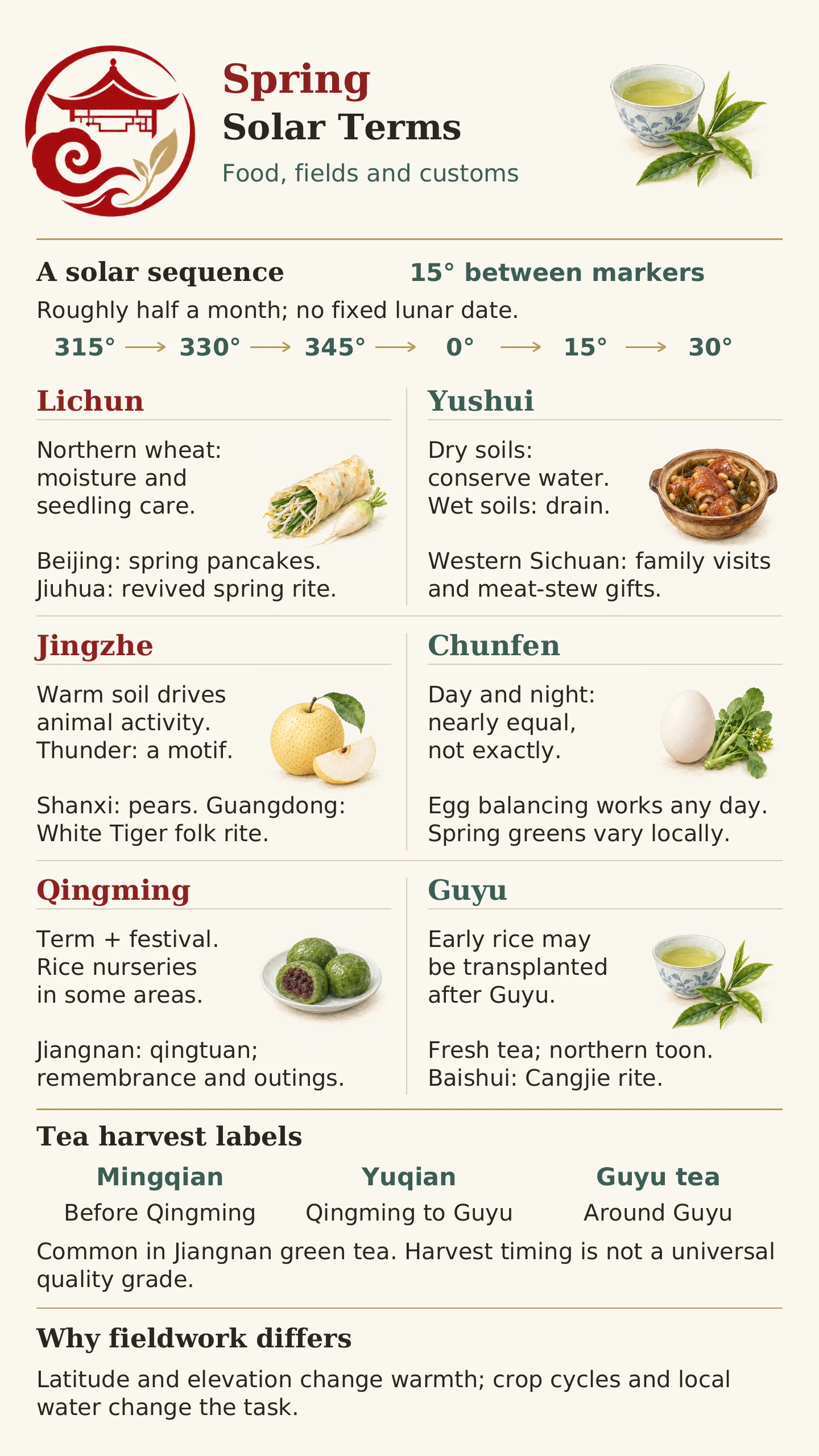
A calendar can announce spring while northern fields remain cold. Farther south, rice nurseries and tea gardens follow different rhythms. China’s spring calendar connects these seasonal changes with food and customs, but their shared sequence does not give every region the same weather or farming timetable.
How the Spring Solar Terms Follow the Sun
The 24 terms divide the Sun’s apparent annual path into steps of 15° of ecliptic longitude. Lichun begins at 315°, followed by 330°, 345°, 0°, 15° and 30° for the remaining spring terms. The interval is roughly half a month, rather than exactly 15 days.[1]
This is the solar component of the Chinese calendar, or Nongli (农历, nónglì). Lunar months follow the Moon, while solar terms keep track of the seasonal year. A term therefore has no fixed lunar month-and-day date. Our Chinese lunar calendar guide explains how those two parts fit together.
Traditional spring runs from Lichun to Lixia, with Chunfen near its middle. Weather-related names preserve observations associated with ancient central China. They provide a seasonal framework, while local plants, soil and weather determine what actually happens in a field.[1]
Farming, Food and Customs Across the Six Spring Terms
The agricultural descriptions below are regional examples, not planting instructions. The foods and rituals show how communities have marked the season in different ways.
Lichun: Welcoming Spring
In northern winter-wheat areas, early spring work concerns a crop already sown the previous autumn. Conserving soil moisture, checking seedlings and managing cold damage can matter more than sowing new fields. Wheat resumes growth progressively from south to north; neither a date on the calendar nor a single warm afternoon makes the entire wheat belt ready for the same work.[3]
Around Beijing, Yaochun (咬春, yǎochūn), or “biting spring,” welcomes the season through food. Chunbing (春饼, chūnbǐng) are thin pancakes wrapped around fillings such as bean sprouts, chives and shredded meat. Radish is another familiar bite-spring food. These are regional expressions of renewal, rather than a meal required across China.[4]
Zhejiang offers a different example: Jiuhua Lichun Ji (九华立春祭, Jiǔhuá Lìchūn Jì), the spring rite in Miaoyuan village, Quzhou. Its modern annual celebrations have been held since 2005 and include spring-ox rituals and wishes for a good farming year. Its long cultural roots coexist with modern revival and adaptation. The Lichun guide explores the custom further.[5]
Yushui: Rain, Soil and Family Visits
Rain Water names the increasing importance of rainfall as spring develops. In warmer farming areas, rain can support winter wheat and rapeseed as growth resumes. Yet water has opposite jobs in different fields: dry northern soils may need moisture conserved, while wet southern fields need working drainage. Yushui does not promise rain on its opening day, and northern snowfall remains possible.[3][6]
In western Sichuan, the term also carries a family association. Married daughters visit their parents with gifts, sometimes bringing Guanguanrou (罐罐肉, guànguànròu), a pot of slow-cooked meat. Pork trotters, beans and kelp appear in recorded versions, though households do not all follow one recipe. The gift expresses thanks to parents and links the seasonal visit with family care.[6]
The visit makes Yushui a family occasion as well as a seasonal marker in western Sichuan. The custom connects a married daughter’s household with her parents’ home; that social setting explains why a pot of meat carries more meaning than an ordinary meal.
Jingzhe: Insects, Fieldwork and Pears
Awakening of Insects evokes spring thunder and creatures emerging from winter shelter. Warming conditions, including soil temperature, drive renewed animal activity; thunder is the traditional image, not a necessary wake-up signal. The timing of the first spring thunder also differs between northern and southern China.[7]
For farmers, this period brings closer attention to growing crops, weeds and pests. In parts of the lower Yangtze region, winter wheat and rapeseed already need active management. Spring fieldwork therefore includes tending established plants, rather than simply beginning a nationwide sowing season.[7]
Eating pears is associated with Jingzhe in places including Shanxi. Folk explanations connect the fruit with leaving troubles behind, but the custom is not proof of a medical effect.[8] In parts of Guangdong, Ji Baihu (祭白虎, jì báihǔ), the White Tiger rite, uses a paper tiger in a tradition concerned with averting quarrels and misfortune. This is separate from controlling pests in crops: the ritual belongs to folk belief, while pest management is agricultural work.[9]
Chunfen: Mid-Spring and Seasonal Games
At the March equinox, the Sun crosses the celestial equator northward. Day and night are nearly equal, rather than exactly twelve hours everywhere: the Sun’s apparent size and atmospheric refraction extend the daylight measured between sunrise and sunset. In the traditional Chinese seasonal sequence, this is mid-spring, not its beginning.[10]
Growing warmth increases the pace of farm work, but crop stage still decides the task. Winter wheat can need water and nutrient management as stems lengthen. Early-rice growers farther south may be raising seedlings, while later or colder rice areas follow a different timetable. There is no universal rule that all paddies must be transplanted at Chunfen.[3][11]
Egg balancing is a seasonal game. An egg can balance on other days too; the equinox supplies the occasion, not a special gravitational force.[12] Chuncai (春菜, chūncài), or spring greens, is another food association. The vegetables vary locally; modern examples include shepherd’s purse and bamboo shoots. The shared idea is enjoying seasonal growth, rather than following a single prescribed menu.[13]
Qingming: Spring Planting and Remembrance
Qingming combines a solar term with the Qingming Festival (清明节, Qīngmíng Jié), an occasion for remembering ancestors. Tomb visits and Taqing (踏青, tàqīng), spring outings, bring remembrance and outdoor seasonal life into the same part of the year. The festival developed alongside older seasonal traditions, including Cold Food observances; the astronomical term and the customs are related but distinct.[13][14]
In rice-growing areas, warming conditions can support seedling production and field preparation. Northern winter-wheat farmers, meanwhile, are caring for an established crop. The familiar saying about planting melons and beans around Qingming expresses a broad seasonal association, not a guarantee that every region is ready to sow.[3][15]
In Shanghai and the wider Jiangnan region, Qingtuan (青团, qīngtuán) are green rice cakes associated with Qingming. Their herb-scented dough encloses sweet or savory fillings, from red bean paste to newer combinations such as salted egg yolk and pork floss. Recipes and fillings vary, and the food is not a nationwide requirement.[14]
Tea picking can already be under way before Qingming. Qingming does not mark the opening of every tea region’s harvest.[16]
Guyu: Crop Rain and Spring Tea
Grain Rain is the last spring term. Water supports newly planted crops, but heavy rain can also flood fields. In the middle and lower Yangtze early-rice belt, transplanting may still continue after Guyu; in warmer southern areas, the same crop can be further advanced. Guyu is not a nationwide deadline for finishing rice planting or the last possible frost.[15]
Spring tea connects these seasonal markers with harvest labels. Mingqian (明前, míngqián) means tea picked before Qingming. Yuqian (雨前, yǔqián) commonly means tea picked between Qingming and Guyu. These labels are especially familiar in Jiangnan green-tea contexts; cultivar, altitude, weather and processing also affect the finished tea. “Earlier” is not a universal quality grade.[16]
Guyu tea (谷雨茶, gǔyǔ chá) is associated with picking or drinking fresh tea around the term. It should not automatically be treated as the same label as Yuqian.[17] Our Chinese tea harvest seasons guide explains the wider picking calendar.
Other local associations include eating Xiangchun (香椿, xiāngchūn), Chinese toon shoots, in parts of northern China, and honoring Cangjie, the legendary creator of Chinese writing, in Baishui, Shaanxi.[17]
Why Spring Arrives Differently Across China
Solar terms locate the Sun in its annual cycle; they do not measure the temperature of an individual field. Three differences explain why the same term can correspond to very different work:
- Latitude and elevation: Southern lowlands generally warm before colder northern or high-altitude areas. Soil can remain too cold for a crop even when a seasonal marker has passed.
- Crop and planting system: Winter wheat was planted the previous autumn and needs spring management. Early rice, single-season rice and different spring-sown crops have separate production cycles.
- Available water: Dry soils create a need to conserve moisture; excessive rain creates a need to drain fields and protect seedlings. Both situations can occur during the same term.[3][6][15]
A useful comparison is established northern wheat versus southern early rice: one farmer may be protecting a growing cereal crop while another is raising or transplanting seedlings. Calling the north simply “not yet farming” misses that difference. The calendar supplies shared seasonal language; crop stage and local conditions explain the actual work.
FAQs About Spring Solar Terms
Are spring solar terms based on the lunar calendar?
They use solar rules within China’s lunisolar calendar. Their timing depends on the Sun’s position, not the Moon’s phase. They appear on lunar calendars but have no fixed lunar date; their Gregorian dates stay within a narrow annual range.
Why does Chinese spring begin before the March equinox?
The systems draw their seasonal boundaries differently. Traditional Chinese spring begins at Lichun in early February, making the March equinox a mid-spring marker. Northern Hemisphere astronomical spring begins at that equinox. Neither definition means every place becomes warm on its opening day.
Does every spring solar term have a special food?
There is no official six-dish menu. Some terms have well-known local associations, such as northern spring pancakes, Jiangnan qingtuan and spring tea near Guyu. Other foods reflect household or regional traditions; they are not compulsory meals for everyone observing the calendar.
Is Qingming a solar term or a festival?
Both. Qingming names an astronomical point and the seasonal period that follows it. Qingming Festival refers to related observances, especially remembrance and tomb visits. The solar calculation, family customs and any official holiday arrangements are different things.
Sources
[1] Hong Kong Observatory. The 24 Solar Terms
[2] Hong Kong Observatory. Date and Time of the 24 Solar Terms
[3] Ministry of Agriculture wheat expert group and NATESC. 2026 spring winter-wheat management guidance
[4] China Cultural Center in Copenhagen. Spring Pancakes
[5] China Intangible Cultural Heritage Network / Zhejiang ICH. Jiuhua spring rite
[6] China Weather. Rain Water customs
[7] China Weather. Jingzhe agricultural conditions
[8] Guangming Daily, republished by Fuzhou local history authorities. Jingzhe and its customs
[9] China Weather. Jingzhe pears and White Tiger rites
[10] NASA. Embracing the Equinox
[11] Ministry of Agriculture rice expert guidance, via Changde agriculture authorities. Southern early-rice production guidance
[12] NASA Cosmicopia. Balance an Egg at the Equinox?
[13] China Weather. Chunfen greens and games
[14] Shanghai municipal portal. Qingtuan and Qingming food traditions
[15] Hunan agriculture authorities and national rice experts. Early-rice stages and rain risks after Guyu
[16] Su Zhucheng, Zhejiang A&F University, in People’s Daily. Mingqian and Yuqian harvest timing
[17] China Cultural Center in Copenhagen. Grain Rain, tea and Cangjie customs