
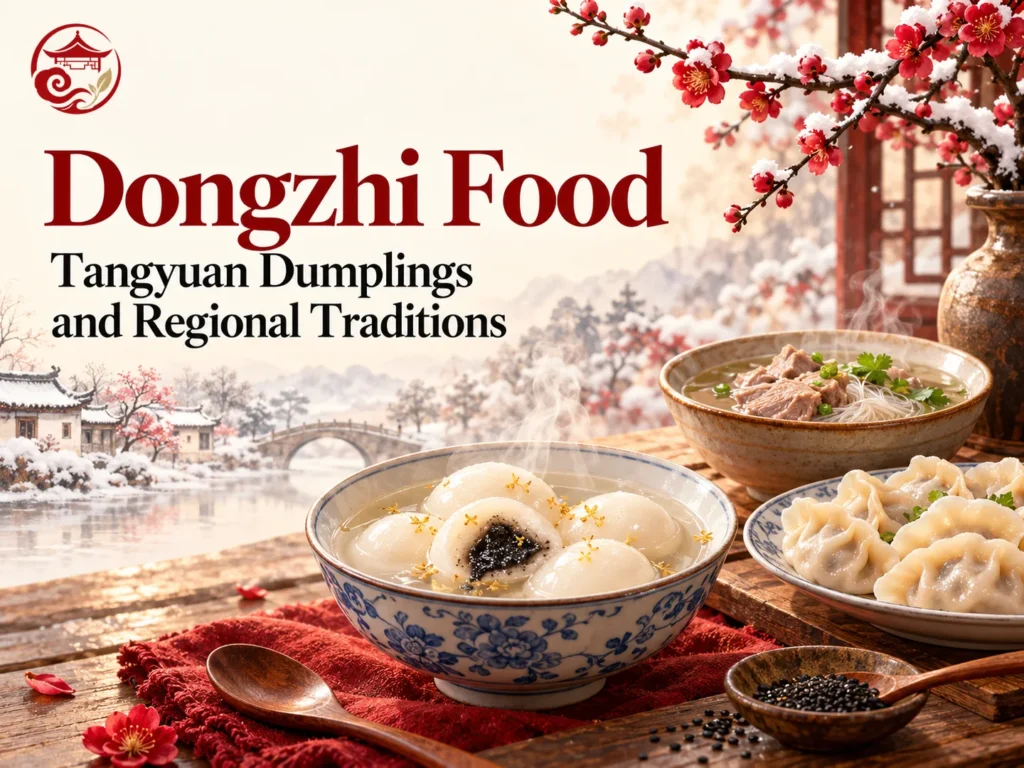

Quick Answer: What Do People Eat at Dongzhi?
Dongzhi (冬至, Dōngzhì) food varies by place and family. The winter solstice is one of China’s 24 solar terms, rather than a festival fixed to one lunar-calendar date. Its meals have several familiar starting points:
- Tangyuan: Rice balls called 汤圆 (tāngyuán), associated with many southern Chinese and overseas Chinese families.
- Dumplings: Wheat-wrapper dumplings called jiaozi, 饺子 (jiǎozi), familiar on winter-solstice tables in Beijing and other northern communities.
- Local alternatives: Wontons (馄饨, húntun), mutton soup, rice cakes and red-bean rice offer other ways to mark the occasion.
These are choices, not a national menu. A family need not serve both dumplings and tangyuan.

A Dongzhi (冬至, Dōngzhì) invitation can mean dumplings, rice balls or a bowl of mutton soup. Which should you expect? This guide explains the foods and their local connections; the Dongzhi Festival overview covers the wider celebration. Each household decides what belongs on its table.
Dongzhi Foods at a Glance
Use these six examples to recognize what is being served. They are an editorial selection, not a traditional six-dish meal. Local associations help explain a food’s place at Dongzhi without defining what every resident eats.
| Food | What it looks like | Place or community | Important distinction |
|---|---|---|---|
| Tangyuan | Round balls of glutinous rice (糯米, nuòmǐ), plain or filled, served in liquid | Singapore Chinese families, among other communities | Sweetness can come from the filling or soup; plain balls can accompany savory broth. [1] |
| Jiaozi | Folded wheat wrappers around meat or vegetable fillings | Beijing and other northern Chinese communities | The ear-protection story is folklore, not evidence that eating dumplings prevents frostbite. [2] |
| Wontons, 馄饨 (húntun) | Wheat-wrapper parcels commonly served in soup | Suzhou | Their winter-solstice connection does not make them rice balls or restrict them to this festival. [3] |
| Mutton and vermicelli soup, 羊肉粉汤 (yángròu fěntāng) | A savory soup with mutton and starch-based ingredients | Yinchuan, Ningxia | It may be served with dumplings; this is a local example, not a requirement throughout Ningxia. [6] |
| Niangao, 年糕 (niángāo) | Rice cakes served in slices or pieces | Hangzhou | Ingredients vary. A plain cake can receive sweet or savory seasoning. [4] |
| Red bean glutinous rice, 赤豆糯米饭 (chìdòu nuòmǐfàn) | Rice grains mixed with red beans | Tongyuan, Haiyan County, Jiaxing | A documented local winter-solstice food, distinct from both rice cakes and rice balls. [5] |
Tangyuan at Dongzhi: Sweet, Savory, Filled or Plain
Tangyuan are made from glutinous rice, but their name does not tell you everything about the bowl. Ask two separate questions: is there a filling, and what liquid surrounds the balls?
A black-sesame or peanut center makes a filled sweet version. Small plain balls have no center at all. Either the ball or its serving liquid can supply flavor, so a white, unfilled ball should not automatically be described as a dessert.
Singapore provides a useful example of that distinction. A Hakka version places unfilled balls in a savory broth containing vegetables and pork. The meat belongs to the soup, rather than being enclosed inside each ball. The same cultural resource also documents the older family practice of shaping colored, unfilled balls together. [1]
The round shape expresses reunion (团圆, tuányuán). That is an emotional association: a bowl can recall family togetherness even when relatives are apart. Tangyuan and tuanyuan are not identical Mandarin pronunciations, and eating the food cannot guarantee harmony or bring someone home.
For a guest, the useful question is therefore not simply “Are we having tangyuan?” Ask whether the household serves a sweet bowl, a savory one, or both. That tells you more about the actual meal than a broad regional label.
Dumplings at Dongzhi: A Northern Tradition and a Folk Story
In Beijing and many other northern communities, jiaozi are a familiar way to mark Dongzhi. Their wheat wrappers enclose a filling, which can include meat, vegetables or a combination. A northern association does not mean every household uses pork, follows one shape, or eats dumplings at a fixed hour.
A popular story connects the custom with the physician Zhang Zhongjing (张仲景, Zhāng Zhòngjǐng). In the tale, he helps people suffering in winter by offering ear-shaped parcels containing mutton and other ingredients. Later retellings link the dumplings with the wish to avoid frostbitten ears. [2]
Treat this as a folk explanation of a familiar food, rather than a proven invention account. Eating dumplings does not protect ears from cold injury. The story helps explain the seasonal association without establishing one founder or compulsory filling. At a present-day gathering, the family’s preferred dumplings matter more than reproducing the ingredients of the tale.
Beyond Tangyuan and Dumplings: Three Local Winter Tables
The familiar north–south shorthand leaves out several distinctive meals. These examples show why a place name is more useful than assuming every southern household wants something sweet or every northern household eats the same dumplings.
Suzhou: Wontons at the Winter Table
Suzhou has a documented connection between winter solstice and wontons. Local cultural activities have included making wontons to introduce children to the city’s Dongzhi traditions. That establishes a continuing food custom without proving a particular invention story. [3]
Wontons belong to the wheat-wrapper family of foods, rather than the glutinous-rice category. A bowl of parcels in broth can therefore appear on a Jiangnan winter table without being tangyuan. Neither the filling nor wrapper thickness needs to follow one citywide specification. The seasonal connection also does not make wontons exclusive to the winter-solstice dinner: the same food is enjoyed on ordinary days.
Hangzhou and Haiyan: Rice Cakes and Red-Bean Rice
Hangzhou’s winter-solstice rice cakes offer another alternative. Descriptions of the local custom include sweet servings with sugar and sesame, stir-fried slices with vegetables and meat, and cakes served in soup. These illustrate different uses, rather than a three-meal schedule every household must follow. [4]
Distinguish the cake’s ingredients from its seasoning. Niangao is not invariably made entirely from glutinous rice. [8] A savory dish does not prove that the plain cake itself contains salt. Its use at Dongzhi also shows why the English name “New Year cake” does not limit it to Chinese New Year.
Nearby Haiyan provides a different rice-food example: a winter-solstice customs display in Tongyuan included red-bean glutinous rice. Here the grains remain recognizable; it is a rice dish, rather than a shaped cake or ball. The record documents a local practice, not a rule for every Jiaxing household. [5]
Yinchuan: Mutton and Vermicelli Soup
In Yinchuan, a winter-solstice meal can combine mutton soup with dumplings. Local descriptions include mushrooms, vermicelli and starch pieces, producing a substantial savory dish rather than a sweet festival snack. The ingredients need not be treated as a fixed formula. [6]
This example also complicates the idea that a household chooses either dumplings or soup: they can form one meal together. Describe the steaming bowl as a winter dining experience, without turning traditional claims about seasonal nourishment into medical benefits. The custom belongs to this local context; it does not prescribe what every family across Ningxia, or every ethnic or religious community there, must eat.
When Families Share the Dongzhi Meal
Do not assume that the main gathering always happens on the evening of Dongzhi itself. In Suzhou, the preceding evening is traditionally called winter-solstice eve, and local accounts describe family meals then. That timing should not be extended to every Chinese household. [7]
Elsewhere, ask the host which day and meal they have arranged. A cultural occasion and the practical time people can gather are different things. There is no need for a guest to infer an exact dinner hour from the festival name.
Food preparation can be shared work, or the family can use ready-made products. Some households also remember ancestors before eating; others simply gather for a meal. Participation in a family dinner does not require a religious ritual or travel home at any cost.
Choosing Food for a Small Dongzhi Meal
- Start with the household: Ask which food carries a family connection. One familiar dish can be enough; there is no need to assemble every regional example.
- Decide its role: A sweet tangyuan bowl might finish a meal, while savory rice balls, rice cakes or red-bean rice can contribute to the main course. The serving style matters.
- Check the whole dish: Review fillings, broth and accompaniments for dietary restrictions. A vegetable filling does not establish that the soup is vegetarian.
- Follow the product: Fresh and frozen foods have different instructions. Use the actual label for preparation and storage, rather than applying one shelf life to every dumpling or rice ball.
FAQs About Dongzhi Food
Do You Have to Eat Both Dumplings and Tangyuan?
No. Serve either, both, or another food meaningful to the household. Regional customs offer examples rather than a compulsory combination, and a small meal does not need to represent every part of China.
Why Are Tangyuan Eaten at Both Dongzhi and the Lantern Festival?
One food can belong to several celebrations. Tangyuan express togetherness at Dongzhi and are also associated with the Lantern Festival (元宵节, Yuánxiāo Jié). Their presence on one occasion does not exclude their use on another.
Can a Dongzhi Meal Be Vegetarian?
Yes. Choose suitable fillings and check the serving liquid and accompaniments too. Plain rice balls may arrive in a meat broth; a vegetarian or vegan meal depends on the complete ingredients, rather than the food’s name.
Are Frozen Dumplings or Tangyuan Acceptable for Dongzhi?
Yes. Frozen products and freshly made food are both practical household choices. Buying a ready-made version does not make a celebration less authentic. Choose something the family enjoys and follow its own storage and preparation instructions.
Sources
[1] Singapore Chinese Cultural Centre. Celebrating Winter Solstice
[2] Beijing Government. Winter Solstice and Dumplings
[3] Suzhou Local Gazetteer Office. Winter-Solstice Wonton Activity
[4] Zhejiang Federation of Humanities and Social Sciences. Winter-Solstice Foods
[5] Zhejiang Online / Jiaxing Daily. Tongyuan Winter-Solstice Customs Display
[6] China Weather. Yinchuan’s Winter-Solstice Mutton Soup
[7] Suzhou Local Gazetteer Office. Winter Solstice and Family Memory
[8] Ningbo News. The Rice Cake Museum