

Quick Answer: What Are Chinese Lantern Riddles?
Chinese lantern riddles, or dengmi (灯谜, dēngmí), are written puzzles that use character shapes, sounds or meanings to conceal an answer.
- Display: Clues appear beside lanterns, on riddle walls and cards, or online.
- Answer range: The stated category may require a character, idiom, name, place or another kind of answer.
- Language: Some puzzles depend on written Chinese or a particular Chinese pronunciation, rather than the clue’s literal translation.
They are associated with the Lantern Festival (元宵节, Yuánxiāo Jié), but not restricted to it. A simple descriptive riddle at a festival need not follow the conventions of literary dengmi.[1][8]
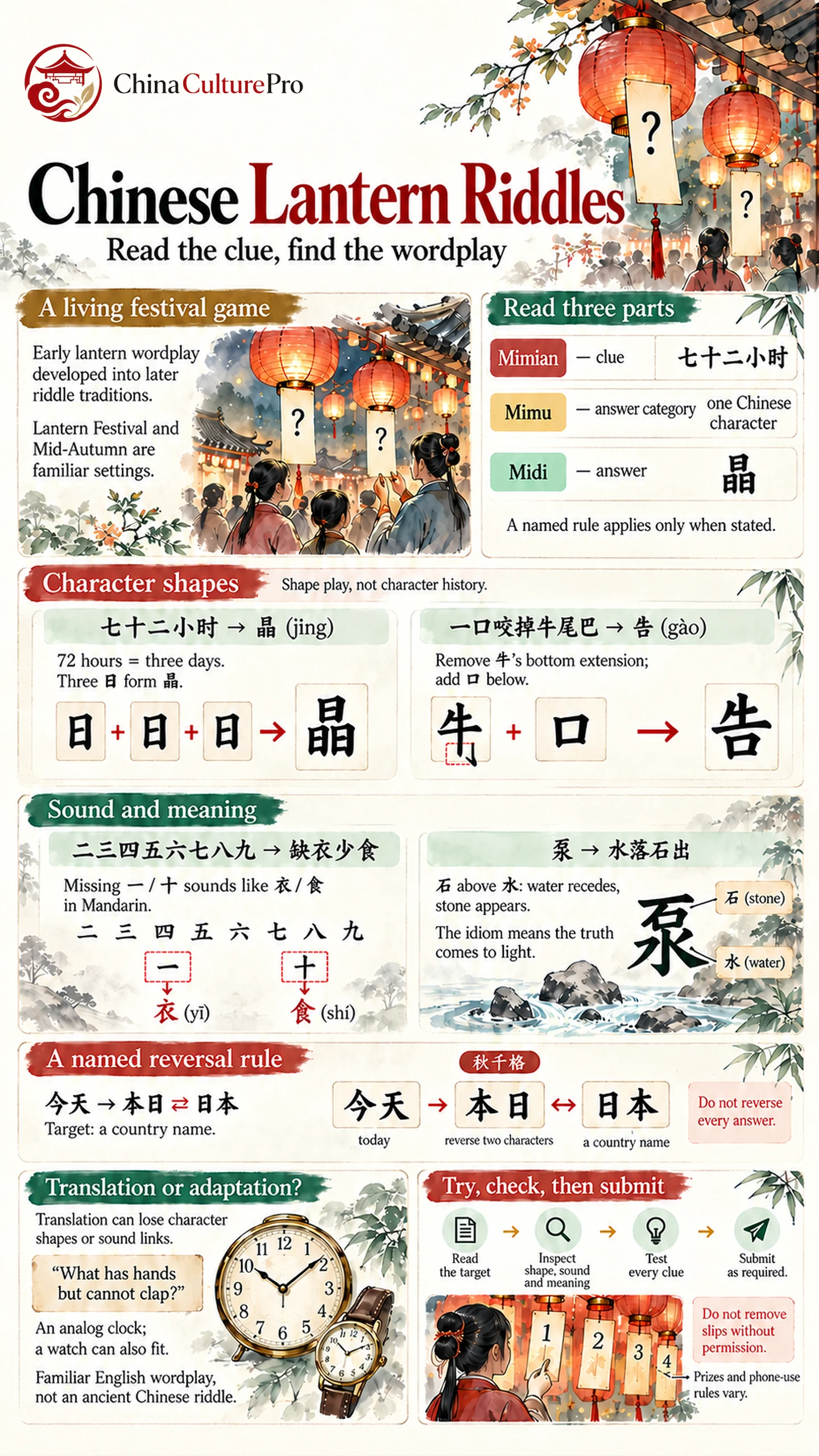
A paper slip beside a lantern may ask for a character, an object or an idiom. Knowing which one changes how you approach the puzzle. This guide explains lantern riddles (灯谜, dēngmí) through worked examples, with wider celebrations covered in our Lantern Festival (元宵节, Yuánxiāo Jié) guide.
From Festival Entertainment to Living Riddle Traditions
Riddling and indirect language existed before lantern riddles developed as a recognizable form. Accounts of Southern Song festivities describe words, concealed meanings and humorous material attached to lanterns. That is evidence of related festival entertainment, not proof that every later rule was already established.[2]
Over subsequent centuries, riddle collections and descriptions of public guessing show the tradition developing. Ming and Qing material provides examples of increasingly recognizable lantern-riddle practice. An early reference, a named genre and widespread participation need not begin together.
The Lantern Festival is a familiar setting, but the activity also belongs to other occasions. Community Mid-Autumn events in Zhangzhou, Fujian, have included public riddle guessing.[3] Such examples connect the game with the Mid-Autumn Festival (中秋节, Zhōngqiū Jié) without making every celebration identical. Schools, museums and cultural groups also use written puzzles for participation and language practice. An event can retain the pleasure of public guessing while using a wall, screen or printed card instead of a physical lantern.
Read the Clue: Mimian, Mimu and Midi
Before guessing, separate what the clue says from what it asks you to produce. A familiar-looking sentence can be misleading if you overlook the required answer category.[1]
| Part | Meaning | What to check |
|---|---|---|
| Mimian (谜面, mímiàn) | The displayed clue | Its wording may offer a second meaning, sound or visual instruction |
| Mimu (谜目, mímù) | The answer’s category, number or scope | “Guess one character” means one Chinese character, not an English letter |
| Midi (谜底, mídǐ) | The answer | It must fit both the clue and the stated category |
A target such as 打一成语 asks for a Chinese idiom (成语, chéngyǔ); 打一国名 asks for a country name. Many familiar idioms have four characters, but “idiom” is not simply a synonym for any four-character phrase. In these target labels, 打 (dǎ) means “guess”; it is not an instruction to hit something.
Mige (谜格, mígé) is an additional named rule used in some puzzles. It is not mandatory. When a clue specifies one, follow it rather than inventing an unrestricted rearrangement.[7]
Chinese Lantern Riddles with Answers and Explanations
These examples illustrate overlapping techniques, not exclusive categories. Read the clue and target before the answer. Pinyin below shows dictionary tones rather than every change in connected speech. English glosses show the surface meaning, while the explanation supplies the Chinese reasoning.
Character Riddles: Shape and Components
Example 1: 七十二小时 — Qīshí’èr xiǎoshí — “Seventy-two hours.”
Target: one Chinese character. Answer: 晶 (jīng), associated with brightness or crystal.
Seventy-two hours equals three days. The character 日 can mean “day,” and three copies arranged together form 晶. The step from duration to written components is the trick; 晶 does not mean “three days.”[4] Write 日 three times and compare their arrangement with 晶: one sits above two more. English alone supplies the arithmetic but not that written arrangement.
Example 2: 一口咬掉牛尾巴 — Yī kǒu yǎodiào niú wěiba — “A mouth bites off the ox’s tail.”
Target: one Chinese character. Answer: 告 (gào), “tell” or “announce.”
Look at 牛, “ox.” Treat its lower protruding vertical segment as the tail, remove that extension and place 口, “mouth,” underneath. The resulting shape is 告.[5] Removing the entire vertical stroke would be misleading. The clue’s 口 does double duty: it describes a bite in the surface story and supplies the square-shaped component in the solution. This is a visual word game, not an account of the character’s ancient origin.
Sound and Meaning Riddles
Example 3: 二三四五六七八九 — Èr sān sì wǔ liù qī bā jiǔ — “Two, three, four, five, six, seven, eight, nine.”
Target: a Chinese idiom. Answer: 缺衣少食 (quē yī shǎo shí), “short of clothing and food.”
The sequence lacks one and ten. In Mandarin, 一, “one,” sounds like 衣, “clothing,” and 十, “ten,” like 食, “food.” The missing pair can be expressed as 缺一、少十. Replacing those numerals with their sound-alike characters gives 缺衣、少食, which together form the answer.[6] The explanation depends on those Mandarin sound relationships; translating the numbers into English does not preserve them.
Example 4: 泵 — Bèng — “Pump.”
Target: a Chinese idiom. Answer: 水落石出 (shuǐ luò shí chū), “the truth comes to light.”
The written character places 石, “stone,” above 水, “water.” Read that arrangement as water receding and a stone appearing, the idiom’s literal image.[7] Its everyday figurative meaning is different. Neither the pump’s mechanics nor a translation of “pump” supplies the solution. Naming only “water” or “stone” would also fail: the target asks for an idiom, and the answer needs to account for their relative positions.
An Example with a Named Rule
Example 5: 今天 — Jīntiān — “Today.”
Target: a country name, using Qiuqian ge (秋千格, qiūqiān gé), a two-character reversal rule. Answer: 日本 (Rìběn), “Japan.”
An equivalent Chinese expression for today is 本日 (běnrì). Reverse those two characters to obtain 日本. Equivalently, reverse the answer to recover the expression fitting the clue.[8] The target matters: 本日 fits “today” but is not a country; 日本 fits the country category, and its reversal fits the clue. The named rule authorizes this operation. Reversing the English spelling of “Japan” would not perform the stated character-based rule.
Can Lantern Riddles Work in English?
Some can be explained across languages, but translation and playable adaptation are different tasks. A descriptive object riddle may retain its logic. A character puzzle needs its written forms, while a sound puzzle needs the relevant pronunciation. Pinyin helps identify sounds; it cannot replace the shapes in examples such as 晶.
Consider a familiar English riddle, suitable for an English-language party game:
“What has hands but cannot clap?”
Target: an everyday object. The usual answer is an analog clock, or 时钟 (shízhōng). “Hands” describes its pointers as well as human body parts. An analog watch can also fit, so a host wanting only “clock” should narrow the hint.
This is English wordplay, not a translation of an ancient Chinese lantern riddle or an original invention claimed here. Translating “hands” into Chinese as human hands would lose the usual term for clock pointers. For a bilingual activity, label an explanation, translation or newly adapted puzzle honestly instead of treating them as interchangeable.
How to Solve and Join Lantern Riddle Games
The activity of solving lantern riddles is cai dengmi (猜灯谜, cāi dēngmí). Start with the information printed on the card, not an assumption that every puzzle uses the same trick.
- Read the target: Identify the answer category, number of characters or answers, and any named rule.
- Inspect the clue: Consider its literal meaning, alternative meanings, sounds and written components. Action words may suggest removing, adding or moving part of a character.
- Test a candidate: Check the complete clue and the target. If your explanation accounts for only one convenient detail, reconsider it.
- Submit as instructed: Use the riddle number, answer card or spoken response required by the organizer. Be ready to explain the reasoning when asked.
Do not assume you should pull down the slip. A 2025 Yishui library event explicitly required participants to leave clue cards in place and submit answers through its numbered system.[9] That is a dated example of one format, not a rule for every future event.
Check whether discussion, phone searches or repeat submissions are permitted. Prizes, if offered, have their own conditions; a correct answer does not guarantee a gift at every gathering. Leave the display available for other participants.
FAQs About Chinese Lantern Riddles
Are lantern riddles only for the Lantern Festival?
No. The Lantern Festival is an important setting, but Mid-Autumn celebrations, community programs and language-learning activities also use them. The occasion and display format do not determine the mechanism of every puzzle.
Do you need to read Chinese to solve dengmi?
It depends on the clue. Character puzzles require the relevant written forms, and sound puzzles require the relevant pronunciation. Bilingual explanations or adapted games can help beginners participate without claiming that translation preserves every original trick.
Should you remove a riddle slip when you know the answer?
Follow the organizer’s instructions. Some events require cards to remain displayed and accept answers by number. Knowing a solution does not automatically give you permission to remove part of the display.
Can a lantern riddle have more than one answer?
Some targets explicitly request multiple answers. Otherwise, check the intended category and complete reasoning. A vague clue can admit alternatives; that calls for clarification, not acceptance of every unrelated guess.
Sources
[1] Nanhai Museum. Online Riddle Guessing: Jiujiang Lantern Riddles
[2] BabelStone, Morrison Collection. Dengmi Yadiao: Lantern Riddles
[3] Fujian Provincial Government. Zhangzhou Lantern Riddles: A Living Cultural Tradition
[4] Chinese Bridge. Chinese Knowledge Question Bank
[5] Yoyo Chinese. Chinese Lantern Riddles: A Fun Challenge for Hanzi Learners
[6] China Education and Research Network. Lantern Festival Riddles and Answers
[7] CCTV Science and Education. An Introduction to Riddles
[8] People’s Daily Overseas Edition. Lantern Riddles: A Chinese Word Game
[9] Yishui County Government / Yishui Library. 2025 Lantern Riddle Event Notice and Rules