


Quick Answer: What Is the Wulin Jiushi?
The Wulin Jiushi (武林旧事, Wǔlín Jiùshì) is Zhou Mi’s (周密, Zhōu Mì) record of the former capital Lin’an (临安, Lín’ān), now Hangzhou (杭州, Hángzhōu), under the Southern Song (南宋, Nán Sòng). Its ten juan (卷, juàn), or textual divisions, gather court occasions, festivals, urban trades, entertainment and remembered scenes.[1][2]
- Kind of book: A collection of notes and records, rather than a continuous city chronicle.
- Distinctive perspective: The court and elite life matter alongside markets and performers.
- Reading caution: Recollection, inherited reports, lists and literary description require different kinds of scrutiny.[2][3][4]
Here Wulin names the Hangzhou setting. The title does not identify a martial-arts handbook.
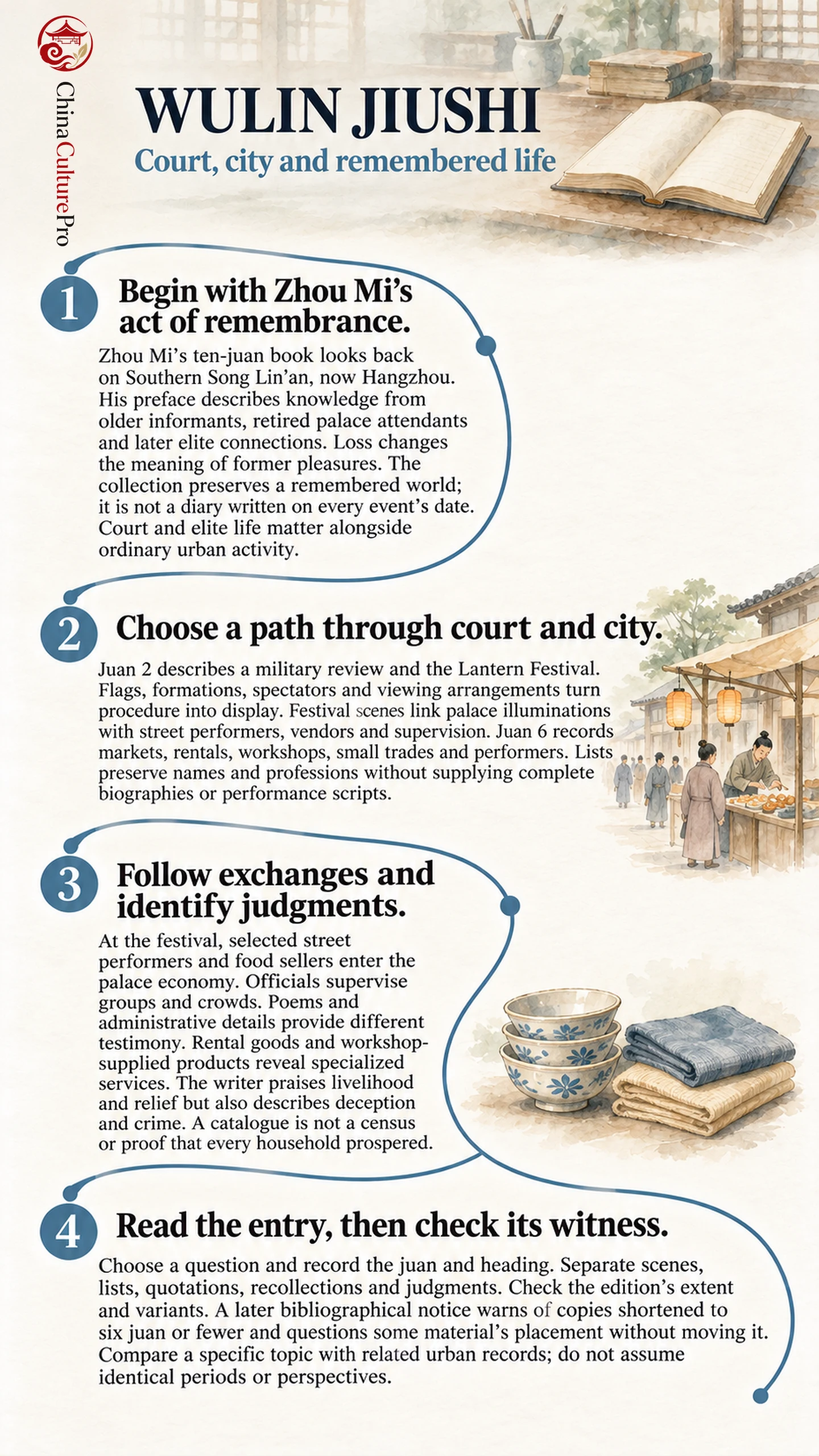
Lantern displays, rented household goods and remembered court ceremonies reveal different sides of the same capital. The Wulin Jiushi preserves them together. Reading it well means noticing both the detail of the city and the writer looking back after its world changed.
Zhou Mi’s Preface: Remembering a Lost Capital
Zhou Mi lived across the end of the Song dynasty and the beginning of the Yuan (元, Yuán). The book looks back on the fallen Southern Song; it should not be treated as a diary recorded on each event’s date.[2][5]
His preface explains how knowledge accumulated. He first heard accounts from old families and elderly people, then listened eagerly to retired palace attendants. Later connections with elite households widened his experience. Earlier court life could therefore reach him through informants even when it preceded his own participation.[2]
The preface also describes the distance created by loss. Former pleasures begin to resemble a dream. Younger listeners might regard his accounts as exaggeration, while surviving friends have become few. Writing preserves a world he fears will otherwise disappear. This is evidence about the book’s purpose as well as a poignant opening.
Wai Tsui’s study argues that the collection constructs a morally favorable memory of the Southern Song court and elite society. That interpretation is useful to test against individual entries, rather than a reason to dismiss their details or assume that nostalgia explains every sentence.[5]
Three Reading Paths Through Court and City
| Entry path | What to follow |
|---|---|
| Court display: juan 2 | The military review entry describes formations, flags, the imperial party and spectators. Ask how procedure becomes a display of order. |
| Festival scene: juan 2 | Yuanxi (元夕, Yuánxī), the Lantern Festival evening, joins palace illuminations, street performances, vendors and official supervision. |
| Urban work: juan 6 | Markets, entertainment grounds, rentals, workshops and Xiao Jingji (小经纪, Xiǎo Jīngjì), or small trades, show a city of specialized services. |
The military scene is not simply an inventory of weapons: movements, colors and viewing arrangements organize a public spectacle. Likewise, the festival entry moves between spaces with different degrees of access. The court’s entertainments and the streets belong to one account without becoming one undifferentiated gathering.[3]
Juan 6 adds another kind of evidence. Its entertainment-ground section distinguishes established venues from performers working in open spaces. Later categories name historical storytellers, shadow-play performers, singers and others. These lists preserve professions and names without supplying a full performance script or a complete biography for every person.[4]
Reading Lists, Scenes and Judgments as Evidence
For the Lantern Festival, follow an exchange rather than collecting picturesque objects. The palace summons selected street performers and food sellers; purchases reward their appearance. Outside, municipal officials supervise dancing groups and crowds. Splendor is supported by labor, selection, money and administration, not merely by decorative lanterns.[3]
Poems appear within the festival account. Their inclusion adds voices and images to the prose, but a quoted poem and an administrative detail are different forms of testimony. Keep the speaker, setting and literary purpose visible when using either as historical evidence.
The rental section in juan 6 lists clothing, furnishings, vessels and other goods for occasions. Workshops supply prepared products for resale; the text describes traders obtaining goods and settling the payment later. These entries allow questions about access and commercial organization that a list of celebrated dishes alone would miss.[4]
The writer also judges what he records. He praises aspects of workshop-supported livelihood, describes relief provisions and complains about urban deception and crime. Those judgments do not establish that every household was prosperous or every service universally available. A crowded catalogue is not a census, and praise of a city is not a complete account of its inequalities.
How to Choose an Entry and Check an Edition
- Choose a question: Begin with a festival, occupation or court occasion, then record the juan and entry heading.
- Identify the evidence: Separate a narrated scene, named list, quotation, personal recollection and authorial judgment.
- Check the edition: Establish its extent and variant notes before comparing or quoting the wording.
The later bibliographical notice warns that some printed versions cut the book to six juan or fewer. It also questions the placement of material near the end while retaining it because proof was insufficient. A shorter copy is not automatically a different authorial work, and ten juan does not mean ten physical bound books.[1]
Zhou’s preface names an aspiration to follow and refine an earlier urban memoir. For that literary relationship, continue to Dongjing Meng Hua Lu (东京梦华录, Dōngjīng Mèng Huá Lù). Another related reading route is Meng Liang Lu (梦粱录, Mèng Liáng Lù). Compare a specific topic instead of assuming that these classical prose works describe the same period from the same perspective.[2]
FAQs About the Wulin Jiushi
Is the Wulin Jiushi about martial arts?
No. Wulin here is associated with Hangzhou, the city recalled in the book. Familiar modern uses of the same characters for the martial world can mislead readers approaching the title alone.
Did Zhou Mi witness everything he describes?
No. His preface explicitly includes knowledge gained from older informants, as well as his later experience. Treat an account’s source and date as questions to investigate, rather than assuming personal observation throughout.
Is the Wulin Jiushi a novel?
No. It is a collection of historical and cultural records, though literary shaping and memory are important. Its scenes, lists and quotations do not form a single invented plot.
Sources
[1] Public-domain Chinese text. Wulin Jiushi: contents and later bibliographical notice
[2] Public-domain Chinese text. Zhou Mi’s preface to Wulin Jiushi
[3] Public-domain Chinese text. Wulin Jiushi, juan 2: court review and Lantern Festival
[4] Public-domain Chinese text. Wulin Jiushi, juan 6: markets, services and performers
[5] Wai Tsui, Chinese University of Hong Kong. Constructing an Ideal Southern Song in Biji: A Study of Zhou Mi’s Anecdotes of Wulin (2021)