

Quick Answer: What Is the Dongjing Meng Hua Lu?
The Dongjing Meng Hua Lu (东京梦华录, Dōngjīng Mènghuá Lù) is Meng Yuanlao’s (孟元老, Mèng Yuánlǎo) recollection of the former imperial capital. Often translated as A Dream of Splendor in the Eastern Capital, it describes streets, shops, food, festivals and ceremonies.[1]
- City: Kaifeng (开封, Kāifēng), also called Bianjing (汴京, Biànjīng), during the Northern Song (北宋, Běi Sòng).
- Form: Ten juan (卷, juàn), or textual divisions, arranged through places, activities and seasonal occasions.
- Perspective: A later memoir whose preface carries the date conventionally labeled 1147.[1][5]
Its vivid descriptions preserve a remembered city; they are not a fictional plot or an exhaustive survey of every resident’s experience.
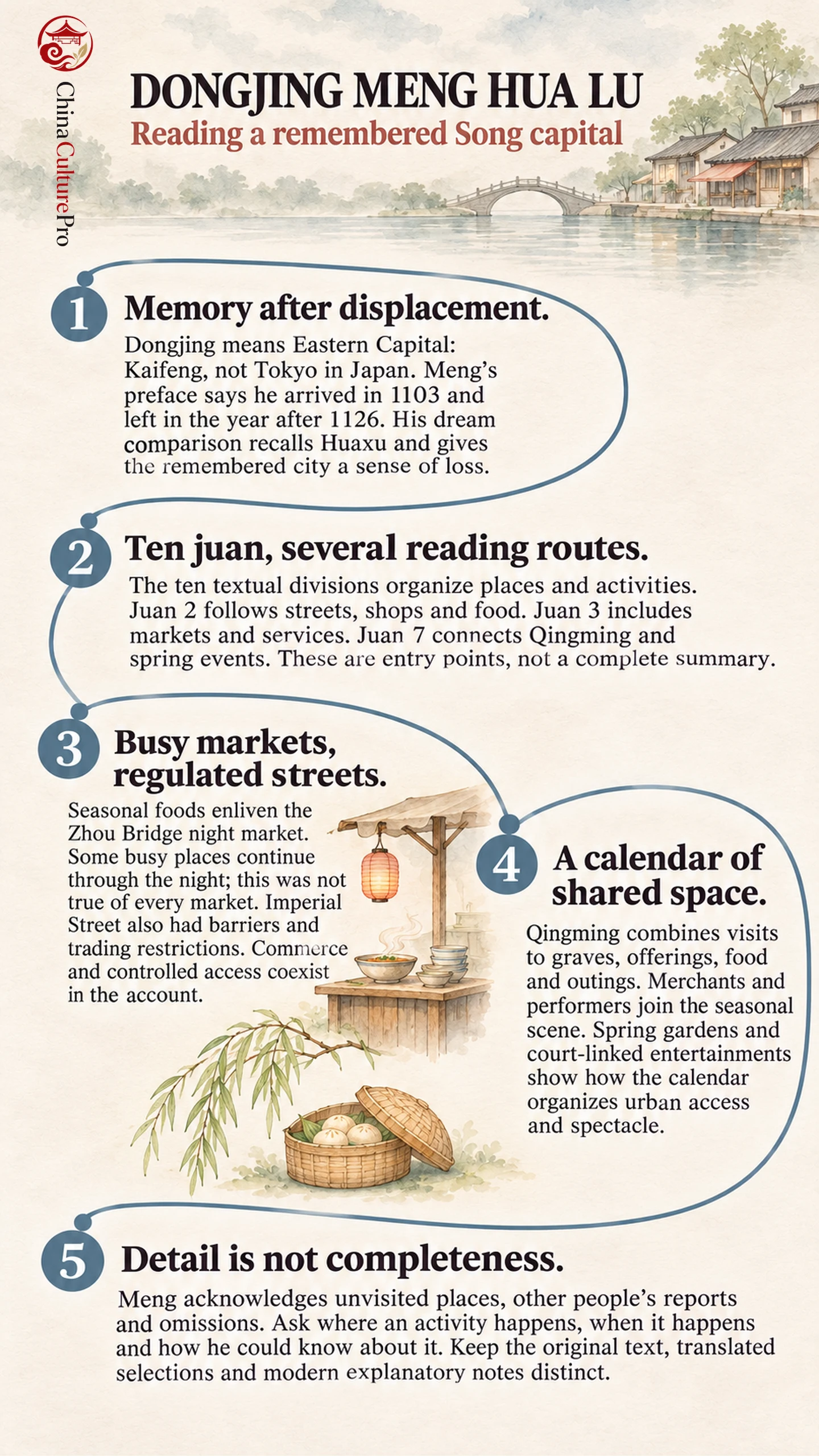
A night-market food list can also describe a street, a season and a way of spending time. Meng Yuanlao follows these activities through named places. Its detail invites close reading, while its retrospective voice asks readers to consider how a lost city is remembered.
Meng Yuanlao, Displacement and the Dream of Hua
Dongjing (东京, Dōngjīng) means Eastern Capital: here it names Kaifeng, not Japan’s Tokyo. The book looks back on the Northern Song city from the Southern Song (南宋, Nán Sòng), after war and displacement.[1][5]
Meng’s preface says he arrived in the capital in 1103 and left for the south in the year after 1126, meaning 1127. His account belongs to the upheaval separating the two phases of the Song dynasty.[1]
The title’s dream imagery comes from the preface’s recollection of Huaxu (华胥, Huáxū), an imagined realm of extraordinary happiness. Meng compares remembering the old capital with waking from such a dream. The dream comparison gives the account of splendor its sense of loss.[1]
How the Ten Juan Organize the City
The work proceeds through named places and subjects rather than a continuous personal narrative. Its contents allow several entry routes. These three examples are useful starting points, not a complete summary of all ten juan:[1][2][3][4]
| Entry point | What to examine |
|---|---|
| Juan 2: streets, wine shops and foods | How commercial activities are located along streets and near landmarks. |
| Juan 3: markets and urban services | The Xiangguo Temple (相国寺, Xiàngguósì) market, hiring, fire precautions and daily selling. |
| Juan 7: Qingming (清明节, Qīngmíngjié) and spring events | How commemoration, outings, court occasions and entertainment occupy seasonal time. |
The sequence also changes scale. A named stall or shop can sit beside a description of an imperial procession or public occasion. Readers interested only in food will miss how commerce, government and spectacle share urban space.[2][4]
Markets, Food and the Limits of Street Access
Juan 2’s Zhou Bridge (州桥, Zhōu Qiáo) night-market entry follows the street and lists foods by season. Summer brings cooling drinks and chilled preparations; winter includes roasted pork and other hot foods. The list records seasonal selling as well as the variety of street food.[2]
Juan 3 adds a rhythm to the activity: markets close late and reopen before dawn, while especially busy locations may continue throughout the night. This is valuable background to Chinese night-market culture, but it does not establish that every market in every district operated continuously.[3]
The lively markets also coexist with restrictions. The Imperial Street (御街, Yùjiē) entry describes barriers separating the central imperial route from ordinary circulation, and a prohibition on trading in its flanking galleries. Commercial abundance should not be mistaken for unrestricted access to all city space.[2]
Entertainment appears within the same geography. Near the commercial streets, wazi (瓦子, wǎzi) were venues combining performances and other activities. The account places performers beside sellers and services, helping explain how leisure was embedded in the streetscape.[2]
Qingming and the City’s Seasonal Life
The Qingming entry combines visits to graves with movement beyond the city gates, offerings, food and social outings. Paper-goods shops prepare elaborate forms, while people gather beneath trees or in gardens with dishes and drinks. Commemoration and recreation are described together.[4]
This gives historical depth to Qingming traditions without implying that the same practices were uniform throughout China. The particular urban setting matters: crowds, merchants, performers and elite carriages all contribute to Meng’s scene. The food details connect the festival with social and seasonal food culture.[4]
The same juan turns to spring openings of gardens and pools and to court-linked entertainments. The calendar therefore organizes access and spectacle as well as family observance.[4]
Reading a Detailed but Selective Recollection
Meng explicitly admits that the capital was too extensive for him to have visited everywhere. Some material came from other people; omissions remained, and he welcomed corrections. His preface makes these different sources of information explicit.[1]
His preface also defends plain or colloquial language as a way to make the account understandable. Names of foods, occupations and entertainments deserve annotation precisely because they can preserve local usage that an elegant general description would lose.[1]
For each passage, ask where an activity happens, when it happens and how Meng could know about it. His recollection of prosperity selects particular city elements; even an exceptionally detailed description is not a complete census. A reconstruction should distinguish explicit textual locations from a reader’s inferred connections.[1][5]
Choose an annotated edition that explains old place names and specialist vocabulary. Check whether an English version supplies the whole text or selections, and keep modern explanatory notes separate from Meng’s words. Returning to the preface after a market or festival entry makes the relationship between memory and detail easier to see.
FAQs About the Dongjing Meng Hua Lu
Does Dongjing mean Tokyo in Japan?
No. It identifies the Eastern Capital of the Northern Song: Kaifeng, also known as Bianjing.[1]
Is the Dongjing Meng Hua Lu a novel?
No. It is a retrospective account of urban life organized around places and activities, rather than an invented continuous storyline.[1]
Did Meng Yuanlao personally witness everything he records?
No. The preface acknowledges secondhand information and places he had not visited.[1]
Does it describe a city where every market stayed open all night?
No. It distinguishes late closing and early reopening from the uninterrupted activity of especially busy places.[3]
Sources
[1] Meng Yuanlao, public-domain Chinese text. Dongjing Meng Hua Lu: author’s preface and contents
[2] Meng Yuanlao, public-domain Chinese text. Dongjing Meng Hua Lu, juan 2: Imperial Street and Zhou Bridge night market
[3] Meng Yuanlao, public-domain Chinese text. Dongjing Meng Hua Lu, juan 3: temple markets and daily commerce
[4] Meng Yuanlao, public-domain Chinese text. Dongjing Meng Hua Lu, juan 7: Qingming and spring outings
[5] Taylor & Francis, original research article. The shaping of cityscape and imagination: Song Dynasty urban pavilions along the streets