


Quick Answer: What Are the Spring and Autumn Annals?
The Spring and Autumn Annals (春秋, Chūnqiū) is a terse chronicle centered on the state of Lu (鲁, Lǔ). One of the Five Classics (五经, Wǔjīng), it arranges records under rulers’ reign years rather than telling one continuous story.[1]
- Contents: Alliances, warfare, deaths, ritual affairs and unusual natural events.
- Dates: Conventionally 722–481 BCE across twelve rulers’ reigns; the endpoint depends on the textual tradition.
- Reading: Its three major commentaries supply different kinds of context and interpretation.
Separate the brief annal entry from the explanations attached to it. The claim that a title or omission conveys moral judgment belongs to an interpretive tradition, not automatically to the plain wording of the record.
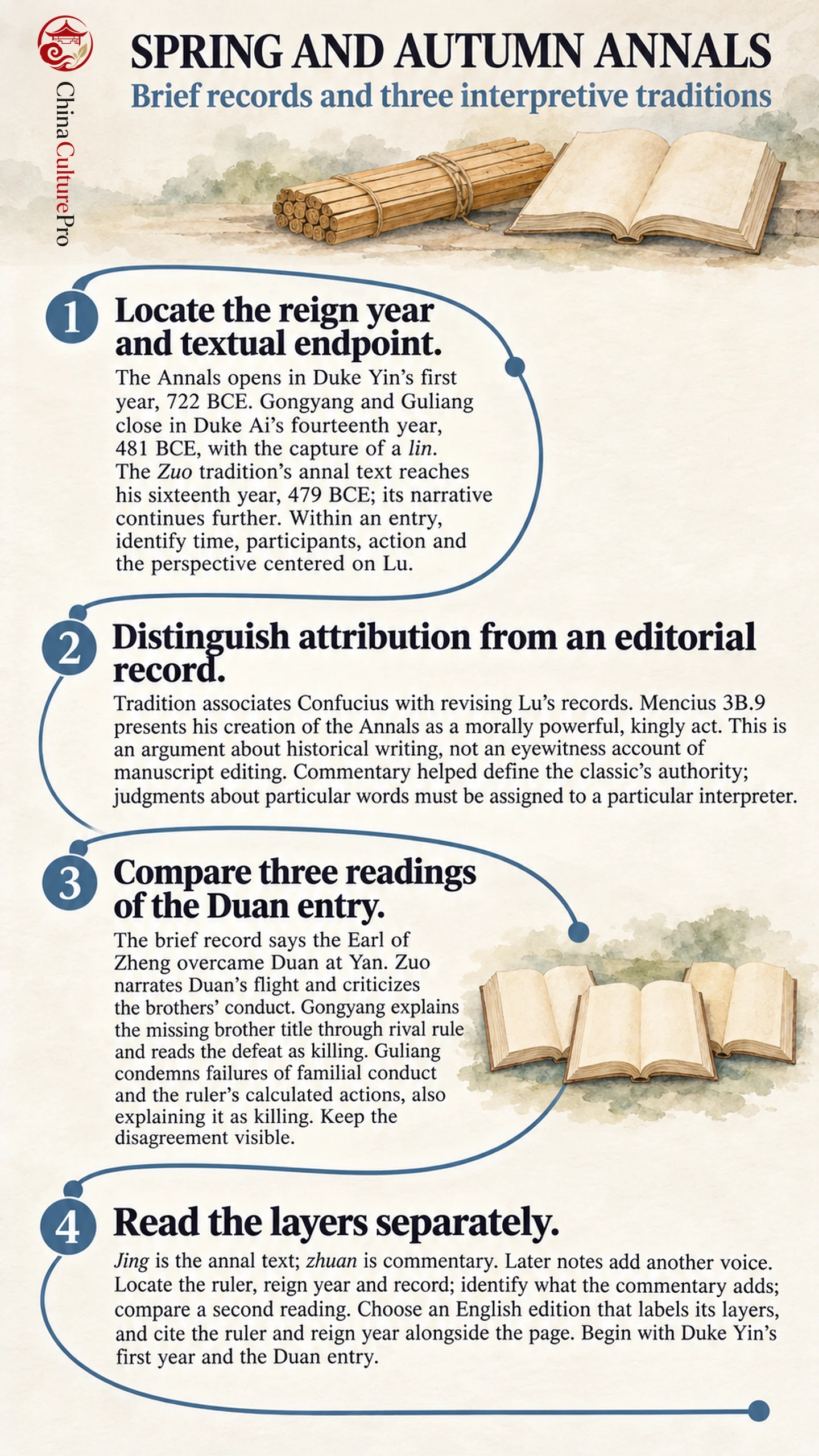
A few characters can record a conflict; several pages may explain its motives and moral significance. The Spring and Autumn Annals rewards reading at both scales. Start with the brief entry, then ask what each commentary adds and why.
Dates, Dukes and the Shape of an Annal Entry
The opening year is that of Duke Yin (隐公, Yǐn Gōng), corresponding to 722 BCE. The usual endpoint is Duke Ai (哀公, Āi Gōng), year fourteen, 481 BCE: a hunt in the west captures a lin (麟, lín), a creature with auspicious significance in the commentarial tradition. The Gongyang Commentary (公羊传, Gōngyáng Zhuàn) and Guliang Commentary (穀梁传, Gǔliáng Zhuàn) close there.[1][9][10]
The annal text in the Zuo Commentary (左传, Zuǒzhuàn) tradition continues to year sixteen, 479 BCE, including the death of Confucius (孔子, Kǒngzǐ). Its accompanying narrative continues further. Thus the final date of the Annals and the final date of a commentary’s narrative are separate questions.[3]
Within a year, look for four features:
- Time: A reign year and season; months and days appear for some events.
- Participants: A ruler’s title, a personal name, a state or an unnamed group.
- Action: A compact verb for an alliance, attack, death or other event.
- Perspective: Local references are centered on Lu, rather than a narrator surveying every state equally.
For example, an entry in the first year says that in summer, the fifth month, the Earl of Zheng (郑, Zhèng) overcame Duan (段, Duàn) at Yan (鄢, Yān). It does not itself supply their family relationship, the buildup to the conflict or a speech explaining the victor’s intentions.[2]
Use the Spring and Autumn period for the wider historical setting. A period label and the chronological limits of this particular book serve different purposes.
Confucius, Mencius and the Claim of Moral Judgment
Traditional accounts connect the Annals with Confucius revising Lu’s historical records. That attribution explains its status as a classic, but does not establish how every surviving sentence was composed.[1]
A central early statement appears in Mencius (孟子, Mèngzǐ), 3B.9. In an argument about political and moral disorder, the speaker presents Confucius’s creation of the Annals as work belonging to a true ruler. The completed book is said to make disorderly ministers and rebellious sons afraid. This is a claim about the moral force of historical writing, not a surviving description of a manuscript being edited.[7]
Once the chronicle was read as a sage’s purposeful work, readers could ask why it used one title, omitted another or recorded an event without a day. The development of the classic and of its interpretive authority cannot be reduced to a finished text followed by neutral explanations; commentary helped define what readers understood the classic to be.[8]
For a particular judgment, name the commentator and show the relevant wording. A general claim that every omission contains one universally agreed moral message conceals the disagreements that make the tradition worth studying.
One Record, Three Commentarial Readings
The first-year entry about Duan shows why the three commentaries should be compared rather than merged. These are readings of the same brief record, with different accounts and emphases:
| Commentarial tradition | What it adds to the Duan entry |
|---|---|
| Zuo Commentary | Narrates the growing conflict between brothers, Duan’s preparations and his eventual flight. It also criticizes the conduct represented by the record’s wording.[6] |
| Gongyang Commentary | Explains the missing “younger brother” title through Duan’s rival claim to rule, and reads “overcame” as killing, condemning the ruler’s conduct.[4] |
| Guliang Commentary | Connects the missing kinship title with Duan’s failure of familial conduct, while also condemning the ruler’s calculated handling of the conflict and explaining it as killing.[5] |
The divergence matters: the Zuo narrative describes an escape, whereas the other readings explain the wording through killing. Do not silently rewrite the short annal entry as if it explicitly states either expanded account. Nor is Zuo simply judgment-free history: it too interprets the missing brother designation and the ruler’s responsibility.
For sustained reading, the Gongyang Commentary and Guliang Commentary merit separate attention. Comparing their reasons is more revealing than using “the commentary” as though only one voice existed.
How to Read the Annals Without Merging Its Voices
In a combined edition, jing (经, jīng) identifies the canonical annal text, while zhuan (传, zhuàn) identifies its commentary. Later annotations add another layer. Typography, brackets and headings can make those boundaries visible; a smooth modern retelling may hide them.
- Locate the record: Note the ruler, reign year and event; first read the annal wording without its surrounding explanation.
- Identify the added claim: Mark which commentary supplies a motive, narrative detail or judgment about a word.
- Compare a second reading: Ask whether it agrees about the event, the interpretation, or both. Keep unresolved differences visible.
When choosing an English edition, establish whether it translates the Annals alone, a particular commentary, or both. Check how it labels the layers and converts reign years to BCE dates. For a citation, retain the ruler and reign year as well as any page number, since pagination changes between editions.
A productive first exercise is the opening year. Read its sparse notices, follow the Duan entry into one commentary, then compare the alternative explanation. That small unit exposes the difference between a recorded action, an expanded story and a judgment about the record.
FAQs About the Spring and Autumn Annals
Why is it called Spring and Autumn?
The words name spring and autumn but can stand for the yearly cycle. Chunqiu also became a name for annalistic histories; the title does not mean that only two seasons appear.[1]
Why do sources give different ending dates?
The Gongyang and Guliang texts end in Duke Ai’s fourteenth year, 481 BCE. The Zuo tradition’s annal text reaches his sixteenth year, 479 BCE; its narrative extends further. Identify which textual layer a date describes.
Is it the same book as the Lushi Chunqiu?
No. The Lushi Chunqiu (吕氏春秋, Lǚshì Chūnqiū) is a separate work. Its title shares the words Chunqiu; use the full title when locating or citing it.
Sources
[1] Ministry of Education, Revised Mandarin Chinese Dictionary. Chunqiu: title, annal form and traditional attribution
[2] Public-domain Chinese text. Spring and Autumn Annals: Duke Yin, first year
[3] Public-domain Chinese text. Zuo textual tradition: the annal for Duke Ai, year sixteen
[4] Public-domain Chinese text. Gongyang Commentary: Duke Yin, first year
[5] Public-domain Chinese text. Guliang Commentary: Duke Yin, first year
[6] Public-domain Chinese text. Zuo Commentary: the conflict between the Earl of Zheng and Duan
[7] Public-domain Chinese text. Mencius 3B.9: Confucius and the Annals
[8] Michael Puett, Oxford University Press / Harvard University. Text and Commentary: The Early Tradition (2017), pp. 112–122
[9] Public-domain Chinese text. Gongyang Commentary: Duke Ai, fourteenth year
[10] Public-domain Chinese text. Guliang Commentary: Duke Ai, fourteenth year