

Quick Answer: Who Is Shu Ting?
Shu Ting (舒婷, Shū Tíng; born 1952) is a Chinese poet from Fujian known for a personal lyric voice, vivid images and poems about relationships, dignity and collective life. She became prominent among the poets associated with the new poetry of the late 1970s and early 1980s.[1][2]
- Begin with images: Trees, boats and working objects carry arguments about how people relate.
- Listen to the address: Ask who speaks and who the poem’s “you” might be.
- Read beyond one poem: Intimate relationships and national feeling take different forms in her work.
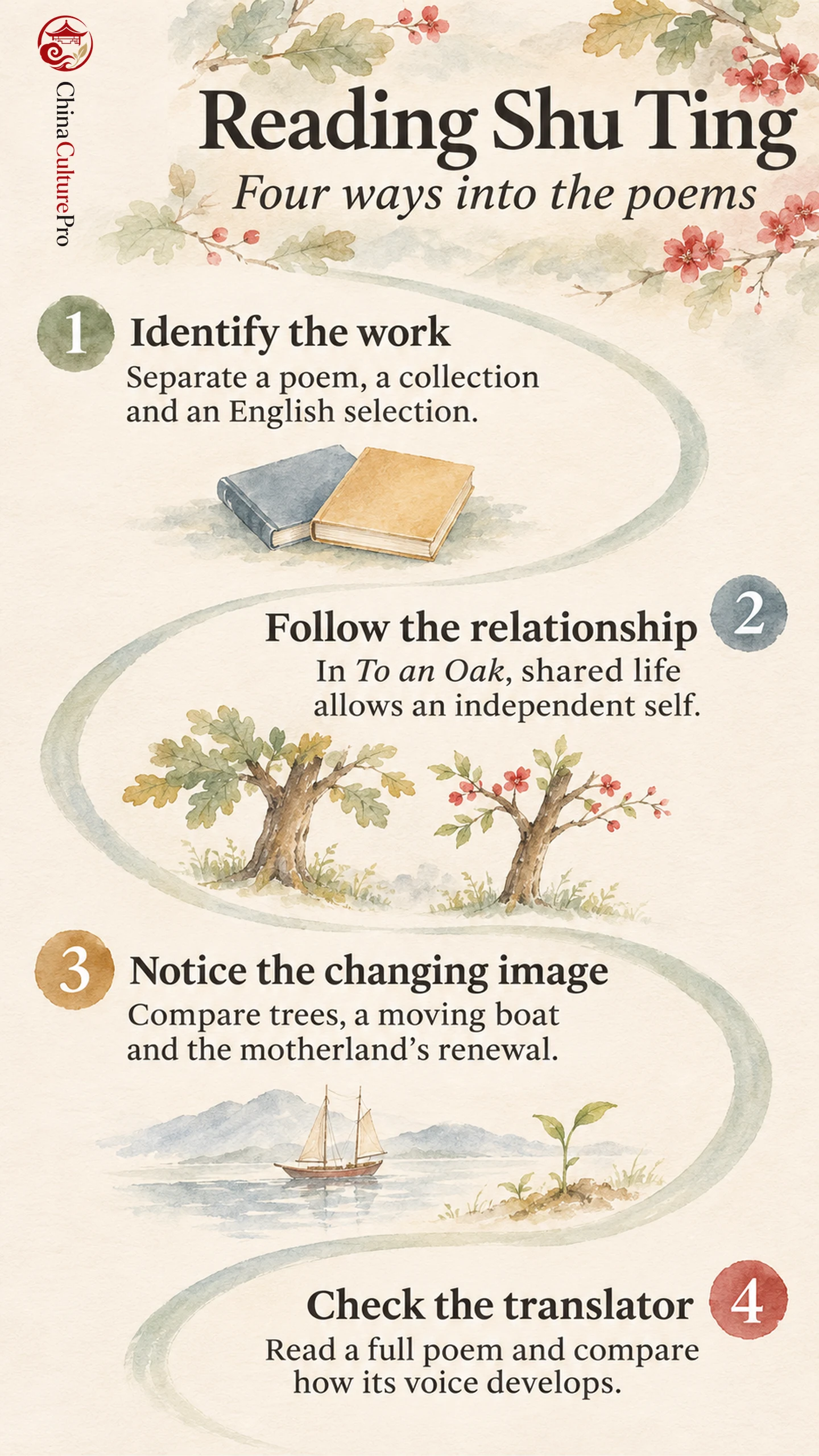
The readings below distinguish individual poems, poetry collections and English selections.
For a wider map of periods and forms, see our Chinese poetry guide. This page focuses on several works that show what makes Shu’s voice distinctive.
Misty Poetry and a Distinctive Personal Voice
Misty poetry (朦胧诗, ménglóng shī) foregrounded subjective experience, individuality and suggestive imagery. Shu is grouped with poets such as Bei Dao (北岛, Běi Dǎo) and Gu Cheng (顾城, Gù Chéng). The label supplies a shared historical context, rather than one formula for reading all their work.[2]
Shu began writing during her period in the countryside and later worked in factories. These experiences place her emergence within the upheavals and changing literary opportunities of her generation. Her published work also includes prose.[1]
Collections and Three Poems to Begin With
Her first poetry collection, A Boat with Two Masts (双桅船, Shuāngwéi Chuán), appeared in 1982. Later collections include The Singing Iris (会唱歌的鸢尾花, Huì Chànggē de Yuānwěihuā) and Archaeopteryx (始祖鸟, Shǐzǔniǎo). These book titles should be distinguished from a selection of individual poems.[1]
| Poem | A useful first question |
|---|---|
| To an Oak (致橡树, Zhì Xiàngshù) | How does the speaker reject dependence while imagining a shared life?[5] |
| A Boat with Two Masts | How do boat, shore, storms and lights express connection across separation?[8] |
| Motherland, O My Dear Motherland (祖国啊,我亲爱的祖国, Zǔguó A, Wǒ Qīn’àide Zǔguó) | How do damaged working objects give way to images of renewal?[7] |
The middle entry is the individual poem sharing the collection’s title. Read the three together to compare a standing pair of trees, a moving boat and a speaker addressing the nation.
Equality, Distance and the Changing Address
In To an Oak, the speaker first refuses forms of love built on clinging, repetition or service. She imagines herself as a tree beside another tree, sharing weather while keeping a distinct shape and voice. Equality here involves both attachment and an independent position; the poem develops that idea through changing comparisons.[5]
A Boat with Two Masts uses movement rather than rootedness. A storm and lamp first connect the figures; a different lamp accompanies their separation. The boat’s journey and the shore’s continuing presence allow distance to remain inside the relationship.[8]
Motherland begins with worn or damaged things, including a waterwheel, a mining lamp and a neglected roadbed. Later images of a sprout and dawn turn towards new possibility. The repeated first-person address binds individual feeling to collective history, carrying pain alongside hope.[7]
For a second reading, trace the verbs and changes of image. Ask whether the speaker refuses, shares, departs or identifies with something larger. That gives each poem a particular emotional movement instead of assigning one meaning to every natural image.
Reading Shu Ting in English
- Shu Ting: Selected Poems: The 1994 Renditions paperback is edited by Eva Hung. Its translator list names Hung, Tao Tao Liu, Gordon Osing, De-an Wu Swihart, Janice Wickeri, Henry Y. H. Zhao and D. E. Pollard. The contents include To an Oak on page 24 and A Boat with Two Masts on page 19, plus a dialogue with the poet and an afterword.[3][4]
- To an Oak Tree: Poetry at Sangam publishes Liu Yuanhao’s English translation, with English and Chinese audio links. It offers a short starting text for following the sequence of comparisons before moving to a larger selection.[5][6]
Compare how a translator handles the speaker’s refusals and the shift to shared experience. Different English titles or wording can reflect translation choices; check the Chinese title when identifying the work.
FAQs About Shu Ting
Is To an Oak only a declaration of romantic love?
Its imagined relationship also makes a claim for an independent self. Read the speaker’s refusals together with the later vision of mutual support.[5]
Does Misty poetry mean every line is obscure?
The label points towards suggestive images and subjective experience. It does not require a reader to treat a clearly developing argument as an unsolvable code.[2]
Is Selected Poems a complete collected edition?
It is a selection. Its contents and accompanying dialogue provide an introduction, rather than a promise to contain every poem or her prose writing.[3]
Sources
[1] CUHK Research Centre for Translation. Shu Ting: author profile and bibliography
[2] Academy of American Poets. A Brief Guide to Misty Poets
[3] CUHK Research Centre for Translation. Shu Ting: Selected Poems, 1994 edition and contents
[4] CUHK Research Centre for Translation. Selected Poems: translator list
[5] Shu Ting, translated by Liu Yuanhao, Poetry at Sangam. To an Oak Tree
[6] Poetry at Sangam. Shu Ting: translation credits and recordings
[7] Shu Ting, Dangdai, reprinted by China Writers Association. Motherland, O My Dear Motherland: Chinese original
[8] Fuzhou University, Shuren. A Boat with Two Masts: Chinese poem