


Quick Answer: Who Was Shi Tiesheng?
Shi Tiesheng (史铁生, Shǐ Tiěshēng; 1951–2010) was a Beijing-born Chinese writer whose work spans essays, short fiction and novels. His writing explores how a person inhabits a body, remembers others and searches for meaning.[1][2]
- Start with an essay: A remembered garden becomes a place for observing life and reconsidering family relationships.
- Try fiction next: His stories range from rural recollection to allegory and experimental narration.
- Read the form: Ask who speaks, what the speaker knows and where memory changes a judgment.
Read his treatment of disability together with his choices of voice, image and structure.
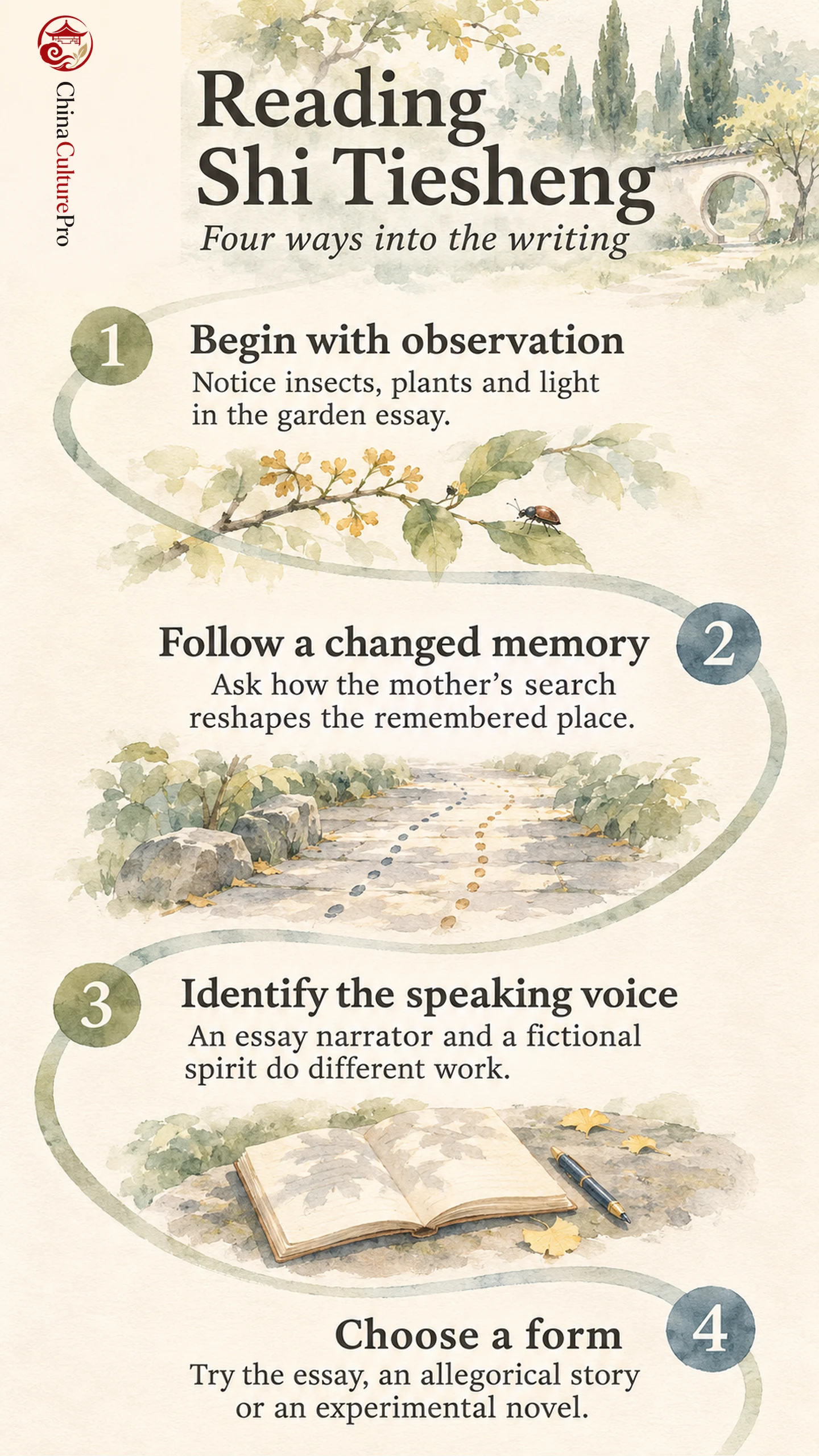
This guide places him within modern and contemporary Chinese literature and offers reading routes across several forms.
A Career Across Memory, Allegory and Experiment
Sent to the countryside near Yan’an during the Cultural Revolution, Shi later returned to Beijing and wrote while living with paralysis. His publisher records work in fiction, essays, scripts, poetry and other forms. That range matters when a familiar school essay seems to stand for his entire career.[1]
For background on the upheaval shaping that generation, read our Cultural Revolution cultural history.
Critic Gu Lin describes interrupted narration and extended reflective dialogue in Shi’s fiction. Watch how a story’s form carries its philosophical inquiry.[2]
Five Works and What to Read For
The English labels below identify the works; published translations and collections may use variant titles.
| Work | Form and reading focus |
|---|---|
| My Remote Qingpingwan (我的遥远的清平湾, Wǒ de Yáoyuǎn de Qīngpíngwān) | Short fiction from 1983: rural experience remembered through an individual perspective.[2][7] |
| Strings of Life (命若琴弦, Mìng Ruò Qínxián) | A 1985 story about two blind musicians: allegory and the question of what sustains a life.[2] |
| The Temple of Earth and I (我与地坛, Wǒ Yǔ Dìtán) | A 1991 essay: observation, time and the belated understanding of a mother’s care.[2][3] |
| Notes on Principles (务虚笔记, Wùxū Bǐjì) | A novel using linked love stories, symbolic characters and reflective dialogue.[2] |
| My Travels in Ding Yi (我的丁一之旅, Wǒ de Dīng Yī Zhī Lǚ) | A novel narrated by a wandering spirit inhabiting a boy: embodiment and the limits of knowing another life.[4] |
Reading The Temple of Earth and I Closely
In the opening, Beijing’s Temple of Earth (地坛, Dìtán) becomes a place the narrator returns to in his wheelchair. The supposedly abandoned garden is busy with insects, plants and changing light. Ruined architecture and continuing life occupy the same space.[3]
The account then turns towards his mother. He remembers seeing her search for him, sometimes without calling out to her. Later he recognizes that the garden contains her anxious journeys as well as his own familiar tracks. The change is ethical as well as emotional: a space understood through his distress is reconsidered through someone else’s care.[3]
On a second reading, mark one concrete observation and one later reinterpretation. Ask how their relationship changes the narrator’s understanding. This is a useful way to move beyond extracting a comforting sentence and missing the work of memory that gives it force.
English Reading Routes
- The Temple of Earth and I: Paper Republic records an English translation by Chen Zeping and Karen Gernant in Turnrow, September 2007. Use the record to identify the translators and publication when searching a journal or library catalogue.[5]
- Strings of Life: Foreign Language Teaching and Research Press lists a Chinese-English reader in its series description. Check the edition’s contents and credits when choosing a bilingual reading copy.[7]
- My Travels in Ding Yi: Sinoist Books’ 2019 English edition is translated by Alex Woodend. Its spirit narrator offers a different starting point for readers interested in experimental fiction rather than a personal essay.[4]
Begin with the essay for close observation, the story for allegory, or the novel for an unusual narrative premise.
FAQs About Shi Tiesheng
Is The Temple of Earth and I an essay or a book?
It is an essay, and its title also appears on later book editions. A 2011 People’s Literature Publishing House listing does not mean the essay first appeared that year.[2][6]
Are all his narrators versions of himself?
No. Personal experience can inform fiction without making every narrator a direct self-portrait. A wandering spirit inhabiting another person is an especially clear reason to distinguish narrative invention from biography.[4]
Is the essay mainly a guide to a Beijing park?
No. Its places and details serve reflection on life, memory and relationships. Read the park as part of the essay’s structure rather than as a present-day visitor itinerary.[3]
Sources
[1] Sinoist Books. Shi Tiesheng: author profile
[2] Gu Lin, Chinese Literary Criticism, reprinted by China Writers Association. A study of Shi Tiesheng’s literary canonization, 2021
[3] Shi Tiesheng, Shanghai Literature, reprinted on The Paper. The Temple of Earth and I: Chinese original, selected passages
[4] Sinoist Books. My Travels in Ding Yi: English edition
[5] Paper Republic. The Temple of Earth and I: translation publication record
[6] National Reading website. The Temple of Earth and I: 2011 book listing
[7] Foreign Language Teaching and Research Press. Strings of Life: series description and author bibliography