
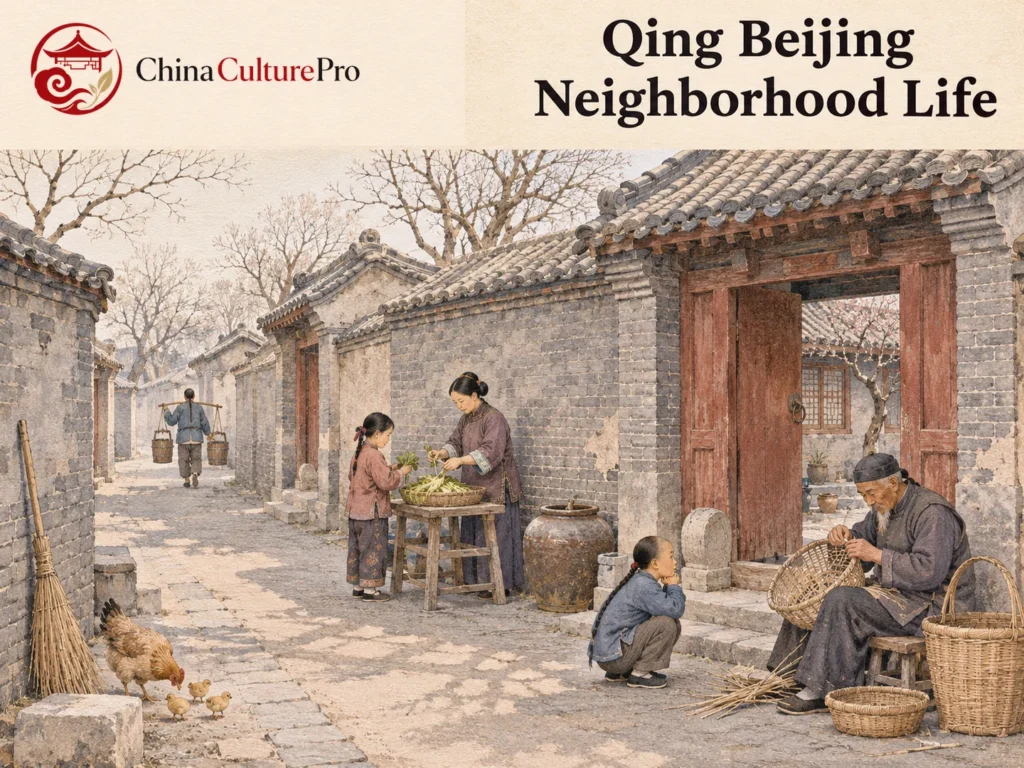

Quick Answer: How Did Qing Beijing Neighborhoods Work?
Qing Beijing neighborhoods grew around lanes, courtyard compounds, shops and institutions that supplied things households needed. The Qing court reserved much of the Inner City for people attached to the Eight Banners (八旗, Bāqí), its military and administrative organization. Many civilian families and businesses were based in the Outer City.[1][2]
- Housing: A hutong (胡同, hútòng) was a lane. It gave access to compounds that could differ greatly in size and wealth.[3]
- Services: Water from wells reached households through systems of public and private carriers.[4]
- Connections: Native-place lodges gave some visitors from the provinces a base in the capital.[5]
The Inner and Outer City distinction shaped daily life, even as people and institutions crossed the divide.[1][2][4][5]

A map can show an alley and a well. It takes other records to find out who lived in the alley, who carried the water, or what brought people from the same province to a lodge in Beijing.[2][4][5]
Inner City and Outer City
Early Qing residential rules designated much of the Inner City (內城, Nèichéng) for the banners and relocated many civilians to the Outer City (外城, Wàichéng). The Outer City contained much of the city’s business activity. Banner membership included people of different origins. Some civilians also remained or lived in the Inner City, while some banner households lived outside it.[1]
The distribution shifted as the dynasty aged. A study of the late Qing and early Republican city documents declining fortunes among some banner households and nobles. Some sold their homes and moved toward the edges of the city. A residential map from around the end of the dynasty therefore records a later social landscape, rather than the original settlement policy.[2]
Hutongs and Courtyard Houses
A lane might open through a gate into a siheyuan (四合院, sìhéyuàn), a compound with buildings arranged around a courtyard. The lane linked compounds to the surrounding street network. The courtyard provided space within a household enclosure. These two features describe different scales of the built environment.[3]
Large residences could take up a remarkable length of a lane. The late Qing minister Na Tong (那桐, Nà Tóng) occupied a compound with several rows of courtyards in what is now Jinyu Hutong. It illustrates how extensive an elite residence could be. By contrast, research on late Qing households records great differences in family size and wealth across Beijing. The same arrangement around a courtyard could serve a very different household on the next lane.[2][3]
Wells, Water Carriers and Daily Work
Much of the city depended on wells, and its water was often salty. Carrying drinking water was specialized work. Historian Lei Zhang distinguishes state carriers associated with the Inner City from private carriers in the Outer City. The way residents obtained a basic necessity reflected both environmental conditions and the organization of the capital.[4]
A well on a neighborhood map tells you where water could be drawn. It cannot identify its quality, who fetched it, or how a household secured a regular supply. Water delivery offers an example of how a formal division in the city could be felt in everyday work.[4]
Native-Place Lodges and Provincial Visitors
A huiguan (會館, huìguǎn) could provide lodging and connections for people from the same native place. Late imperial Beijing had many lodges serving visiting scholars and officials. Provincial networks gave sojourners a place to stay and helped maintain ties between the capital and their home districts. These institutions served purposes different from a commercial inn.[5]
Some visitors came to the capital through the civil examination system. The palace examination gave qualified candidates a reason to be in Beijing. A lodge helped some provincial visitors find people they knew or could approach during a longer stay.[5]
FAQs About Qing Beijing Neighborhoods
Were hutongs the same as courtyard houses?
A hutong was a lane. A courtyard house was a compound that could have an entrance opening onto one.[3]
Did only Manchu people live in the Inner City?
Banner membership and ethnic identity were different categories. The Inner City had many banner households and also some civilians. Residential patterns changed over time.[1][2]
What did native-place lodges do?
They gave provincial sojourners, including scholars and officials, a place to stay and maintain connections with people from the same area.[5]
Sources
[1] University of Minnesota Digital Conservancy. The Juridical System of the Qing Dynasty in Beijing
[2] Acta Geographica Sinica. A Preliminary Study of the Social Geography of Beijing During the Late Qing and the Early Republican Period
[3] Beijing Municipal Government. The Art of Living a Harmonious and Orderly Life
[4] Lei Zhang, Journal of Water History. One City with Two Water: Drinking Water in Beijing, 1644–1900
[5] Richard Belsky, Harvard University Asia Center. Localities at the Center: Native Place, Space, and Power in Late Imperial Beijing