

Quick Answer: What Were Inns Like in Imperial China?
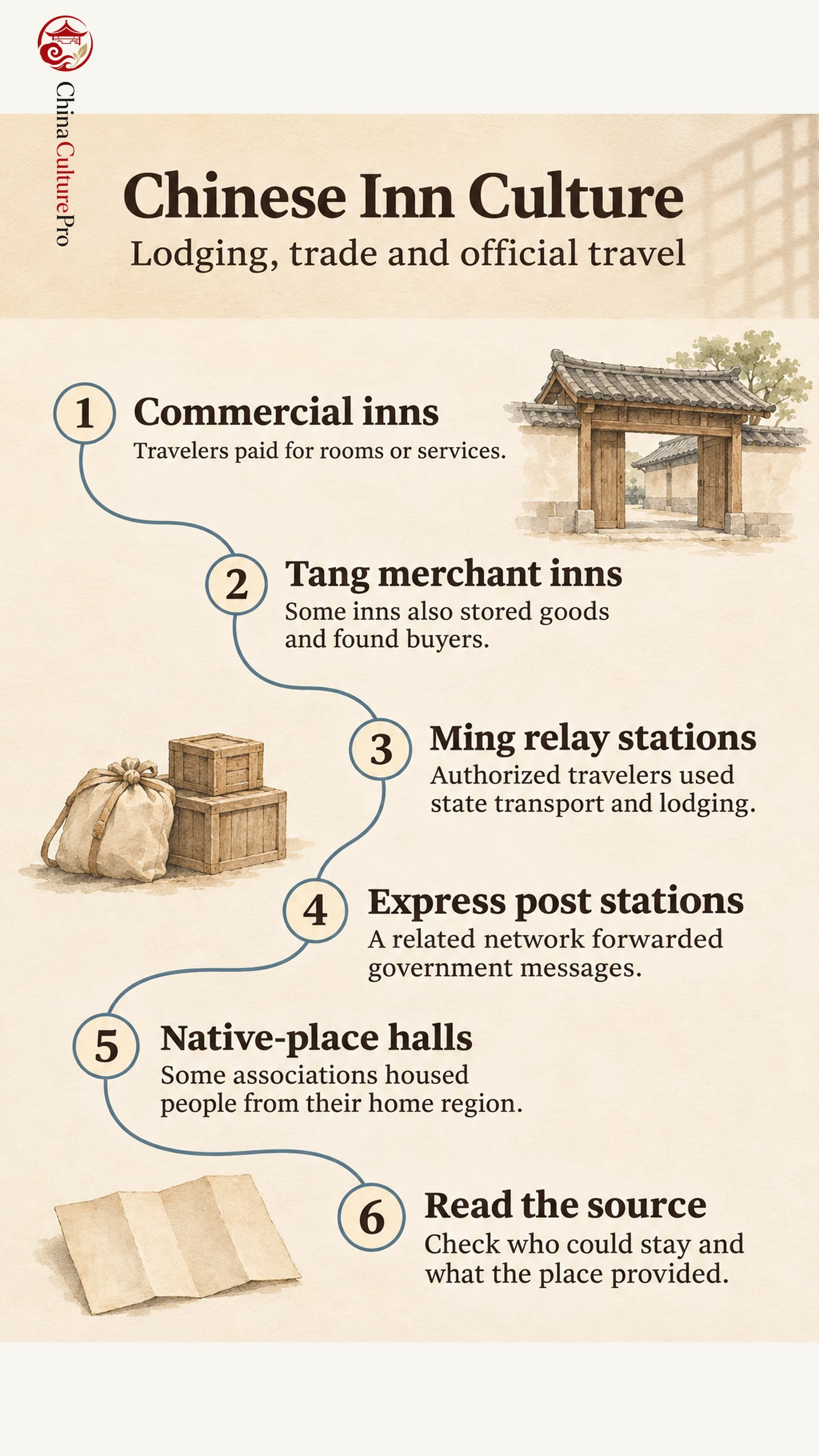
Travelers in imperial China stayed in establishments with different owners and rules. A commercial inn (客店, kèdiàn) sold lodging or related services. A relay station (驛站, yìzhàn) served the government’s travel network. A native-place hall (會館, huìguǎn) could offer a base to people from a particular locality. [1][2][4][5]
- Commercial lodging: Travelers paid for services. Some Tang merchant inns also stored and handled goods.
- Government relay: Officials, envoys and couriers used facilities tied to authorized government travel.
- Association lodging: A native-place organization could arrange rooms for people it supported, such as examination candidates. [1][2][4][6]
All three could receive travelers. Their purpose and the terms of access differed.
An inn could be where a merchant found a room, left a shipment or met a buyer. On the same broad route, a government messenger might rely on an entirely different institution. Look at what the traveler was doing and who provided the service to understand what kind of place the source describes. [1][2][3]
What a Tang Merchant Could Find at an Inn
Tang markets included establishments called didian (邸店, dǐdiàn). Some served travelers food and provided lodgings while holding merchandise in storage. A merchant with goods to sell might need a place for those goods as much as a room. An innkeeper could also connect a traveler with local customers. In some businesses the owner took merchandise on consignment or helped arrange onward transport. [1]
These services reduced the work a trader had to do in an unfamiliar market. A customer could leave goods with an intermediary rather than stay in town until a buyer appeared. Late Tang evidence even points to innkeepers who entered wholesaling and lending. Such businesses could join several commercial functions under one owner. Those were additional services of some businesses, with no reason to assume a roadside inn offered them. The article on Tang Chang’an city life puts commercial inns in a broader urban setting. [1]
Why Government Relay Stations Were Different
The Ming relay system used stations, horses, carts and other resources maintained at government expense. It supplied accommodation and transport to eligible officials, envoys and messengers. Express post stations (急遞鋪, jídìpù) belonged to a related network for forwarding written communications. Both systems moved people or information for the state, but the post station’s message-handling role differed from the relay’s support for authorized journeys. [2]
Official roads could also be useful to private travelers. An early nineteenth-century Buddhist itinerary compiled by the monk Ruhai Xiancheng (如海顯承, Rúhǎi Xiǎnchéng) often follows routes shared by long-distance commerce and the relay network. This tells us where routes were practical and connected. It does not make the pilgrim an official traveler or show that he used relay accommodation. To determine where he slept, you would need an entry identifying his lodging. [2][3]
How Native-Place Halls Served Travelers
Some late Ming and Qing native-place associations ran halls where people from the same region could meet. In Beijing, officials and scholars helped establish such organizations. In other trading centers, merchants often took the lead. The connection was membership or shared origin, rather than a public offer of accommodation on the same terms to anyone. [4][5]
The Hunan Guild Hall in Beijing provided lodging to people from Hunan who came to sit examinations. Rooms mattered because a candidate’s stay could extend beyond the trip itself. A hall also gave newcomers a place to meet people from home. In the late Qing, both older inns and halls stood around Xiheyan near the busy Qianmen commercial area. The two types could exist on the same street because they served different groups and purposes. See Qing Beijing neighborhood life for the wider urban setting. [4][5][6]
Commercial associations could use halls for functions beyond lodging. At Zhengyici near Xiheyan, Zhejiang merchants bought a temple site in 1667 and established a hall connected to their financial businesses. Its theatre served gatherings and celebrations. The example gives a reason to identify who founded a hall before treating it as an inn. [5]
How to Tell These Places Apart in a Historical Source
A translation may call a building an “inn” because travelers slept there. Start by asking how they gained access. A shopkeeper’s dealings with goods, a courier’s authority to travel and an association’s link to a native place point toward different institutions. One feature, such as a meal or overnight room, can occur in more than one setting. [1][2][4][6]
| Place | Main relationship | Useful clue in the source |
|---|---|---|
| Commercial inn | Customer and proprietor. [1] | Payment, meals, merchandise or help finding buyers. |
| Government relay station | Authorized traveler and state service. [2] | Official itinerary, transport resources or government provisions. |
| Native-place hall | Sojourner and association. [4][5][6] | A shared place of origin, exam lodging or a meeting arranged by the association. |
FAQs About Chinese Inn Culture
Did Inns Also Serve Food?
Some did. Tang merchant inns could offer food as part of a mix of services. The menu and arrangement depended on the business, so the term inn alone tells us little about what was served. [1]
Could Private Travelers Use the Official Relay Network?
They could travel on some of the same roads. Access to government accommodation and transport depended on official status or authorization, so a shared route does not show that two travelers used the same lodging. [2][3]
What Can an Inn Scene in a Story Tell Us?
Stories about Tang travelers collected in a later compilation use lodgings as places for educated travelers to meet and share information. Such scenes show what a setting meant to storytellers. Identifying a particular inn’s rates, rooms or clientele takes other evidence. [7]
Sources
[1] Yōhei Kakinuma. Money, Markets, and Merchants
[2] Lane J. Harris. The Arteries and Veins of the Imperial Body: The Nature of the Relay and Post Station Systems in the Ming Dynasty, 1368–1644
[3] Marcus Bingenheimer. Knowing the Paths of Pilgrimage: The Network of Pilgrimage Routes in Nineteenth-Century China
[4] Bryna Goodman. Native Place, City, and Nation: Regional Networks and Identities in Shanghai, 1853–1937
[5] Beijing Municipal Bureau of Culture and Tourism. Guild Halls, Theatres and the History of Xiheyan
[6] Beijing Tourism. Hunan Guild Hall
[7] An In. A Study of the Platform Function of Accommodation Facilities During the Tang Dynasty