


Quick Answer: What Is Qiang New Year?
Qiang New Year(羌年,Qiāngnián)is a harvest-season festival of Qiang communities in Sichuan. Thanksgiving, religious observance and renewed family relationships connect its different activities within Qiang culture.[1]
- Ritual: Thanksgiving and offerings
- Celebration: Shared meals, visits and dance
- Transmission: Knowledge passed between generations
Local observances and public presentations may show different parts of the tradition.
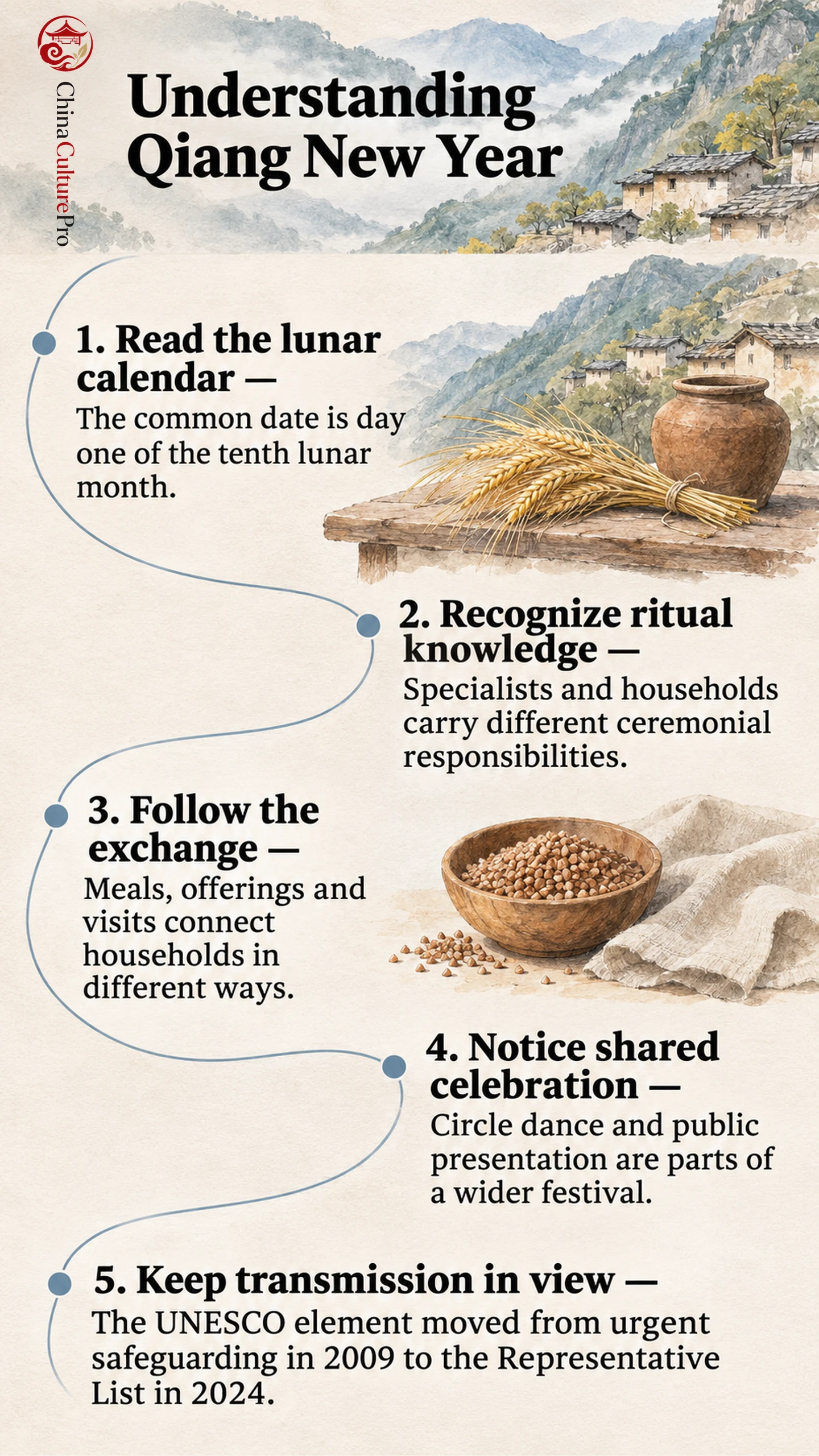
A shared meal, a circle of dancers and a mountain rite belong to different parts of Qiang New Year. Understanding how they connect is more useful than expecting one spectacle to represent the whole festival. This guide explains its calendar, religious specialists, food and community celebrations, alongside the modern work of transmission.
When and Where the Festival Is Observed
The common date is the first day of the tenth lunar month, after the harvest. Spring Festival(春节,Chūnjié)begins the first lunar month.[1]
In 2026, the tenth lunar month begins on November 9. That conversion identifies the calendar date, not the advertised programme of every village or venue. The Chinese and Gregorian calendars do not assign the same numbered months to the same days.[2]
The standardized date also needs historical context. A study based on fieldwork in Qiang villages describes a shift from more flexible local ritual occasions toward a fixed, publicly promoted New Year calendar during the modern revival. Its account of Longxi(龙溪,Lóngxī)distinguishes a major village celebration from the larger officially supported events that followed heritage recognition. Today’s common date should not be projected unchanged onto every earlier community observance.[3]
Documented festival communities include the Aba(阿坝,Ābà)area, including Maoxian(茂县,Màoxiàn), and Beichuan(北川,Běichuān)in the Mianyang(绵阳,Miányáng)area.[4]
Ritual Knowledge and Mountain Worship
A shibi(释比,shìbǐ)is a ritual specialist who carries knowledge of chants, narratives and ceremonial procedures. In the documented New Year rites, the specialist directs mountain worship and recites traditional epic material. The role requires religious knowledge beyond the skills visible in a public demonstration.[5]
Mountain ceremonies express thanks and seek protection through offerings and prayers. Some documented forms include sacrificing a goat. Household observances bring offerings and worship back into the family setting. These are descriptions of religious practice and intentions, not claims that a ceremony can guarantee a harvest or prevent misfortune.[5]
The movement between a community rite and household worship is significant: participation involves more than gathering at a main stage. A short public demonstration can show a chant, a costume or a movement without reproducing the obligations and relationships of a village ceremony. As with other Chinese folk religious practices, interpretation benefits from knowing the particular setting and participants.
Food, Drink and Visits between Households
Wada(瓦达,wǎdá)is a large steamed buckwheat dumpling, documented with cured pork, tofu and pickled wild greens. Families divide it for sharing; it is one recorded festival food, not a compulsory dish everywhere.[4]
Animal-shaped buckwheat-flour offerings include cattle, sheep and chickens. Their ceremonial purpose differs from that of dumplings served as a meal.[4]
Zajiu(咂酒,zājiǔ)is a homebrewed alcoholic drink associated with visits and hospitality. Relatives and neighbours invite one another, exchange greetings, share food and play games. The social exchange matters as much as any single item on the table.[4]
For food or drink offered at an event, ask what the household has prepared. A tofu-containing dumpling may also contain pork, and a ceremonial drink is still alcohol. Neither its name nor its festival role establishes that it suits a particular dietary restriction.
Salang and Shared Celebration
Salang(沙朗,shālǎng)is a communal circle-dance tradition associated with Qiang celebrations. Its name is explained as singing and dancing, and participation gives a gathering a different form from the specialist-led rites. It belongs within the wider variety of Chinese traditional dance, rather than standing for every Qiang ceremonial movement.[6]
A December 2024 report from Maoxian offers an example of teaching alongside public presentation. Yu Youchen(余有陈,Yú Yǒuchén), a provincial-level heritage bearer, had trained three apprentices and described plans to continue passing on shibi performance techniques. The report also documented salang performed for visitors in the town’s cultural setting.[6]
Apprenticeship develops a bearer’s skills over time; a public performance gives audiences access to selected forms. Both belong to transmission, with different purposes and participants.
Reconstruction and Living Heritage
The 2008 Wenchuan earthquake damaged communities and ritual spaces and disrupted transmission. Recovery involved rebuilding cultural spaces and supporting bearers and teaching.[6]
| Recognition milestone | What it records |
|---|---|
| China’s national heritage list, 2008 | Qiang New Year entered the second national batch.[4] |
| UNESCO Urgent Safeguarding List, 2009 | International recognition of a tradition facing serious threats.[1] |
| UNESCO Representative List, 2024 | Transfer from the Urgent Safeguarding List, rather than a first-ever inscription.[1] |
Recognition and continued practice are related but distinct. Research on post-earthquake cultural reconstruction asks how official categories and public celebrations reshape village traditions. That perspective makes the knowledge held by ritual specialists, families and other participants central to understanding what is being transmitted.[3]
The festival’s current heritage status therefore belongs alongside its local practices. Reading both avoids treating a listing as the whole story of a living community celebration.
FAQs About Qiang New Year
Is Qiang New Year the same as Spring Festival?
No. Its common date is in the tenth lunar month, whereas Spring Festival begins the first lunar month.
Does Qiang New Year fall on October 1?
Not in the Gregorian calendar. The tenth lunar month begins on a different Gregorian date each year.
Is every public dance performance a complete festival ritual?
No. A presentation may show selected dances or ceremonial elements without reproducing the entire village or household observance.
Was Qiang New Year inscribed by UNESCO in 2009 or 2024?
Both dates matter: inscription on the Urgent Safeguarding List occurred in 2009, followed by transfer to the Representative List in 2024.
Sources
[1] UNESCO. Qiang New Year Festival
[2] Hong Kong Observatory. Gregorian–Lunar Calendar Conversion Table of 2026
[3] Qiaoyun Zhang. Intangible Cultural Heritage Safeguarding in Times of Crisis
[4] China Intangible Cultural Heritage Protection Center. Qiang New Year
[5] UNESCO Multimedia Archives. Qiang New Year Festival: Nomination-Era Description
[6] Xinhua. Decoding Decades of Efforts to Preserve Qiang New Year Festival