

Quick Answer: What Does Qiang Culture Include?
Qiang culture belongs to the Qiang(羌族,Qiāngzú), with important communities in Sichuan’s mountain and river-valley regions. Language, stone building, embroidery, music and seasonal observances are prominent parts of its cultural life. [1]
- Language: Local varieties differ across communities.
- Architecture: Towers and houses share materials but have different functions.
- Arts: Needlework, flute playing and song-dance involve learned skills.
- Ritual: New-year celebrations connect community gatherings with inherited knowledge.
These visible traditions continue amid changes in housing, education, work and performance; they are not a fixed description of every person’s life.

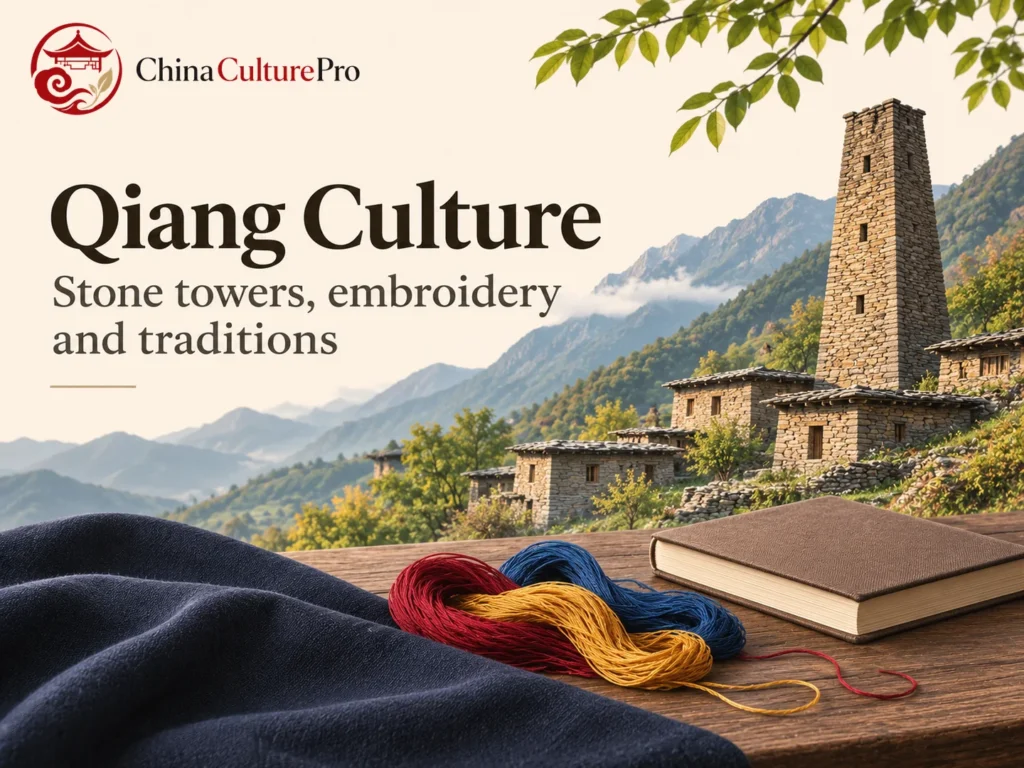
A stone tower rises above a village, while embroidery decorates an apron and singing gives movement to a circle of dancers. Each image points toward a different skill. Understanding its purpose and setting reveals more about Qiang culture than treating the images as one timeless scene.
Qiang Communities, Names and Language
Maoxian, Wenchuan, Lixian, Songpan, Heishui and Beichuan are important Qiang settlement areas. Rma(尔玛,Ěrmǎ)is one recorded self-designation. This geography places communities among mountain slopes and river corridors, with differing local histories. [1]
The modern ethnic category should be distinguished from every ancient use of the name Qiang. Historian Wang Ming-ke shows how early Chinese sources used that label broadly for western outsiders. A historical exonym cannot by itself establish an unchanged identity or one continuous genealogy for today’s population. [2]
The Qiang language(羌语,Qiāngyǔ)belongs to the Sino-Tibetan family, with northern and southern varieties and considerable local diversity. Many speakers also use Chinese. [1]
Randy LaPolla and Chenglong Huang’s 2003 grammar describes the Northern Qiang variety of Ronghong village in Maoxian. Its precise location matters: a detailed account of one variety is not a description of every community’s speech. Oral narratives, conversation and song need the same attention to local language. [3]
Stone Towers and Village Houses
Traditional diaolou(碉楼,diāolóu)served purposes including lookout, defense, signaling and storage. Their walls narrow as they rise, while timber beams and floors divide the interior. The Wenchuan building tradition entered the national intangible heritage list in 2011. [4]
| Architectural form | Main distinction |
|---|---|
| Tower | A tall structure historically associated with observation, defense, signaling and storage, sometimes combined with other uses. |
| Village house | A domestic building organized around living, working and storing household resources. |
Traditional houses often have stone walls and flat roofs, with internal levels serving different purposes. Towers may stand beside homes, and uses can overlap; their height alone does not explain every building. [4][5]
These forms belong within a wider cultural geography of terrain, available materials and settlement. They demonstrate skilled construction, but no traditional building type can be assumed immune to earthquakes. The condition and history of a particular structure still matter.
Embroidery, Clothing and Useful Objects
Qiang embroidery(羌绣,qiāngxiù)includes counted or cross-stitch work alongside several other stitches, including chain and flat embroidery. Floral, animal and geometric subjects appear in different arrangements. Black-and-white work and brighter colored designs are both documented. [6]
Aprons and yunyun shoes(云云鞋,yúnyúnxié)are especially recognizable objects. Dense stitching provides decoration and can reinforce areas exposed to wear. An embroidered garment therefore combines visual expression with practical use, rather than functioning only as a picture of a symbol. [6]
The Wenchuan embroidery tradition was nationally listed in 2008. That recognition concerns a transmitted craft. It does not create one compulsory outfit or authorize a universal meaning for every motif. The garment’s use, its maker, its locality and the occasion help explain a design. [6]
Flute Music and Salang Dance
The Qiang flute(羌笛,qiāngdí)uses two parallel bamboo pipes with reed components. It is commonly played solo, with breath control and finger movements shaping a layered sound. The Maoxian tradition of playing and making the instrument received national recognition in 2006. A modern instrument and an ancient poetic reference to a flute should not automatically be treated as identical objects. [7]
Salang(萨朗,sàlǎng)has a different musical setting. The song-dance described by Sichuan’s arts researchers uses singing without instrumental accompaniment and gives considerable attention to footwork. It appears at festivals, weddings and other gatherings, with its form adjusted to the occasion. [8]
Thus, a flute performance, a social circle dance and a ritual drum performance need not share one accompaniment or purpose. Learning these distinctions gives traditional music and performing arts their social context.
Qiang New Year and Ritual Knowledge
Qiang New Year(羌年,qiāngnián)is associated with the first day of the tenth lunar month. Community gatherings express gratitude, reverence and hopes for harmony between people and their surroundings. Household and village participation connect the occasion with intergenerational relationships. [9]
A shibi(释比,shìbǐ)is a traditional ritual specialist. Learned recitation and ceremonial performance are part of this role. The sheepskin-drum tradition, for example, has settings in spring mountain observances and new-year activities. This role should be distinguished from being a singer or dancer in a general public performance. [12]
In 2009, the festival entered UNESCO’s Urgent Safeguarding List. In 2024 it was transferred to the Representative List of the Intangible Cultural Heritage of Humanity. The decision recognized improved transmission and community participation, including links with education; it did not mean that every future safeguarding challenge had ended. [10]
These practices also belong to the broader diversity of religion in China. They describe inherited community traditions rather than obligations that can be presumed for every Qiang individual.
Heritage, Recovery and Everyday Life
The 2008 Wenchuan earthquake caused severe losses to communities, buildings and cultural transmission. Researcher Qiaoyun Zhang’s 2018 account examines subsequent heritage programs, including official recognition, support for practitioners and public celebrations. Recovery involved decisions about what to preserve and how it would be presented. [11]
Rebuilding a structure, recording a narrative and helping someone learn a skill are related but distinct tasks. A new stage presentation can provide visibility while changing the setting in which an audience encounters the tradition.
Everyday livelihoods also deserve attention. Maize, barley, wheat, beans and vegetables connect households with local farming and food culture. These ordinary activities show how cultural knowledge also belongs to fields, kitchens and family routines. [1]
FAQs About Qiang Culture
Is Qiang New Year Still on UNESCO’s Urgent Safeguarding List?
It was transferred to the Representative List in 2024. Descriptions that mention only the 2009 urgent inscription omit this later change. [10]
Do All Qiang People Speak the Same Variety?
No. Northern and southern varieties contain further local differences, and individual language use varies. A recording from one village should not be generalized to everyone. [1][3]
Are Qiang Towers and Houses the Same Building Type?
Their materials and uses can overlap, but tall towers historically served particular defensive and signaling purposes. Domestic houses have their own arrangements for living and work. [4][5]
Is Every Qiang Dance a Religious Ceremony?
No. Dances have social, festive, ceremonial and staged settings. A performance’s occasion helps explain its purpose and how participants understand it. [8][12]
Sources
[1] National Ethnic Affairs Commission. Qiang overview
[2] WangMingke. Making History While Being in History,inChasingTraces2024
[3] RandyLaPolla andChenglongHuang. A Grammar of Qiang
[4] China Intangible Cultural Heritage Network. Qiang tower building Wenchuan
[5] China Intangible Cultural Heritage Network. Qiang towers and dwellings
[6] China Intangible Cultural Heritage Network. Qiang embroidery
[7] China Intangible Cultural Heritage Network. Qiang flute playing and making
[8] Sichuan Arts Research Institute. Salang dance classroom
[9] UNESCO. Qiang New Year festival
[10] UNESCO Intergovernmental Committee. Decision19.COM7.c.2
[11] QiaoyunZhang. Heritage making after the earthquake
[12] China Intangible Cultural Heritage Network. Qiang sheepskin drum dance