

Quick Answer: Who Was Pu Songling?
Pu Songling (蒲松龄, Pú Sōnglíng; 1640–1715) was a Qing writer from Shandong, best known for Strange Tales from a Chinese Studio (聊斋志异, Liáozhāi Zhìyì). His working life included private tutoring, and his writing extended beyond the supernatural story collection.[1]
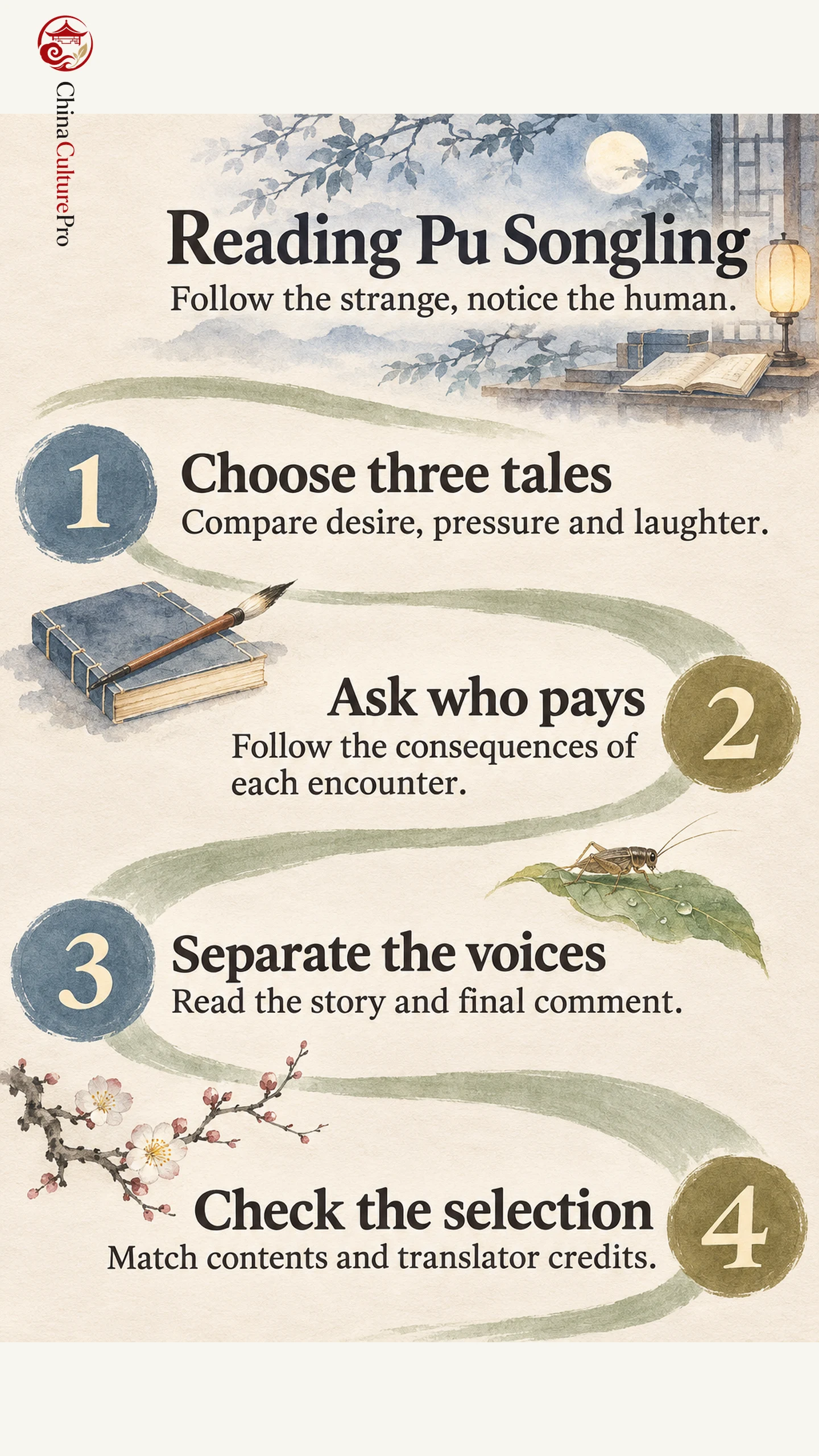
- For a first encounter: read three different stories rather than judging the whole collection by one ghost.
- For interpretation: ask what a strange event reveals about an ordinary human relationship.
- For an English edition: check which stories a selection includes and who translated them.
This guide introduces Pu as a writer and offers a reading route; it does not treat fantastic events as documented history.
The supernatural can attract a reader’s attention before the narration has done its quieter work. Who believes too readily? Who bears the consequences? Who gets the last word? Those questions let wonder and criticism coexist rather than forcing a choice between an entertaining tale and a serious one.
The Writer Behind the Strange Encounters
CUHK’s profile places Pu in the Qing cultural world, recording a brief period as a magistrate’s aide followed by work as a private tutor. It also notes his productivity in rustic songs (俚曲, lǐqǔ). The celebrated collection is his main English-language entrance, not his entire literary output.[1]
The imperial examination system provides useful background to scholarly aspiration and status. Use such context to frame a question rather than deciding that every disappointed character simply represents Pu himself. For the collection’s wider forms and contents, continue with the Strange Tales reading guide.
Three Representative Stories and Their Reading Questions
These entries identify three original tales, not plots borrowed from later films. Their different pressures make a useful first comparison.
| Story | Central reading question |
|---|---|
| Painted Skin (画皮, Huà Pí) | How does desire override warnings, and who must repair the damage?[3] |
| The Cricket (促织, Cù Zhī) | How can an imperial pastime become a household catastrophe?[4] |
| Yingning (婴宁, Yīngníng) | What changes when laughter meets household rules and grief?[5] |
Keep brief notes on a character’s first judgment and the information that later unsettles it. This makes comparison more useful than collecting three general morals before reading the stories.
Read the Human Stakes and the Final Comment
In Painted Skin, the wife’s difficult effort to recover her husband complicates a reading focused only on the monster. In Yingning, a laughing presence later weeps over the ghostly foster mother. Tenderness and distress disturb any simple division between frightening creatures and ordinary human feeling.[3][5]
The Cricket ends with prosperity after severe harm to a family. Read that resolution beside the pressures that produced it, rather than assuming a changed fortune cancels the earlier suffering.[4]
Also distinguish the tale’s action, the narrator’s final evaluation and a named later commentator’s notes. When a translation marks those voices separately, preserve the distinction in your own summary. A comment can guide interpretation without exhausting what an episode makes visible.
The fox-spirit tradition offers additional background for encounters that cross the boundary between human and nonhuman. Keep the individual story’s treatment in view instead of assigning every figure the same moral character.
Choosing an English Entry Point
- For an extensive modern selection: John Minford’s Strange Tales from a Chinese Studio contains 104 selected stories, according to Penguin. Its substantial size does not make it a complete translation of every tale.[2]
- For another translated selection: CUHK lists Selected Tales of Liaozhai, translated by Yang Hsien-yi and Gladys Yang and published by Chinese Literature in 1981.[1]
Before choosing, compare the contents with the stories you want. Keep the translator and identifying Chinese title in your notes: English story titles and romanizations may differ. Read any introduction and commentary as part of that edition’s interpretation, with a clear distinction between the editor’s account and the translated narrative.
FAQs About Pu Songling
Is Strange Tales a single continuous novel?
No. It is a collection of separate tales. A translation can select from it without following one continuous central plot.[1][2]
Are all the supernatural women dangerous?
Make the judgment story by story. Yingning combines laughter, dangerous trickery and tender attachment; assess acts and consequences rather than assigning a fixed moral label.[5]
Can a film adaptation stand in for the original story?
Use the film as its own work. To understand Pu’s narrative, compare the actual tale’s sequence, character judgments and ending. Shared names do not guarantee that a later adaptation preserves those choices.
Sources
[1] Chinese University of Hong Kong. Pu Songling
[2] Penguin Random House. Strange Tales from a Chinese Studio
[3] Pu Songling, Shidian Guji text. Painted Skin
[4] Pu Songling, Shidian Guji text. The Cricket
[5] Pu Songling, Wikisource text. Yingning, volume 2