

Quick Answer: Who Was Qian Zhongshu?
Qian Zhongshu (钱锺书, Qián Zhōngshū; 1910–1998) was a Chinese fiction writer, essayist and scholar, known especially for Fortress Besieged (围城, Wéichéng). English readers can approach his fiction, short prose and literary scholarship through different translated volumes.[1][4]
- For a sustained story: begin with his celebrated novel and follow its judgments about status and relationships.
- For shorter sessions: choose a collection of essays and stories.
- For literary scholarship: try a selected reading note and examine how its examples build an argument.
This guide separates those routes so that familiarity with one book need not become a judgment about his entire output.
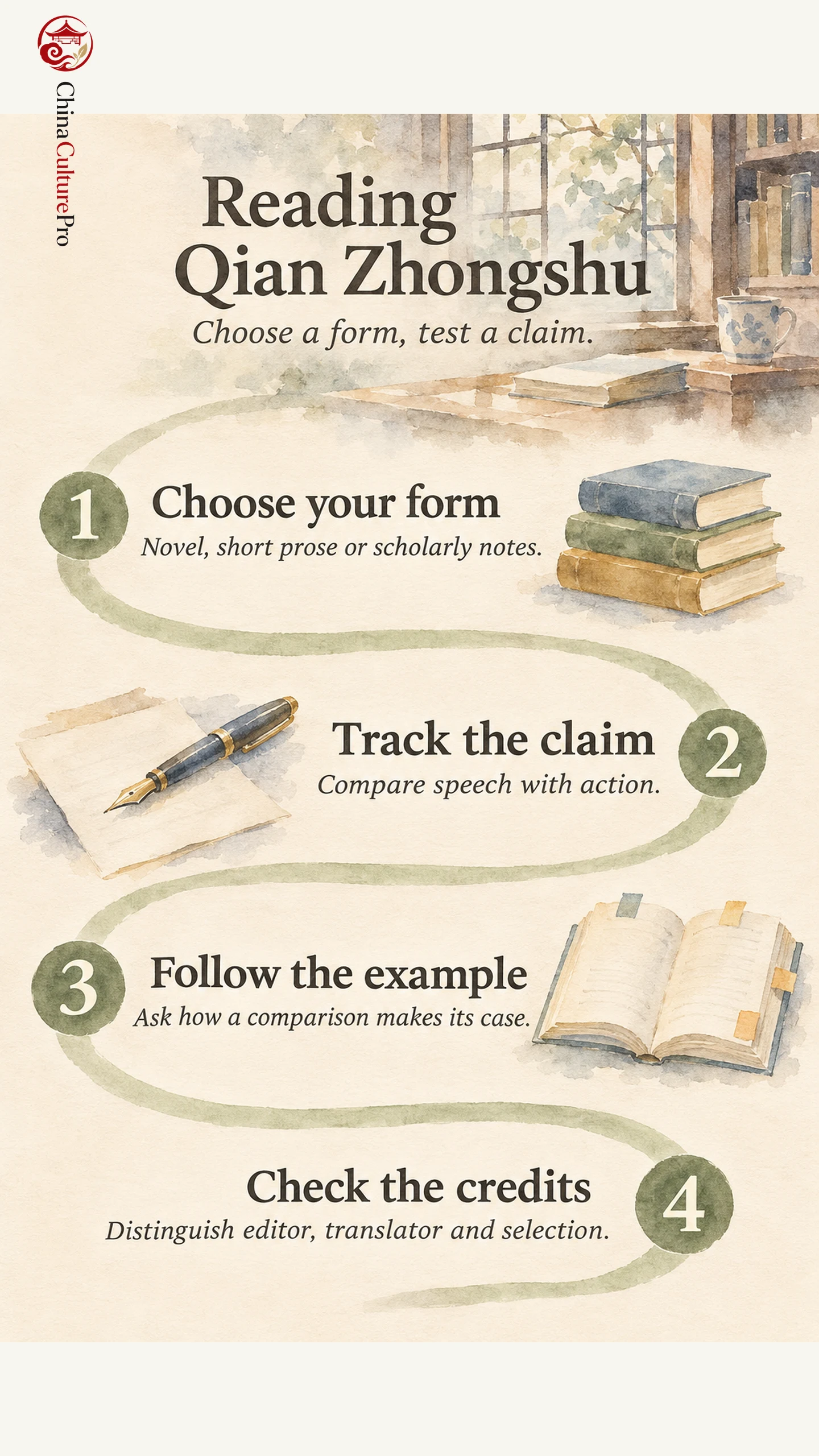
Qian’s place in modern Chinese literature becomes easier to explore when genre comes before reputation. Start by deciding whether you want narrative development, a compact intellectual provocation or a sustained comparison of texts. Then choose the corresponding work.
Four Major Works and Their Different Jobs
The original Chinese works below do not map one-to-one onto the English book titles in a catalogue. In particular, an English collection can combine material from two earlier books.
| Work | Form and useful entrance |
|---|---|
| Fortress Besieged (围城, Wéichéng) | A comic novel involving dubious credentials, academic employment and marriage.[1] |
| Written in the Margins of Life (写在人生边上, Xiě Zài Rénshēng Biānshang) | A 1941 essay collection that turns small subjects toward larger questions.[2] |
| Human, Beast, Ghost (人兽鬼, Rén Shòu Guǐ) | A 1946 collection of four short stories.[2] |
| Limited Views (管锥编, Guǎnzhuī Biān) | Essays and reading notes on early Chinese classics, available in a selected English translation.[3] |
Read Satire as a Test of Claims
New Directions’ synopsis introduces the novel’s returning student with a bogus foreign degree, then follows him into a university position and an unhappy marriage. Those situations give a first reader several kinds of claims to track: educational authority, professional standing and personal understanding.[1]
For a practical reading method, keep a short record of what a character says about an ability or relationship and what a subsequent action reveals. Include the speaker and the circumstances of each judgment. This is more precise than treating every witty sentence as Qian’s direct personal opinion.
The essay collection offers another scale of inquiry: Columbia’s contents include pieces on windows, happiness, laughter, eating and reading Aesop. The publisher emphasizes how apparently simple topics open questions about judgment and critical independence.[2]
A Different Kind of Reading in Limited Views
A publicly displayed opening from one translated note considers a horse painting whose legs have been damaged while its impression of movement remains. It offers a concrete entrance to the relationship between image and meaning. The example matters as part of an inquiry, not simply as an amusing anecdote.[3]
When reading such a note, mark the proposition, each example and the inference that connects them. Ask whether a comparison supplies evidence, proposes an analogy or changes the terms of the question. Background on Chinese literary allusions can help you recognize references while keeping Qian’s particular use of them in view.
Three English Starting Points
- For the novel: Fortress Besieged is translated by Jeanne Kelly and Nathan K. Mao. Confirm those credits rather than treating a new cover or introduction as a new translation.[1]
- For shorter fiction and essays: Humans, Beasts, and Ghosts: Stories and Essays, edited by Christopher G. Rea, combines the two earlier collections identified above. Translations are by Dennis T. Hu, Nathan K. Mao, Yiran Mao, Christopher G. Rea and Philip F. Williams.[2]
- For scholarship: Ronald Egan selected and translated 65 pieces for Limited Views: Essays on Ideas and Letters, published in 1998 by the Harvard University Asia Center.[3]
Read one substantial unit before changing routes. If an allusion or unfamiliar reference slows you down, note the unresolved point and test it against the surrounding argument. The wider Chinese literature guide provides a frame for moving among these different kinds of writing.
FAQs About Qian Zhongshu
Is Humans, Beasts, and Ghosts one original Chinese book?
The English volume combines essays from Written in the Margins of Life with the four stories of Human, Beast, Ghost. Its contents therefore span two original collections.[2]
Is Limited Views a complete English translation?
No. Egan’s volume selects 65 pieces from a much larger four-volume Chinese work. Check its scope before citing it as the whole original.[3]
Should Fortress Besieged be approached only as a marriage novel?
Marriage is one important setting, alongside academic employment and the performance of education and status. The publisher’s synopsis makes that wider social range clear.[1]
Sources
[1] New Directions. Fortress Besieged
[2] Columbia University Press. Humans, Beasts, and Ghosts: contents and credits
[3] Harvard University Asia Center, JSTOR. Limited Views: metadata and displayed chapter openings
[4] New Directions. Qian Zhongshu: author profile