


Quick Answer: Who Was Meng Jiao?
Meng Jiao (孟郊, Mèng Jiāo; 751–814) was a Tang poet whose English readership can explore both familiar short poems and ambitious late sequences. David Hinton’s The Late Poems of Meng Chiao opens a particularly challenging part of his work.[1]
- For an accessible beginning: compare a poem of maternal care with one of exam-day delight.
- For a different register: read the numbered late-poem excerpts available from Hinton.
- For sustained reading: follow images across a sequence rather than treating each excerpt as a complete author portrait.
This is an introduction to representative works and reading choices, not a claim that all his writing expresses one mood.
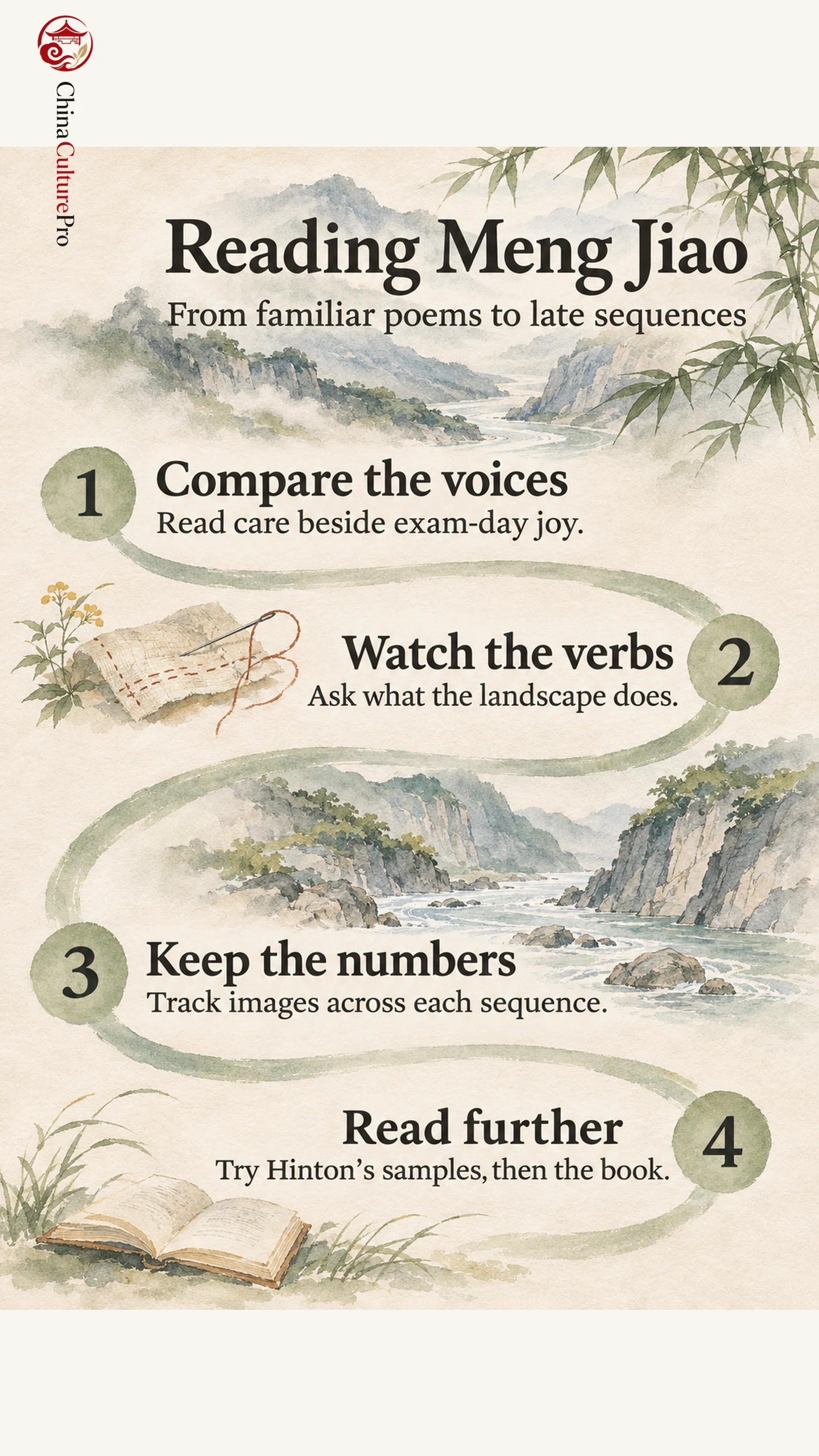
A familiar poem and a difficult poem need not require different standards of attention. In both, ask what the language makes concrete and how that detail changes your sense of the speaker. The contrast is a useful way into Meng’s range without turning his life into a diagnosis.
Four Works Beyond a Single Reputation
CUHK places Meng in the literary circle around Han Yu (韩愈, Hán Yù), noting unusual imagery, poverty as a subject and careful workmanship. This account supplies a context for difficulty; it does not require every line to be treated as an autobiographical confession.[2]
| Work | What to notice |
|---|---|
| The Wanderer’s Song (游子吟, Yóuzǐ Yín) | A mother’s sewing becomes a measure of care difficult to repay.[3] |
| After Passing the Examination (登科后, Dēng Kē Hòu) | A fast-moving horse and flowers register exhilaration after hardship.[4] |
| Laments of the Gorges (峡哀, Xiá Āi) | Hinton’s excerpts 3 and 9 turn water and constriction into threatening forces.[5] |
| Autumn Thoughts (秋怀十五首, Qiū Huái Shíwǔ Shǒu) | Excerpts 1 and 5 bring aging, sound and fragile bodily images together.[5][6] |
The first two titles identify individual poems. The later entries lead into sequences; their numbering is part of what an English reader should preserve when taking notes.
From Small Objects to Unsettling Landscapes
The sewing poem moves from thread and clothing to grass and spring sunlight. It gives filial gratitude a physical scale rather than merely stating a moral. Hinton’s gorge excerpts, by contrast, make waters cut and rage; scenery presses upon a vulnerable human presence.[3][5]
Try listing the verbs before assigning a label such as sentimental or obscure. Which objects act? What receives their action? Read a strange image twice: first as a physical impossibility, then as a way of organizing pressure or feeling. You do not need to reduce every unsettling detail to a hidden biographical event.
Reading a Sequence Without Flattening Its Voice
Hinton’s publisher describes the late selection in terms of large poetic sequences. That scale matters: a reader who sees only a single striking passage may miss the effect of recurrence and variation.[1]
Hinton’s Autumn Thoughts excerpts 1 and 5 both draw on thread imagery, connecting bodily vulnerability with a line that may fray.[5]
Make two brief columns in your notes: repeated image and changed function. Record a recurrence only after checking the wording, then ask whether its emotional force stays constant. Keep the sequence number beside each observation. This makes your account testable and lets a second reading revise the first rather than merely confirm a general impression.
The exam poem also offers a useful contrast with the late material. For the institution behind its occasion, consult the imperial examinations guide; return to the poem to study its particular speed and tone.
Finding Meng Jiao in English
- Sample before choosing: Hinton’s website displays four numbered excerpts from the two late sequences listed above. Read the pairs together.[5]
- Continue in a book: The Late Poems of Meng Chiao is translated by David Hinton and published by Princeton. The publisher identifies its focus as large late sequences, a different reading experience from a collection of isolated short lyrics.[1]
For a wider formal frame, use the Tang poetry reading guide. A translator’s strong English voice is also worth noticing: compare syntax and rhythm as well as the apparent meaning of individual images.
FAQs About Meng Jiao
Is Meng Chiao a different poet?
No. Meng Chiao is the romanization used in Hinton’s title for the poet identified here as Meng Jiao. Use both forms when searching a library catalogue.[1]
Does Autumn Thoughts identify the same work as Ma Zhiyuan’s lyric?
No. Meng’s sequence here is identified by its Chinese title and numbering. An English title alone is insufficient to locate a Chinese poem reliably.[6]
Does the late-poems volume contain everything Meng Jiao wrote?
No. The publisher describes a selection of his late sequences. Use its title as a scope statement rather than treating it as a complete collected works.[1]
Sources
[1] Princeton University Press. The Late Poems of Meng Chiao
[2] Chinese University of Hong Kong. Meng Jiao: author profile
[3] Meng Jiao, Wikisource text. The Wanderer’s Song
[4] Meng Jiao, Wikisource text. After Passing the Examination
[5] David Hinton. Authorized sample poems
[6] Chinese Text Project. Collected poems, Autumn Thoughts sequence