

Quick Answer: What Does Moonlit Night by Du Fu Mean?
In Moonlit Night by Du Fu (月夜, Yuè Yè), Du Fu (杜甫, Dù Fǔ) imagines his distant wife watching the moon and hopes for a time when they can stand in its light together. Wartime separation gives this intimate family poem its setting.[1][2]
- The viewpoint: The opening pictures the wife’s experience from the absent husband’s side of the separation.
- The children: Their limited understanding deepens the emotional meaning of her watching alone.
- The ending: Shared light and dried tear marks belong to a hoped-for future, introduced by “when?”
The wife’s scene is poetically imagined, and the reunion remains a wish within the poem.[1][3]
A man separated from his family begins by picturing his wife, not by describing his own room. She looks toward the same moon, while their children cannot fully understand her longing. Across eight short lines, separation becomes an act of imagining another person’s distress.
The Complete Poem and an English Sense Translation
The poem is a five-character regulated verse (五言律詩, wǔyán lǜshī): eight lines, each containing five Chinese characters. This guide’s English sense translation preserves the turn from an imagined present to a desired future.[1]
| Chinese text | English sense |
|---|---|
| 今夜鄜州月, | Tonight, the moon over Fuzhou (鄜州, Fūzhōu); |
| 閨中只獨看。 | in her chamber, she watches alone. |
| 遙憐小兒女, | From afar I think tenderly of the little children, |
| 未解憶長安。 | not yet understanding the longing for Chang’an (長安, Cháng’ān). |
| 香霧雲鬟濕, | Fragrant mist leaves her cloudlike coils of hair damp; |
| 清輝玉臂寒。 | in the clear radiance, her jade-white arms are cold. |
| 何時倚虛幌, | When shall we lean beside the sheer curtain, |
| 雙照淚痕乾。 | the light falling on us both, the marks of tears dry? |
Chang’an is where the poet is separated from his family. The children’s inability to understand remembering that place therefore has a personal meaning: their father is there.[2]
Two Places during the Rebellion
The poem belongs to autumn 756, during the An Lushan Rebellion (安史之亂, Ān Shǐ zhī Luàn). Du Fu was in rebel-held Chang’an while his family was at Qiang Village in the Fuzhou region. The details of his capture and movements are uncertain; a barred prison cell is not needed to explain the separation.[2]
This Fuzhou is associated with present-day Fu County in Shaanxi. It is not the southeastern city whose Chinese name is written 福州.[4]
The An Lushan Rebellion guide supplies the wider conflict. Here the war’s effect is concentrated into a family divided between two places, rather than a description of armies or a battlefield. The Du Fu guide places this family concern within his broader writing.
Why the Poem Begins with His Wife
The first line locates the moon above the family’s place, not above the poet’s own city. The second imagines the wife looking at it. He conveys his longing by asking the reader to inhabit the scene he pictures for her.[1][3]
This shift does not give him a witness’s knowledge of her exact actions. It makes concern for her loneliness a way of expressing his own. The feeling travels outward before returning to the question of being together.[1]
The Children and the Meaning of Being Alone
The children complicate the opening word “alone.” The poem acknowledges them immediately after imagining their mother’s solitary gaze. Her solitude need not mean that nobody else is in the house; it concerns an experience that the young children cannot yet share or understand.[1]
Nor does the poem accuse them of indifference. The tenderness of the father’s thought makes their limited understanding another source of sorrow. They are part of the family he misses, even though they cannot fully comprehend the separation.[1]
Damp Hair, Cold Arms and the Paired Lines
The middle couplet matches fragrant mist with clear radiance, hair with arms, and dampness with cold. Its balanced construction makes the imagined figure vivid through both appearance and physical sensation.[1]
Cloudlike hair and jade-white arms belong to an elevated poetic vocabulary for feminine beauty. In this family setting, such language gives the absent wife a tender immediacy. It is a stylized image, not a record of her actual hairstyle, complexion or clothing that night.[3]
Dampness and cold also let the reader feel exposure and duration. The poem does not need to count the hours she has watched; bodily sensations suggest how long and intensely the imagined vigil continues.[1]
From Watching Alone to Light on Both
The last couplet changes the poem’s time. “Tonight” becomes “when?” and watching “alone” becomes light shining on “both.” These paired changes carry the hope of reunion without giving it a date.[1]
Dry tear marks complete the desired scene. The image joins bodily closeness with relief from grief; it is not an explanation of moonlight physically drying water from skin. The question remains open at the poem’s end.[1]
For a different response to separation in the occupied capital, compare Spring View. The Chinese moon poetry guide offers a broader comparison of how a shared moon can connect people across distance.
How to Follow the Poem’s Shifting Perspective
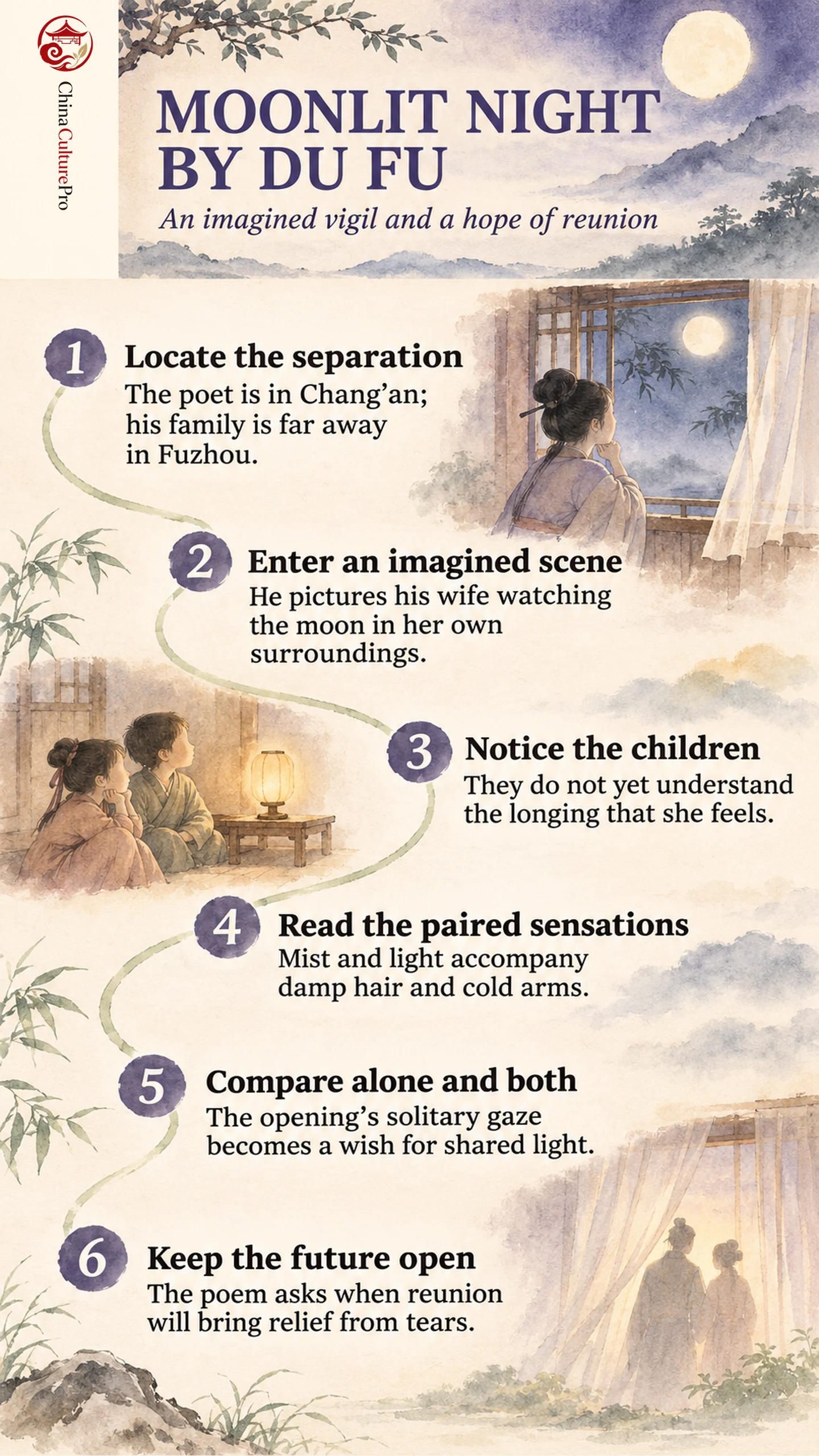
- Locate the separated family: Keep the poet’s city distinct from the place where his wife and children are staying.
- Identify the imagined scene: Read the wife’s watching as his projection of her experience, not a direct report.
- Notice the paired sensations: Follow mist and light through damp hair and cold arms.
- Compare opening and ending: Hear the change from tonight and alone to an unknown future and both.
FAQs About Moonlit Night by Du Fu
Is this a poem mourning a dead wife?
No. The poem concerns a living family separated by war and hopes for reunion. Its intimate imagery should not be confused with an elegy for a deceased spouse.
Are the children physically absent?
The poem does not say that they are absent from their mother’s surroundings. It emphasizes that they do not yet understand the longing involved in their father’s separation.
Does the final couplet describe an actual reunion?
It asks when shared moonlight and relief from tears will be possible. That makes the ending an imagined future, not a report that the couple has already met again.
Is the poem set in the Fujian city of Fuzhou?
No. Its place name is written 鄜州 and concerns the family’s refuge in the region of modern Fu County, Shaanxi. The Fujian city uses the different characters 福州.
Sources
[1] Du Fu. Yue Ye
[2] Stephen Owen. The Poetry of Du Fu, Volume 1, Poem 4.18 and Context, Pages 246–249
[3] 呂家慧, City University of Hong Kong; hosted by the Hong Kong Education Bureau. Du Fu’s Poetry and Human Relationships
[4] Fu County Local Gazetteer Office, Shaanxi. Annotated Fuzhou Gazetteer, Note on Qiang Village