


Quick Answer: What Does Magpie Bridge Immortal Mean?
Magpie Bridge Immortal (鵲橋仙, Què Qiáo Xiān) by Qin Guan (秦觀, Qín Guān) turns the annual lovers’ reunion associated with Qixi (七夕, Qīxī) into a reflection on the value and duration of love.[1][3]
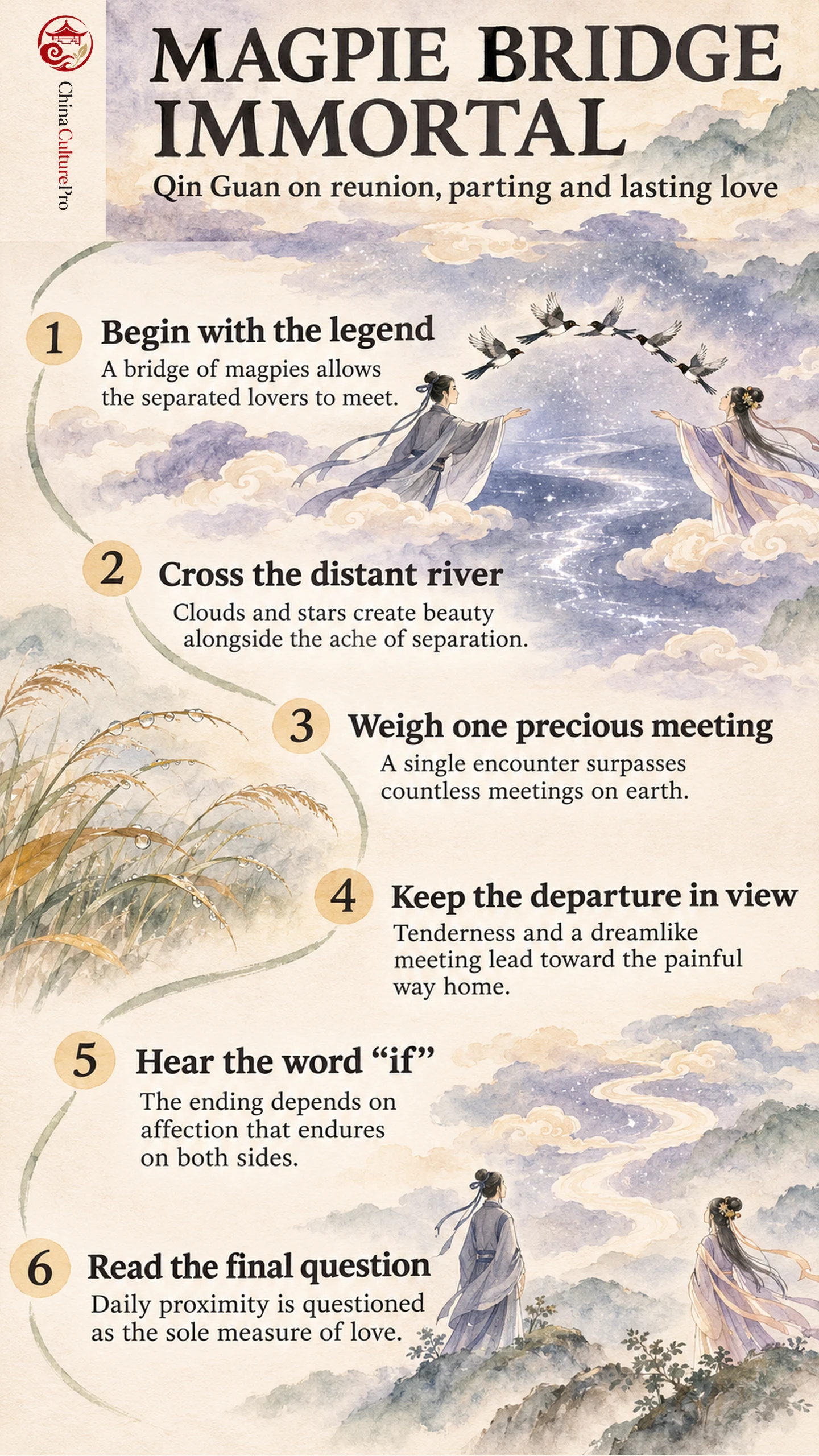
- The meeting: A single precious encounter is said to surpass countless encounters in the human world.
- The separation: Tenderness and dreamlike happiness do not remove the sorrow of the return journey.
- The final question: If mutual affection endures, must its worth depend on being together every morning and evening?
The ending affirms lasting attachment without making separation painless or guaranteeing that every distant relationship will last.[1]
One meeting can matter more than countless others. That bold claim gives this short lyric its first emotional peak, but the lovers must still part. Its famous ending gains force from the pain that comes immediately before it.
The Complete Lyric and an English Sense Translation
This ci (詞, cí), or song lyric, has 56 Chinese characters in two stanzas of 28. The complete text below includes the tenderness, dream and homeward bridge passage sometimes absent from short quotations. The English is a new sense translation for this guide.[1][2]
| Chinese text | English sense |
|---|---|
| 纖雲弄巧, | Fine clouds fashion delicate patterns; |
| 飛星傳恨, | flying stars convey the ache of parting; |
| 銀漢迢迢暗度。 | across the distant Silver River, a crossing in the dark. |
| 金風玉露一相逢, | One encounter amid autumn wind and luminous dew |
| 便勝卻人間無數。 | surpasses uncounted meetings in the mortal world. |
| 柔情似水, | Tender feeling is like water; |
| 佳期如夢, | the happy meeting seems a dream; |
| 忍顧鵲橋歸路。 | how bear to look toward the way home across the magpie bridge? |
| 兩情若是久長時, | If the affection of both can last, |
| 又豈在朝朝暮暮。 | why should it depend on every morning and every evening? |
The first five phrases form the upper stanza, and the remaining five form the lower stanza. The break comes after the comparison with the human world.[1]
The Lovers and the Bridge behind the Poem
The legend concerns the Cowherd (牛郎, Niúláng) and Weaver Girl (織女, Zhīnǚ). Magpies gather into a bridge across the heavenly river so that the separated lovers can meet at Qixi. Qin Guan assumes that background instead of retelling their entire story.[3]
The Cowherd and Weaver Girl guide explains the narrative behind the encounter, while the Qixi Festival guide supplies the wider seasonal and festival setting.
Within the lyric, distance matters before the lovers meet. The repeated sense of remoteness in the river’s description makes the crossing an achievement. Yet the same bridge that enables reunion also provides the route away. A place of connection becomes a reminder of the next separation.[1]
How One Meeting Outweighs Countless Others
The opening clouds suggest delicate pattern-making, while the stars carry sorrow across a vast space. Beauty and longing appear together; the sky is not merely a decorative backdrop to an uncomplicated celebration.[1]
The expression jinfeng yulu (金風玉露, jīn fēng yù lù), literally golden wind and jade dew, evokes autumn scenery. The colors lend the encounter a clear, precious atmosphere. They do not describe gold blowing through the air or literal jade falling from the sky.[1][4]
Then the lyric changes from scene-setting to judgment. “One” meeting is weighed against “uncounted” meetings on earth. Quantity loses to the quality of this encounter. The poem gives no account of particular unhappy human couples; it makes its comparison through compression and exaggeration, not through a catalogue of failed marriages.[1]
Why the Return Journey Still Hurts
The lower stanza begins with two comparisons: feeling is like water, and the happy occasion is like a dream. Water suggests flowing tenderness, while the dream image makes the meeting seem difficult to hold. The next phrase brings the route home into view.[1]
“How bear to look” gives the departure its emotional cost. Without this moment, the closing assertion might sound effortless. With it, the reader sees affection being tested by the need to leave. The poem has room for both a confident judgment about love and an unwillingness to part.[1]
This is not a narrative in which the lovers abolish the barrier and remain together forever. The power of the meeting coexists with the continuing conditions of their separation.[1][3]
The Last Question: Enduring Love and Daily Togetherness
The closing sentence begins with “if.” It asks what follows when the affection of both people truly lasts. The qualification involves mutual attachment, not one person’s determination alone.[1]
The last phrase moves from the extraordinary annual encounter to the ordinary repetition of mornings and evenings. It challenges daily proximity as the sole measure of love. The question does not diminish the value of everyday companionship.[1]
The two stanza endings therefore answer each other. The first revalues the number of meetings; the second revalues continual togetherness. For the poet’s wider themes and career, see Qin Guan.
How to Read the Two Stanzas Together
- Establish the legend: Identify the heavenly river and the bridge as the setting for an exceptional reunion.
- Notice the first judgment: Follow the shift from clouds and stars to one meeting outweighing countless others.
- Keep the departure: Read the tenderness and homeward route before moving to the famous final couplet.
- Preserve the condition: Hear “if” and the affection of both people before interpreting the last question.
FAQs About Magpie Bridge Immortal
Is Magpie Bridge Immortal a poem or a song?
It is a ci lyric written to an established tune pattern. The surviving words can be read as poetry; the tune title identifies a form that other writers could also use. The Song ci poetry guide explains this relationship between words and pattern.[5]
Does golden wind and jade dew name a solar term?
The expression evokes autumn wind and dew. It does not fix the poem to the specific White Dew solar term or supply a modern calendar date.
Was Qin Guan writing about a particular lover?
The lyric names no historical recipient and gives no composition date. A story identifying a particular lover needs independent evidence rather than the famous closing couplet alone.
Does the poem say separation is better than being together?
No. It values an enduring mutual bond beyond continual proximity, while allowing the departure to remain painful. The argument concerns the worth of affection, not the superiority of distance.
Sources
[1] Qin Guan. Que Qiao Xian
[2] Hong Kong Education Bureau. Que Qiao Xian: Reference Text
[3] Ministry of Education, Taiwan. Que Qiao: Magpie Bridge
[4] Ministry of Education, Taiwan. Jinfeng Yulu
[5] Global Medieval Sourcebook, Stanford University. As If in a Dream: Introduction to Ci