
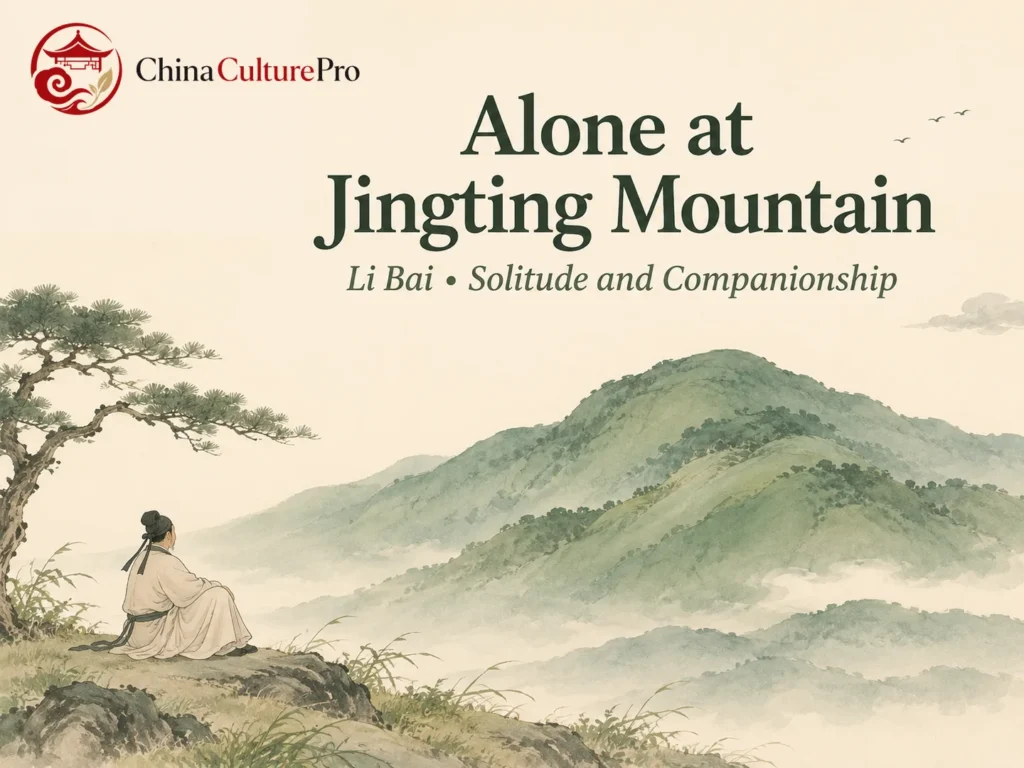

Quick Answer: What Does the Poem Mean?
Sitting Alone on Jingting Mountain (獨坐敬亭山, Dú Zuò Jìngtíng Shān) by Li Bai (李白, Lǐ Bái) turns a solitary view into an imagined relationship between the person watching and the mountain watched.
- Departure: Birds fly out of sight, and the lone cloud moves away at ease.
- Attention: The speaker stays with the scene long enough for those departures to register.
- Companionship: Person and mountain seem to look at one another without growing weary.
This five-character quatrain (五言絕句, wǔyán juéjù) contains four lines and twenty Chinese characters. Solitude remains present, but it is reshaped by a sense of enduring companionship.[1]

Birds disappear into the height, and a cloud drifts away. The scene grows quieter, but the poem does not finish with an empty world. Its last two lines discover a companion in the mountain that remains before the speaker.
The Complete Poem and an English Sense Translation
The following is the complete received text, with an original English sense translation. The spelling 閑 has the same sense here as the commonly printed 閒.[1][2]
| Chinese text | English sense |
|---|---|
| 衆鳥高飛盡, | The flock climbs high until it disappears. |
| 孤雲獨去閑。 | A single cloud goes drifting away at ease. |
| 相看兩不厭, | We look on one another, neither growing weary. |
| 只有敬亭山。 | Only Jingting Mountain remains. |
“Neither” anticipates the final identification: the two are the speaker and the mountain. “At ease” describes the cloud’s unhurried movement, while “growing weary” concerns the sustained gaze.
Jingting Mountain and the Poem’s Quiet Setting
Jingting Mountain (敬亭山, Jìngtíng Shān) is near Xuancheng (宣城, Xuānchéng), in Anhui (安徽, Ānhuī). Jingting is the mountain’s name; the final phrase should not be split into an unnamed mountain and a pavilion.[2]
The Li Bai guide places the poem within his wider writing. Here, the narrow scene needs only a departing flock, a cloud, the mountain and the watcher. The four lines leave the exact date and viewing position unstated.
Birds and a Cloud Leave the View
The birds do more than fly high: they disappear from sight. Then even the single cloud goes away. The change from a flock to one cloud gradually reduces the movement occupying the sky.[1]
That sequence makes stillness something experienced over time. The speaker has continued looking while the view changes. The quiet emerges through sustained observation.
The departing cloud is unhurried. Its ease contrasts with the more concentrated human attention that follows. Their movements open space around the relationship that remains.
The Mountain Becomes a Companion
The mutual gaze (相看, xiāng kàn) changes the mountain from a viewed object into an imagined participant. The speaker looks at it, and the poem lets it seem to look back. This is personification, giving a natural feature the role of a companion.[1][2]
The next phrase denies weariness on both sides. It means that neither tires of looking, rather than that both remain dissatisfied. The relationship is sustained through attention; no conversation or promise is needed.
Naming the mountain only at the close gives that relationship its final shape. The reader first encounters the “two,” then learns exactly who remains with the watcher. The title’s aloneness has acquired a different emotional texture.
For related ways landscape becomes part of human experience, see the guide to Chinese nature poetry. This poem offers an especially compact example through its movement from departure to companionship.
How to Read Departure and the Mutual Gaze
- Follow what leaves: Read the disappearance of the birds before the cloud’s departure.
- Feel the duration: Notice that the watching continues while movement diminishes.
- Identify the two: Pair the speaker with the mountain in the reciprocal looking.
- Return to the title: Consider how the ending changes what being alone feels like within the poem.
FAQs About Sitting Alone on Jingting Mountain
Who are the two looking at each other?
They are the speaker and Jingting Mountain. The mountain is personified as a companion; the line does not introduce a second human observer.[1]
Does the cloud remain above the mountain?
The poem says that the cloud goes away. It is part of the departing movement that leaves the speaker’s attention concentrated on the mountain.[1]
Does the poem place the speaker on the summit?
The title presents solitary sitting at the mountain, while the body describes looking toward it. The four lines do not identify a precise summit seat or a verifiable viewing spot.
Sources
[1] Li Bai; Chinese Wikisource. Sitting Alone on Jingting Mountain
[2] Hong Kong Education Bureau. Classical Poetry Reading Materials: Sitting Alone on Jingting Mountain