
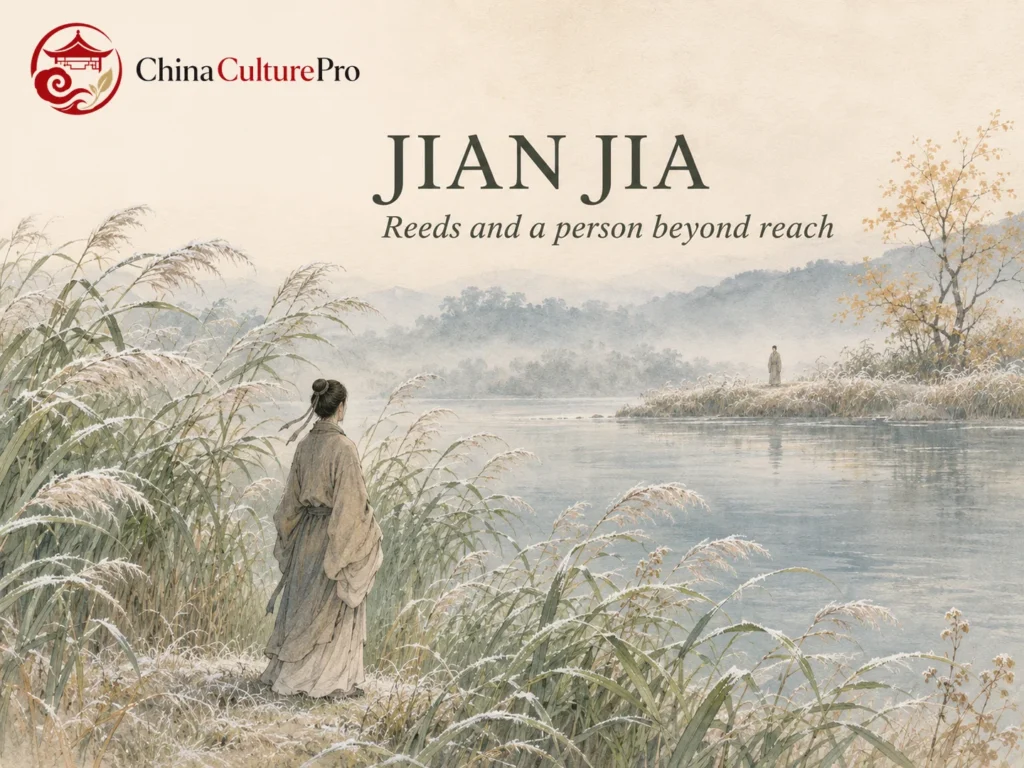

Quick Answer: What Does Jian Jia Mean?
Jian Jia (蒹葭, Jiānjiā), often translated as “Reeds,” is an anonymous poem from the Book of Songs (詩經, Shījīng) about seeking someone who remains beyond reach. Its three stanzas return to the same waterside scene with small changes.[1]
- The person: The speaker’s longing is clear, while the other person’s identity is left open.
- The landscape: Reeds, frost and water make distance something the reader can picture and feel.
- The pattern: Repeated attempts sustain desire without producing a reunion.
A love-poem reading is natural; a named couple and a successful ending are additions to the text.
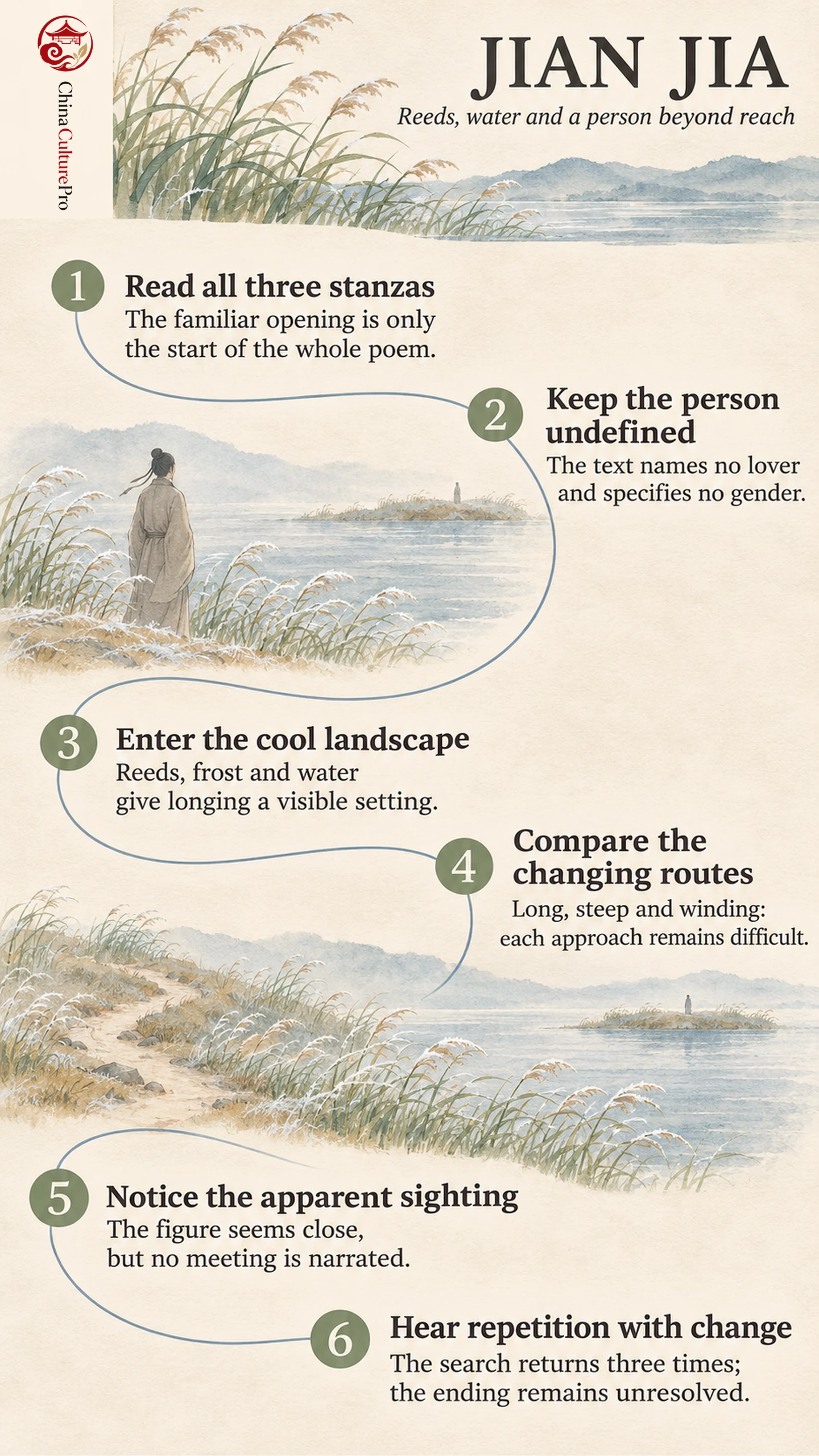
The famous opening about someone beyond the water belongs to a three-stanza poem. Reading the whole piece lets you hear how its recurring phrases work: familiar sounds return, while the route and the apparent location change.
The Complete Poem and an English Sense Translation
The poem belongs to the Airs of Qin (秦風, Qín Fēng), a regional section of the Book of Songs. The received text has three stanzas of eight lines each. Most lines have four characters; each stanza’s final line has five. The translation below gives an original English sense rendering of all three stanzas.[1]
| Stanza | Chinese text | English sense |
|---|---|---|
| 1 | 蒹葭蒼蒼,白露為霜。 所謂伊人,在水一方。 溯洄從之,道阻且長。 溯游從之,宛在水中央。 | Dense grow the blue-green reeds; pale dew has become frost. The one I mean is there, across the water. I follow upstream; the way is blocked and long. I follow downstream; they seem to be amid the water. |
| 2 | 蒹葭萋萋,白露未晞。 所謂伊人,在水之湄。 溯洄從之,道阻且躋。 溯游從之,宛在水中坻。 | Thick grow the reeds; the pale dew has not dried. The one I mean is there, beside the water. I follow upstream; the way is blocked and steep. I follow downstream; they seem to be on an islet in the water. |
| 3 | 蒹葭采采,白露未已。 所謂伊人,在水之涘。 溯洄從之,道阻且右。 溯游從之,宛在水中沚。 | Abundant grow the reeds; the pale dew still lingers. The one I mean is there, at the water’s edge. I follow upstream; the way is blocked and winding. I follow downstream; they seem to be on a small island in the water. |
“Upstream” and “downstream” follow a traditional explanation of the paired movements. They convey changed attempts to approach, rather than instructions for locating a particular river crossing.[2]
Who Is the Person across the Water?
The expression “that person” (伊人, yīrén) singles out someone important to the speaker without naming them. Neither person’s gender is specified. English versions using “she,” “he” or “beloved” therefore make interpretive choices; “they” here keeps that uncertainty visible.
The poem readily supports a romantic reading: sustained attention, frustrated approach and an absorbing image of another person all belong to the language of longing. It can sit alongside other Chinese love poems without requiring a recoverable courtship story.[3]
Interpretation has also followed other paths. The traditional preface connects the poem with criticism of a Qin ruler’s failure to use Zhou ritual. Centuries later, Zhu Xi (朱熹, Zhū Xī) explains the repeated unsuccessful search but acknowledges that its precise referent is unknown. These are different layers of reception, not proof that the original speaker meant one identifiable political figure.[1][2]
Reeds, Frost and the Distance That Persists
The opening places longing in a cool, thickly vegetated waterside setting. The dew and frost suggest autumn chill; they need no fixed dictionary in which reeds always mean one virtue and water always means one emotion.[3]
Here water has a concrete role: it separates an observer from someone they want to reach. The difficult route extends that separation into effort. The person can seem close to sight while remaining inaccessible to movement.
The recurring word translated “seem” matters. Each stanza closes with an apparent location amid the water or on an islet. The poem does not confirm that someone has physically run from one island to another. Its language allows the uncertainty of a searching gaze to remain.[1][2]
What Changes across the Three Stanzas?
Each stanza follows the same sequence: reeds and dew, the desired person, a difficult approach, then an apparent sighting. Changes within that frame prevent repetition from becoming an exact restart.
The route becomes long, then steep, then winding. The dew changes from frost to moisture that has not dried and still lingers. These shifts can make the search feel prolonged, though they do not provide a precise timetable from one recorded minute to the next.[1][3]
The closing locations become more particular, yet a clearer imagined position brings no actual meeting. That is the poem’s persistent tension: more attention and renewed effort do not settle the distance. Compare Guan Ju for another early poem that uses repeated language to explore longing, while following a different emotional movement.
How to Read the Repeated Search
- Read one complete stanza: Notice the movement from the surrounding scene to a person and an attempted approach.
- Mark the altered words: Compare the road descriptions and each stanza’s final location.
- Listen for uncertainty: Keep “seem” distinct from a confirmed encounter.
- Return to the last line: Ask what remains unresolved after the third attempt, then explore other forms through the Chinese poetry guide.
FAQs About Jian Jia
Who wrote Jian Jia, and when?
Its individual author is unknown. It survives in the Qin regional collection of the Zhou-era Book of Songs. A precise composition year cannot be recovered from the poem itself.
Is the white dew a reference to the Bailu solar term?
The words “white dew” (白露, báilù) describe the poem’s moisture and frost. They also name the Bailu White Dew solar term, but the shared wording does not establish an exact calendar date for this scene.
Does the speaker finally reach the other person?
No meeting is narrated. The final stanza ends with an apparent sighting on a small island, leaving the search unresolved rather than announcing success or permanent separation.
Sources
[1] Book of Songs. Jian Jia: received text and traditional preface
[2] Zhu Xi. Collected Commentary on the Book of Songs, volume three: Jian Jia
[3] Yin Jianzhang and Xiao Yuexian. Analysis of Jian Jia, hosted by the Hong Kong Education Bureau