

Quick Answer: What Is Guan Ju About?
Guan Ju (關雎, Guān Jū), often translated as The Ospreys, opens the Shijing (詩經, Shījīng), or Book of Songs. Its unnamed speaker longs for a woman described as a suitable partner.[1]
- Emotional movement: Admiration becomes sleepless yearning, followed by images of musical companionship and celebration.
- Poetic method: Repeated phrases return with small changes, allowing feeling to develop within a recognizable pattern.
- Cultural importance: Later readers treated the song as a model of feeling expressed with measure.
Read beyond the famous opening: the sleepless middle changes how the final sounds of celebration are heard.

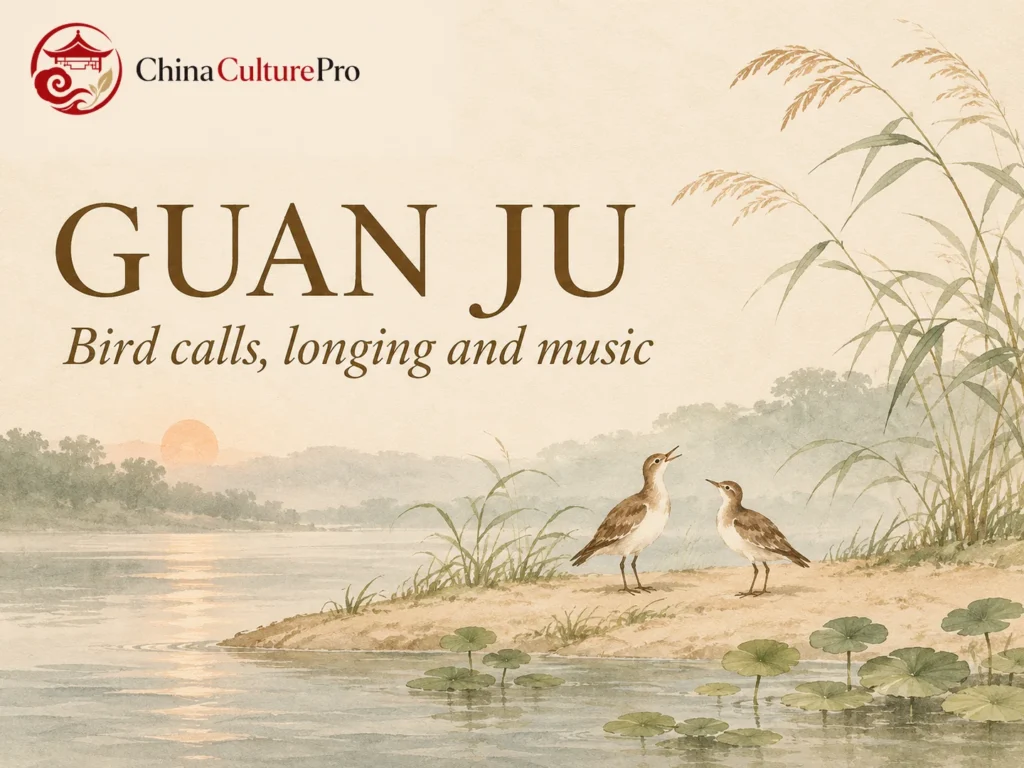
Calling birds open the scene, but a sleepless human heart soon takes its place. The first poem in the Book of Songs makes desire audible through recurring phrases, then changes the imagined soundscape from a river island to strings, bells and drums.
The Complete Poem and an English Sense Translation
The anonymous song belongs to the Zhounan (周南, Zhōunán) section. Its 80 Chinese characters form 20 four-character lines. The five reading blocks below keep the recurring patterns visible; some editions group the same text into three stanzas.[1][5]
This original English rendering follows the Chinese sense rather than reproducing a modern translator’s rhyme. Junzi (君子, jūnzǐ), rendered as “gentleman,” carries social and ethical associations beyond simply “a man.”
| Chinese text | English sense |
|---|---|
| 關關雎鳩,在河之洲。 窈窕淑女,君子好逑。 | Guan-guan, the waterbirds call from an island in the river. A woman graceful and good: a fitting companion for a gentleman. |
| 參差荇菜,左右流之。 窈窕淑女,寤寐求之。 | Water plants, uneven in length: reach for them to left and right. That woman, graceful and good: awake and asleep, he seeks her. |
| 求之不得,寤寐思服。 悠哉悠哉,輾轉反側。 | He seeks her, yet cannot find fulfillment; awake and asleep, she fills his thoughts. So long, so long the longing: he turns this way and that. |
| 參差荇菜,左右采之。 窈窕淑女,琴瑟友之。 | Water plants, uneven in length: gather them to left and right. That woman, graceful and good: with qin (琴, qín) and se (瑟, sè) zithers, he would draw close to her. |
| 參差荇菜,左右芼之。 窈窕淑女,鐘鼓樂之。 | Water plants, uneven in length: select them to left and right. That woman, graceful and good: with bells and drums, he would bring her joy. |
The conditional “would” in the final blocks makes the imagined reading explicit. The original does not mark English-style verb tense, so the translation leaves room for interpretation rather than supplying a dated sequence of events.
Bird Calls, Water Plants and Repeated Phrases
The title takes characters from the opening bird call. The jujiu (雎鳩, jūjiū) are waterbirds conventionally called ospreys in English translations. Traditional explanation connects their pairing with human partnership; this is a literary association, not a scientific claim about one species’ relationships.[3]
This opening illustrates xing (興, xìng): an external image initiates a poem’s feeling. The birds are heard before desire is stated. Their responsive calls let the idea of companionship enter through a scene rather than an explanation.[2]
The xingcai (荇菜, xìngcài) are aquatic plants, often called floating-heart in English. Their uneven growth and the repeated reaching to either side provide a pattern that returns around the speaker’s restless thoughts. The changing plant verbs—seeking, gathering and selecting in this rendering—keep repetition from becoming static. They need not describe three separately observed visits to the river.
That effect also makes Jian Jia a useful companion reading: both songs return to waterside images while desire remains difficult to satisfy.
From Sleepless Longing to Music and Celebration
The middle block interrupts the plant refrain. Seeking has not brought fulfillment, and the body registers that lack by turning repeatedly in bed. The stretched expression of longing slows the poem at its most inward point.
When the plants return, music changes what the speaker imagines doing. The two zithers suggest drawing close; bells and drums enlarge the sound into celebration. The movement is from solitary wakefulness toward a relationship that could be shared and acknowledged.
The guqin guide introduces the later tradition of one of these instruments. It should not lead us to picture every detail of a later scholar’s seven-string instrument as a reconstruction of this early song’s performance.
Nothing in the verse gives the woman a reply or narrates a completed wedding. Its emotional resolution may lie in imagining harmonious companionship. Preserving that distinction makes the ending more interesting than a simple report that persistence succeeded.
Why Confucian Readers Valued This Love Poem
Confucius (孔子, Kǒngzǐ), in the Analects (論語, Lúnyǔ) 3.20, praises the song’s joy without excess and sorrow without injury.[4] The judgment values a balance of feeling; it does not deny that the poem contains desire and distress. The Analects reading guide provides the wider philosophical context.
The Mao Preface (毛詩序, Máo Shī Xù) gives the poem a more explicit public meaning, connecting it with the queen consort’s virtue and proper relations between spouses.[1] That is evidence of an influential interpretive tradition, not a name or political program stated in the song itself.
These readings help explain why a brief poem of longing could stand at the entrance to a classical anthology. Readers could hear an intimate wish and also debate the relation between emotion, marriage and social order.
How to Read Guan Ju Aloud and Follow Its Changes
- Hear the opening before explaining it: Let the repeated bird call establish the expectation of an answering voice.
- Mark each return of the plants: Compare the changing verbs instead of treating the passages as identical refrains.
- Pause at the sleepless centre: Notice where recurring scenery gives way to a body that cannot settle.
- Listen to the expanding music: Follow strings into bells and drums while keeping imagined fulfillment distinct from a documented event.
This close attention to recurring words is useful throughout the Chinese poetry collection.
FAQs About Guan Ju
Who wrote Guan Ju?
Its author is unknown. It is an anonymous early song preserved in the Book of Songs; later Confucian discussion does not make Confucius its author.[1][4]
Does the poem have three stanzas or five?
Both arrangements occur. Five four-line blocks can be grouped into three larger stanzas of four, eight and eight lines. The complete text still contains 20 four-character lines.[2][5]
Does the ending prove that the couple married?
No. Strings, bells and drums suggest hoped-for companionship and celebration, but the verse does not explicitly recount a wedding. Reading the ending as imagined fulfillment preserves that uncertainty.[1]
Sources
[1] Anonymous. Guan Ju and the classical Mao Preface: original texts
[2] Tan Huiyun and Zeng Yongcong, published by Hong Kong Education Bureau. Using recommended texts: Guan Ju teaching examples, pages 27–31
[3] Taiwan Ministry of Education. Revised Mandarin Chinese Dictionary: jujiu
[4] Analects. Book Three, section 20: classical text
[5] James Legge, 1871 translation, reproduced by Ruism. Classic of Poetry, Ode 1: three-stanza text arrangement