


Quick Answer: What Does South Village Mean?
South Village (題都城南莊, Tí Dūchéng Nán Zhuāng) by Cui Hu (崔護, Cuī Hù) contrasts a remembered encounter with a return to the same place, where peach blossoms bloom but the familiar person is missing.
- Then: A face and peach blossoms reflected one another’s redness.
- Now: The speaker does not know where that person has gone.
- Effect: Flowers “smiling” in the spring wind make the human absence more poignant.
The full title can be rendered “Written at a Village South of the Capital.” The poem is a seven-character quatrain (七言絕句, qīyán juéjù): four lines and 28 Chinese characters. Its associated love story adds events the verses themselves do not tell.[1][2]
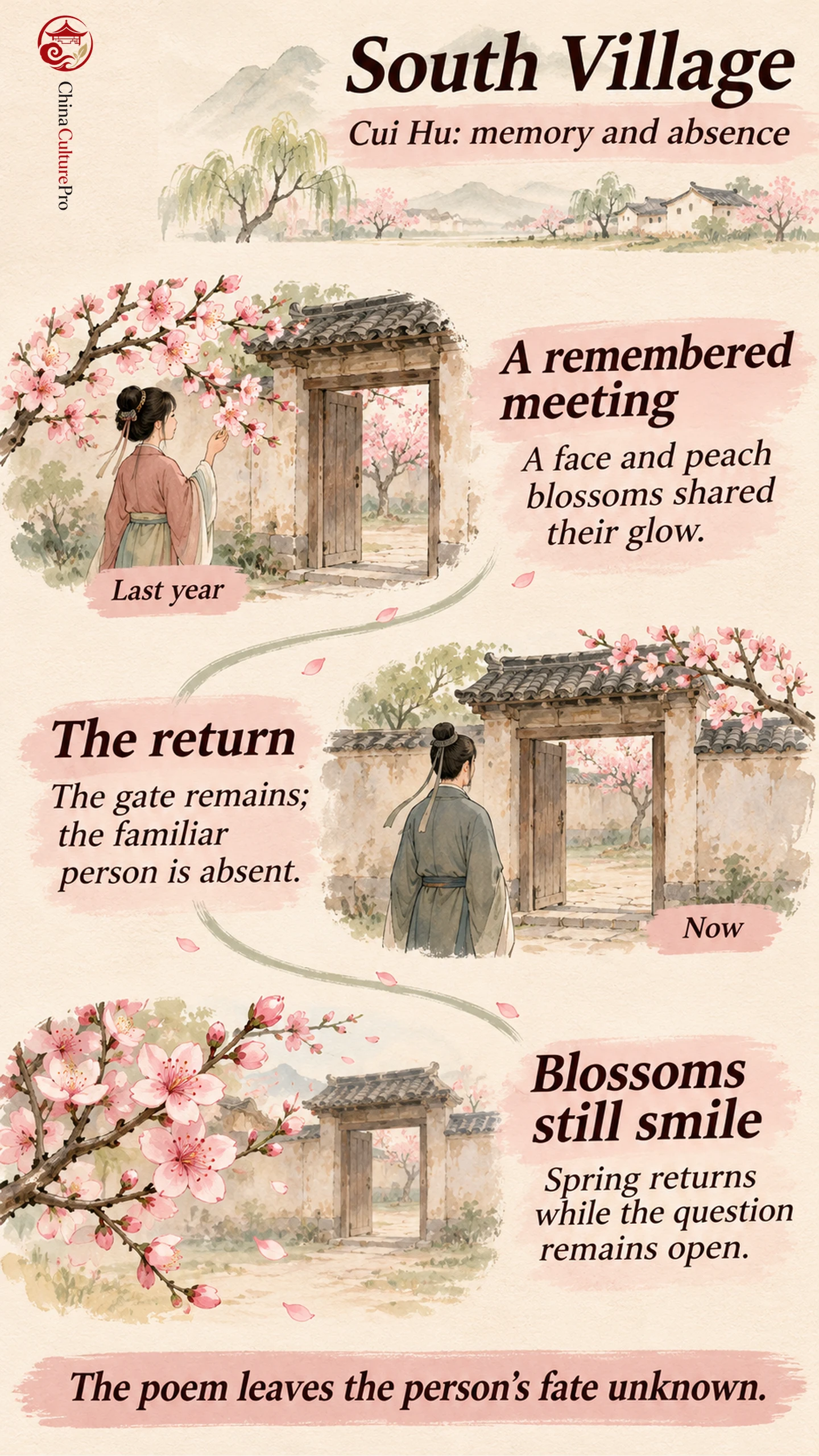
A gate and a season return, but the person remembered there does not. This short poem places a face beside peach blossoms, then lets the flowers remain in view after the face has disappeared. Its small scene leaves the reason for that absence unresolved.
The Complete Poem and an English Sense Translation
The English below is an original sense translation. The Chinese follows the received 不知, “do not know,” and 去, “gone,” readings; other editions preserve variants in the third line.[1][2]
| Chinese text | English sense translation |
|---|---|
| 去年今日此門中, | Last year, on this very day, within this gate, |
| 人面桃花相映紅。 | a face and peach blossoms reflected each other’s red. |
| 人面不知何處去, | That face—I do not know where it has gone; |
| 桃花依舊笑春風。 | the peach blossoms still smile in the spring wind. |
“A face” stays close to the Chinese rather than supplying a personal name. The traditional reading understands a young woman, but the poem does not give her name or narrate a conversation.[1][2]
One Gate, Two Moments
“Last year,” “this day” and “this gate” establish the remembered encounter through specific coordinates. The speaker is looking back from a return, so the opening already holds two moments together: the earlier meeting and the act of remembering it.[1]
The second line places the face and blossoms in a reciprocal relation. Each seems to give color to the other. The person is remembered through the scene rather than through a catalogue of features.
The third line repeats “face,” but the relation has broken. Where there was a shared image, there is now an unanswered question about location. Returning to the place and season cannot recover the encounter.
Why the Blossoms Still Smile
The final line repeats the other element of the earlier pair: peach blossoms. Both images return in the wording, but only the flowers return in the scene. That difference makes the poem’s structure carry the loss.[1]
“Still” means the blossoms appear as before. It does not require the same individual flowers to have survived for an entire year. The return of spring can resemble continuity while a particular human meeting remains unavailable.
Calling the flowers’ opening a smile brings a human expression back into the scene without bringing back the person. It can make their beauty feel tender and painful at once. The broader peach symbolism guide distinguishes such blossom imagery from other uses of the fruit and tree.
The Love Story and the Idiom It Inspired
A traditional anecdote reproduced alongside the received text tells of Cui Hu asking a woman for water, then returning at Qingming (清明, Qīngmíng) the following year and leaving this poem when she is absent. Its extended ending gives her her apparent death from grief, his return, her revival and their marriage. These are events of the anecdote, not a conclusion contained in the four lines.[1]
The poem also gave rise to renmian taohua (人面桃花, rénmiàn táohuā), “a face and peach blossoms.” The idiom can describe a woman’s beauty, and it can express the sadness of a familiar scene remaining while human circumstances have changed.[3]
For companion readings about attachment and separation, the Chinese love poems guide offers a wider selection. This poem’s distinctive force lies in how little it tells us about the missing person’s fate.
How to Read the Poem’s Returning Images
- Mark the coordinates: Notice the repeated day and gate before supplying a backstory.
- Hold the pair together: Read the face and blossoms as a single remembered image.
- Follow their repetition: Observe how each returns in the second couplet with a different status.
- Keep the absence open: Separate what the poem leaves unknown from the anecdote’s later ending.
FAQs About South Village by Cui Hu
Does the poem say the woman has died?
No. Its third line says the speaker does not know where the person has gone. The death-and-revival episode belongs to the associated story.[1]
Is South Village a precise modern address?
The title places a village or estate south of the capital. It does not provide enough information to identify a particular surviving gate or modern sightseeing stop.[1][2]
Are the peach blossoms mocking the speaker?
“Smile” personifies their blooming. The contrast can sharpen the speaker’s sadness without requiring the flowers to have a deliberate, cruel intention.[1]
Sources
[1] Cui Hu; Chinese Wikisource. Ti Ducheng Nanzhuang, with the Traditional Anecdote
[2] University of Geneva, Poésie Tang. Cui Hu: Ti Ducheng Nanzhuang
[3] Taiwan Ministry of Education. Idiom Dictionary: Renmian Taohua