
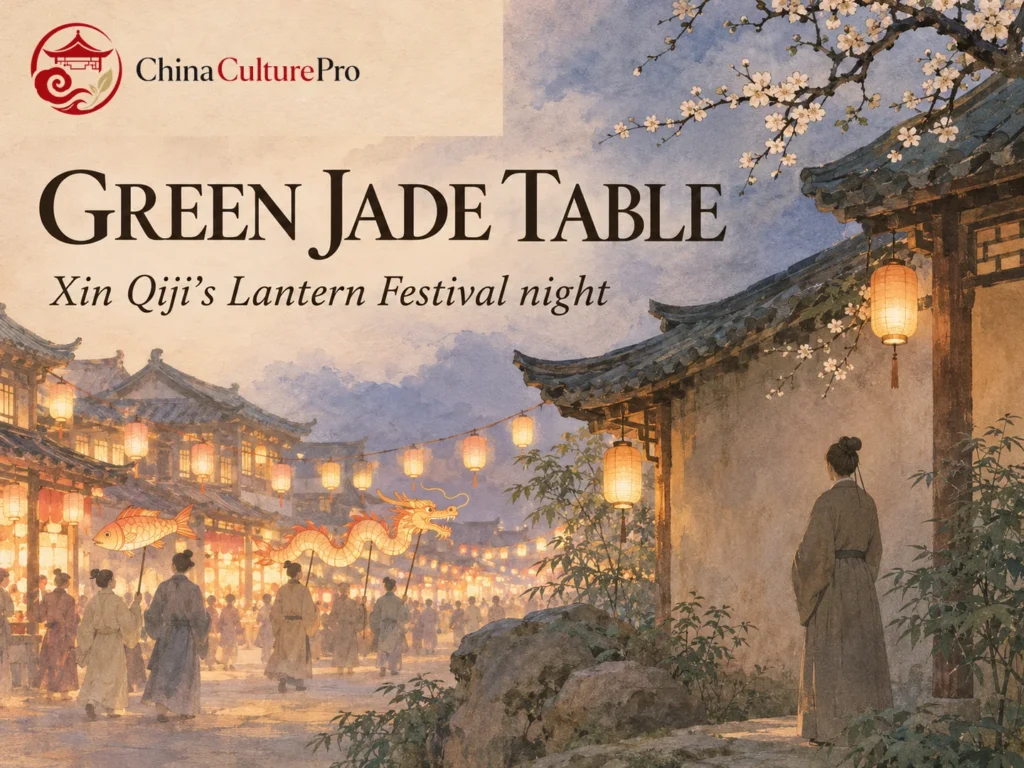

Quick Answer: What Does Green Jade Table Mean?
Green Jade Table (青玉案, Qīng Yù Àn) is the tune name of a lyric by Xin Qiji (辛棄疾, Xīn Qìjí). It is a ci (詞, cí) lyric. Its subtitle Yuanxi (元夕, Yuánxī) identifies the night of the Lantern Festival (元宵節, Yuánxiāo Jié).[1][2]
- Festival: Light, music, carriages and decorated people create a crowded, moving scene.
- Search: The speaker repeatedly looks for someone who matters more than the passing spectacle.
- Recognition: A sudden turn reveals that person where the lights are dimmer or more scattered.
The encounter supports a reading of personal longing; broader readings of integrity or discovery belong to its interpretive history rather than to an explicitly stated explanation.

A whole festival seems to pass before us: bright lights, fine carriages, music and laughing people. Yet the lyric’s attention finally settles on one person away from the brightest activity. The discovery changes how we read everything that came before it.
The Complete Lyric and an English Sense Translation
The complete text has 67 characters in two stanzas. The following original English rendering keeps the lyric’s sequence and images, without reproducing its musical pattern or rhyme.[1]
| Chinese text | English sense |
|---|---|
| 東風夜放花千樹, 更吹落、星如雨。 | At night the east wind makes a thousand trees flower with light; then blows down stars as though they were rain. |
| 寶馬雕車香滿路, 鳳簫聲動,玉壺光轉, 一夜魚龍舞。 | Fine horses and carved carriages fill the road with fragrance; flutes sound, the jade-white moon turns its light; fish and dragon lanterns dance through the night. |
| 蛾兒雪柳黃金縷, 笑語盈盈暗香去。 | Moth ornaments (蛾兒, é’ér), snow willow sprays (雪柳, xuěliǔ), golden threads (黃金縷, huángjīnlǚ); graceful laughter and talk pass by, leaving a delicate scent. |
| 眾裡尋他千百度; 驀然回首,那人卻在, 燈火闌珊處。 | Among the crowd I search for that person countless times; suddenly I turn my head—and there they are, where the lantern lights have thinned. |
The Song ci poetry guide explains how a tune name works. Here the subtitle supplies the occasion: the fifteenth night of the first lunar month.[2] The broader Lantern Festival guide gives the customs behind that setting.
Lantern Light, Moving Crowds and Festival Dress
The opening transforms artificial light into an abundant natural spectacle. The flowering trees evoke lantern displays; the falling stars suggest showers of fireworks, although the latter image has also been read in relation to lanterns.[2] Either way, the night appears more animated than ordinary darkness.
The jade vessel (玉壺, yùhú) commonly means the moon here; a lamp is another reading.[2] The rendering selects the moon and keeps light in motion.
Fish and dragon-shaped lanterns move through the festivities. The next stanza’s named ornaments are head decorations, not descriptions of skin or body shape.[2]
These details make the crowd perceptible in different ways. We see light and dress, hear flutes and laughter, and encounter fragrance as people pass. The scene keeps moving beyond the speaker’s attention. Its fullness prepares the question that follows: among so much to see, who is actually being sought?
The Turn toward the Person in Dimmer Light
The search is expressed through a large number of repetitions. “Countless times” carries its intensity without treating the line as a tally of separate attempts. The sudden turn then changes both the direction of looking and the pace of the lyric.
Until this point, the scene has accumulated movement: lights flare, carriages pass, music sounds and people go by. The ending offers a person located in one quieter place. The speaker recognizes someone rather than finding a still brighter attraction within the same display.
The lights are thinning or dim. The phrase does not require a completely dark corner where nothing could be seen. The person remains visible enough for recognition, while being set apart from the densely illuminated celebration.
The ending also stops before an explanation. We are not told what the person says, whether the two approach one another or what happens afterward. That restraint allows the moment of seeing to remain the lyric’s conclusion.
Love, Integrity and a Later Reading of Discovery
At the level of its scene, the lyric describes seeking a particular person. A romantic reading is natural. The isolated figure has also been read as integrity, with possible echoes of the poet’s public disappointments.[2] The Xin Qiji overview supplies the wider author context.
Those readings should retain their status as interpretations. The lyric does not name the person or declare that each festival object represents a political position. Its contrast can carry more than one meaning without requiring a fixed secret code.
Much later, Wang Guowei (王國維, Wáng Guówéi) used the closing search and recognition in Renjian Cihua (人間詞話, Rénjiān Cíhuà). He made it the third of three poetic images for the pursuit of major work and learning: after sustained searching, an unexpected recognition arrives.[3]
He also cautioned against simply imposing that borrowed meaning on the original lyrics. That qualification matters. The later reading helps explain the ending’s cultural reach, while leaving us free to return to its original festival, seeker and discovered person.
How to Follow the Movement from Spectacle to Stillness
- Separate tune and occasion: Read the title as a formal label and the subtitle as the festival setting.
- Gather the moving details: Notice light, sound, fragrance and dress before reducing the opening to background scenery.
- Locate the change of attention: Follow the repeated search into the sudden physical turn of the head.
- Stop with the recognition: Consider what the quiet ending adds before supplying a conversation, biography or allegorical answer of your own.
This distinction between a scene and its later uses is useful across the wider Chinese poetry collection.
FAQs About Green Jade Table by Xin Qiji
Is Green Jade Table a piece of furniture in the scene?
No. Here it names the tune pattern. The lyric itself concerns a festival night, not an encounter at a jade table.[2]
Is the person at the end definitely a woman?
Many translations choose a woman within a romantic reading. The Chinese wording does not specify the person’s gender in the way a modern English pronoun would, so “that person” preserves some openness.
Does the ending describe a conversation or reunion?
It describes finding the person in the dimmer lights. A conversation, embrace or subsequent reunion is not supplied by the text.[1]
Sources
[1] Xin Qiji. Green Jade Table, Yuanxi: complete classical text
[2] Hong Kong Education Bureau. Green Jade Table, Yuanxi: text, lexical notes and interpretations
[3] Wang Guowei. Renjian Cihua, 1926 edition: the passage on three stages