


Quick Answer: What Is Song of the Beautiful Ladies About?
Song of the Beautiful Ladies (麗人行, Lìrén Xíng) by Du Fu (杜甫, Dù Fǔ) turns a display of aristocratic beauty and luxurious dining into a satire of the powerful Yang family.
- Display: Clothing, ornaments and rare food first draw the eye toward elegance and expense.
- Privilege: Palace kitchens and a crowded entourage reveal access to imperial resources.
- Threat: The final warning exposes the intimidating authority behind the gathering.
The old-style poem makes the display of beauty serve a wider criticism of privilege. Its criticism becomes clearest when the lavish details are read against the last couplet.[1][2]
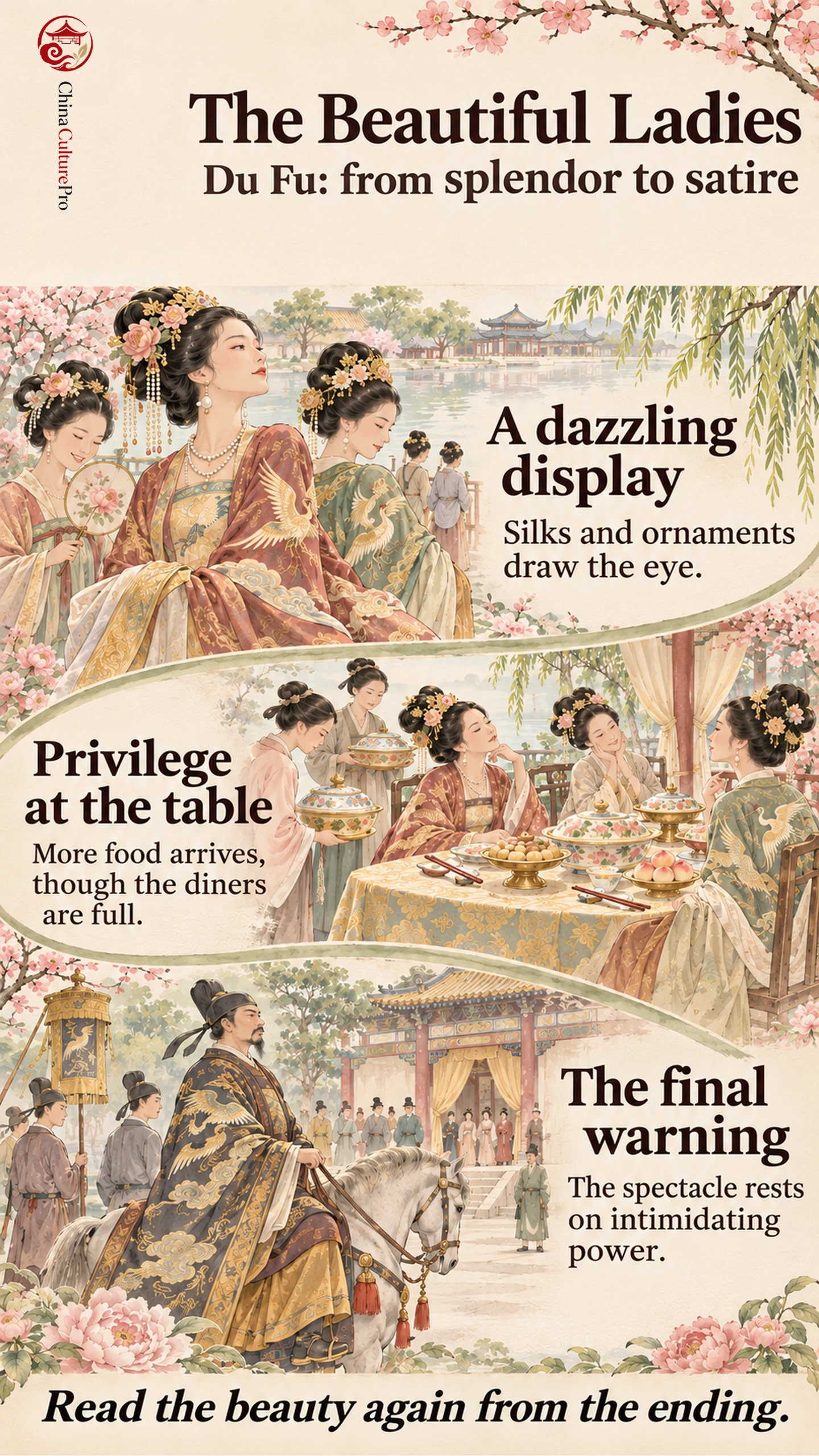
The poem begins with an attractive spring outing and ends with a warning to keep away. Between those moments, embroidered clothes, precious dishes, palace deliveries and a leisurely arrival reveal the power supporting the spectacle. The ending changes how the opening looks.
The Complete Poem and an English Sense Translation
The following presents the complete poem in thirteen paired reading groups. Two short questions interrupt the predominantly seven-character lines. The English is an original sense translation; the head-ornament line retains the received 翠微㔩葉 wording.[1]
| Chinese text | English sense translation |
|---|---|
| 三月三日天氣新,長安水邊多麗人。 | On the third day of the third month, the air is fresh; many beautiful women gather by the waters of Chang’an (長安, Cháng’ān). |
| 態濃意遠淑且眞,肌理細膩骨肉勻。 | Rich in bearing, distant in expression, gentle and natural; fine in skin and balanced in form. |
| 繡羅衣裳照暮春,蹙金孔雀銀麒麟。 | Embroidered gauze clothes light up late spring: gold-thread peacocks and silver qilin (麒麟, qílín). |
| 頭上何所有?翠微㔩葉垂鬢脣。 | What is on their heads? Blue-green leaf ornaments hang beside their temples. |
| 背後何所見?珠壓腰衱穩稱身。 | What can be seen behind them? Pearls weight the waist fastening, fitting the garment to the body. |
| 就中雲幕椒房親,賜名大國虢與秦。 | Among the cloudy curtains are the imperial consort’s kin, granted the grand titles Lady of Guo (虢國夫人, Guóguó Fūrén) and Lady of Qin (秦國夫人, Qínguó Fūrén). |
| 紫駝之峰出翠釜,水精之盤行素鱗。 | Camel hump comes from green cauldrons; crystal plates carry pale fish. |
| 犀箸饜飫久未下,鑾刀縷切空紛綸。 | Sated diners leave their rhinoceros-horn chopsticks unused; the carving knives busily slice fine, in vain. |
| 黃門飛鞚不動塵,御廚絡繹送八珍。 | Palace attendants speed on horseback without raising dust; imperial kitchens send delicacies in an unending stream. |
| 簫鼓哀吟感鬼神,賓從雜遝實要津。 | Pipes and drums sound plaintively enough to move spirits; guests and followers crowd the place of influence. |
| 後來鞍馬何逡巡,當軒下馬入錦茵。 | How slowly the later rider approaches! He dismounts before the entrance and steps onto brocade carpeting. |
| 楊花雪落覆白蘋,青鳥飛去銜紅巾。 | Willow down falls like snow upon white water plants; a blue-green bird flies off carrying a red kerchief. |
| 炙手可熱勢絕倫,愼莫近前丞相嗔。 | Power hot enough to scorch the hand, beyond all peers: take care not to approach and anger the chief minister. |
The qilin are embroidered motifs, not animals attending the banquet. The qilin symbolism guide explains the creature beyond this use as costly decoration. “Eight delicacies” signals prized food; the poem does not supply a menu of eight named dishes.[1]
The Spring Outing and the Yang Family
The opening date belongs to the traditional calendar. The Shangsi Festival (上巳節, Shàngsì Jié) became associated with the third day of the third month and spring gatherings by water. It should not be translated as March 3.[4]
The poem is generally dated to 753 and associated with the waterside outing at Qujiang (曲江, Qūjiāng), near the Tang capital. The titled women are sisters of the favored imperial consort Yang Guifei (楊貴妃, Yáng Guìfēi). The chief minister is Yang Guozhong (楊國忠, Yáng Guózhōng), their cousin.[3]
Those relationships explain why the poem can move from a crowd of women to royal kitchens and finally to a minister. The Du Fu guide places the work within his wider engagement with society and political life.
When Elegant Description Becomes Criticism
The questions about head and back make the reader inspect the display piece by piece. Gold and silver patterns, colored ornaments and pearls invite sustained looking. Their accumulation matters more than an isolated decorative detail.[1]
The scene then becomes costly activity. Cooks slice, attendants ride and more food arrives, although the diners have already had enough. “In vain” makes the imbalance pointed: considerable work continues around people who scarcely need what it produces.
The stream of deliveries comes from the imperial kitchens. The poem thereby connects a private-looking outing with royal provision. Its satire gains force through these concrete relationships rather than a general claim that beauty or expensive clothing is inherently wrong.[1]
The Late Rider and the Warning About Power
The unhurried arrival contrasts with the haste of those delivering food. One figure can move slowly because so much activity already serves the gathering. The brocade carpet receives him as the poem shifts toward the person whose anger others must avoid.[1]
The willow down and kerchief-carrying bird have often been read as suggestive allusions to the Yang family’s private relations. Such readings belong to the poem’s satirical interpretation; these lines should not be presented as independent proof of a specific sexual scandal.[3]
The ending makes power physically imaginable as heat. Zhishou kere (炙手可熱, zhìshǒu kěrè), “hot enough to scorch the hand,” here carries danger, reinforced by the warning about the minister’s anger. An attractive public spectacle has become an intimidating space.[1]
Read backward from that warning: the lavish display depends on a power that discourages approach. The final two lines reframe the earlier spectacle.
How to Read the Satire Beneath the Display
- Follow the gaze: Move from the whole waterside scene to particular clothes and ornaments.
- Watch who works: Compare the cooks and rushing attendants with diners who are already full.
- Notice unequal movement: Set the late rider’s leisure against the haste surrounding him.
- Reread from the warning: Let the minister’s threatening power alter the meaning of the opening beauty.
FAQs About Song of the Beautiful Ladies
Is Yang Guifei explicitly named in the poem?
No. The poem refers to the imperial consort’s relatives and gives the titles Guo and Qin. Identifying the family draws on historical context.[1][3]
Does the poem give a recipe or an exact banquet menu?
No. Camel hump, fish and costly utensils characterize luxury. The reference to prized delicacies does not enumerate every dish or explain how to cook them.[1]
Does the last couplet praise a popular minister?
Its heat image and warning about anger make the authority threatening. Reading the ending as a cheerful compliment would miss the satire established by the surrounding excess.[1][2]
Sources
[1] Du Fu; Chinese Wikisource. Liren Xing
[2] Taiwan Ministry of Education. Revised Mandarin Dictionary: Liren Xing
[3] University of Geneva, Poésie Tang. Du Fu: Li Ren Xing, Text and Commentary
[4] Taiwan Ministry of Education. Revised Mandarin Dictionary: Shangsi