

Quick Answer: What Does Spring View Mean?
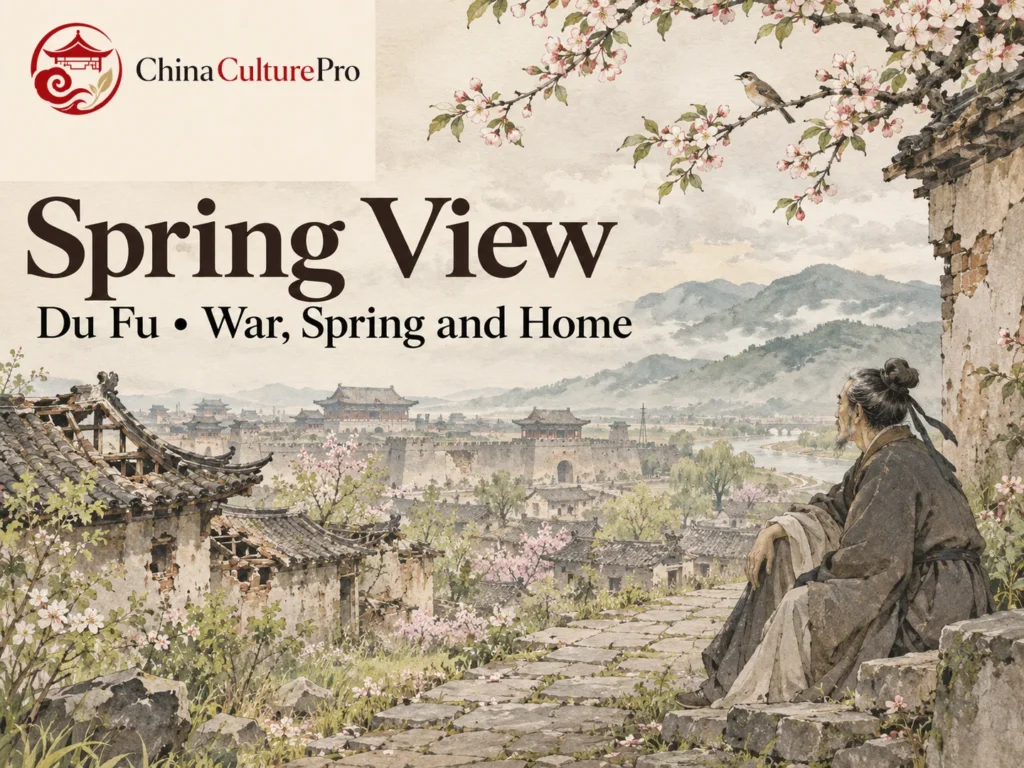
Spring View (春望, Chūn Wàng) by Du Fu (杜甫, Dù Fǔ) joins grief over a war-damaged capital with longing for family news. Ordinary signs of spring become difficult to bear in a time of separation.
- Setting: The poem belongs to spring 757, when the poet was trapped in rebel-held Chang’an (長安, Cháng’ān).
- Feeling: Flowers and birds are drawn into sorrow over the times and separation.
- Focus: The poem moves toward a priceless family letter and the speaker’s thinning white hair.
Its form is five-character regulated verse (五言律詩, wǔyán lǜshī): eight lines, forty Chinese characters. The “broken country” opening expresses catastrophe around the capital, not the historical end of the Tang dynasty.[1][2][3][4]

The mountains and rivers remain, but the capital has been broken by war. Spring growth deepens the sense of neglect rather than offering easy comfort. As the poem narrows from city to family to a worried gesture, public disaster becomes painfully intimate.
The Complete Poem, Pinyin and English Meaning
The table gives the entire received text, modern Mandarin pinyin and an original English sense translation. It follows 城春, “the city in spring”; the transmitted text also records 荒, “desolate,” in that line.[1]
| Chinese text | Pinyin | English sense translation |
|---|---|---|
| 國破山河在, | Guó pò shān hé zài | The realm lies broken; its mountains and rivers are still here. |
| 城春草木深。 | Chéng chūn cǎo mù shēn | Spring reaches the city, where grass and trees grow thick. |
| 感時花濺淚, | Gǎn shí huā jiàn lèi | Grieving for these times, I see flowers and tears fall. |
| 恨別鳥驚心。 | Hèn bié niǎo jīng xīn | Pained by separation, I hear birds and my heart is startled. |
| 烽火連三月, | Fēng huǒ lián sān yuè | War beacons have continued through three months. |
| 家書抵萬金。 | Jiā shū dǐ wàn jīn | A letter from home would equal ten thousand in gold. |
| 白頭搔更短, | Bái tóu sāo gèng duǎn | Scratching my white-haired head, I find the hair still sparser. |
| 渾欲不勝簪。 | Hún yù bù shēng zān | It can almost no longer support a hairpin. |
The flower-and-bird couplet permits more than one reading. The English here supplies the poet as the person weeping and startled. Another reading personifies the flowers and birds as sharing his grief. The compact Chinese allows the emotional boundary between observer and scene to remain fluid.[2][3]
Spring in an Occupied Capital
The background is the An Lushan Rebellion (安史之亂, Ān-Shǐ zhī Luàn). Du Fu had been captured by the rebels in 756 and remained separated from his family in the occupied capital before escaping the following year. The Du Fu guide places this period within his life.[2][4]
In the first couplet, mountains and rivers survive while political and ordinary human order has been damaged. The overgrown city brings that contrast close. Plants returning in spring would ordinarily suggest renewal; here their unchecked depth makes the loss of ordinary activity felt.[1]
For the earlier capital’s institutions and everyday setting, see Tang Chang’an city life (唐長安, Táng Cháng’ān). The poem offers a concentrated wartime view rather than a complete survey of every street.
Flowers, Birds and the Two Central Pairs
The second couplet places feeling before each natural image: grief for the times before flowers, and pain at separation before birds. The parallel shape connects public sorrow with private loss even before the family letter appears.[1]
The flowers do not restore happiness simply by blooming. Birdsong does not automatically reassure. Whether one reads the natural things as causing the poet’s tears or as sharing his emotion, the couplet makes familiar beauty participate in distress.[3]
The next pair brings those two concerns into material form: war beacons correspond to the troubled times, and a letter corresponds to separation. This close arrangement gives the middle of the poem its coherence. The regulated form also pairs lines and rhymes at the even-numbered endings; modern pinyin does not reproduce all of the historical rhymes.[3]
Why a Family Letter Is Worth Ten Thousand in Gold
The comparison expresses the extraordinary value of news when warfare obstructs communication. It is not a recorded postal charge or an instruction to pay a literal sum. Knowing whether family members are safe matters more than ordinary measures of wealth.[1][2]
“Three months” presents continuing war through a span of time. It should not be used to claim that the whole rebellion lasted only three months. The poem’s purpose is to make persistence and separation felt, rather than supply the campaign’s complete chronology.[1][2]
A companion reading about family separation is Moonlit Night by Du Fu (月夜, Yuè Yè). Here, the plain object of a letter gives the longing an immediately recognizable form.
The White Hair and the Hairpin
The last couplet turns from what the speaker sees and longs for to what he does: he scratches his white-haired head. The small gesture makes worry physically visible. His hair is becoming too sparse to secure the pin.[1]
Zan (簪, zān) is the hairpin in that closing image. Ancient men also secured dressed hair or headwear with pins; it should not automatically make the speaker a woman. The Chinese hairpins guide explains the wider object history.[2]
The image completes the narrowing movement. A damaged realm, thick city vegetation, emotional reactions, distant family and finally a small object at the speaker’s head occupy one short poem. The gesture gives both kinds of grief a human scale.
How to Follow the Poem’s Four Couplets
- Set the contrast: Read the surviving landscape against the broken human order.
- Notice the paired feelings: Connect grief for the times with separation from family.
- Value the letter: Let interrupted news explain the extravagant gold comparison.
- End with the gesture: Return from the capital’s scale to the worried hand and thinning hair.
FAQs About Spring View by Du Fu
Are the flowers literally crying?
They can be read as personified mourners, or as flowers that prompt the poet’s tears. Both readings connect the scene with his emotional condition.[3]
Does “ten thousand in gold” give a real letter price?
No. It is an emphatic comparison for the value of family news amid war and separation, not a postal tariff.[1][2]
Does the poem say Du Fu received the letter?
No receipt is narrated. The line expresses how precious a letter from home would be under these conditions.[1]
Sources
[1] Du Fu; Chinese Wikisource. Chun Wang
[2] Tang Poetry Close Reading course, hosted on Chaoxing. Chun Wang: Text and Notes
[3] University of Geneva, Poésie Tang. Du Fu: Chun Wang
[4] Columbia University, Asia for Educators. Selected Poems by Du Fu: Background and Primary Documents