

Quick Answer: What Is Moonlit Night on the Spring River About?
Moonlit Night on the Spring River (春江花月夜, Chūn Jiāng Huā Yuè Yè) by Zhang Ruoxu (張若虛, Zhāng Ruòxū) connects a luminous spring landscape with questions about human generations, separation and returning home. Its 36 seven-character lines move far beyond a description of scenery.[1]
- The opening: Moonlight brings sea, river, flowers and sand into one expansive field of vision.
- The middle: Questions about the first human observer give way to a traveler in a boat and someone longing from a room.
- The ending: Spring passes and the moon sets, while the question of who will return remains unanswered.
The shared light connects separated people imaginatively; it does not bring them together within the poem.[1]
A moon rises with the tide, spreads its light across flowering riverbanks, and eventually sinks into mist. Between its rising and setting, this poem asks who first saw the moon and imagines people who cannot reach one another. Its landscape keeps changing as its human concerns come into view.
The Complete Poem and an English Sense Translation
The whole poem appears below, paired by couplet. The English is a new sense translation for this guide. It prioritizes the movement of images and questions, without attempting to recreate the original rhyme changes.[1][4]
| Chinese text | English sense |
|---|---|
| 春江潮水連海平, 海上明月共潮生。 | The spring river’s tide reaches level with the sea; above the sea, the bright moon rises with the tide. |
| 灩灩隨波千萬里, 何處春江無月明? | Shimmering light follows waves for countless miles; where along the spring river is the moon not bright? |
| 江流宛轉遶芳甸, 月照花林皆似霰。 | The river bends around fragrant fields; moonlight makes the flowering woods resemble snow pellets. |
| 空裏流霜不覺飛, 汀上白沙看不見。 | Frost seems to stream through the air, unseen in flight; the white sand on the shoals disappears from sight. |
| 江天一色無纖塵, 皎皎空中孤月輪。 | River and sky share one color, without a trace of dust; bright in the open sky hangs the solitary moon’s disk. |
| 江畔何人初見月, 江月何年初照人? | Who first beheld the moon beside this river? In what year did the river moon first shine on people? |
| 人生代代無窮已, 江月年年望相似。 | Human generations succeed one another without end; year after year, the river moon appears much the same. |
| 不知江月待何人? 但見長江送流水。 | Who is the river moon waiting for? I do not know; I see only the long river sending its waters onward. |
| 白雲一片去悠悠, 青楓浦上不勝愁。 | A single white cloud drifts far away; at Qingfengpu (青楓浦, Qīngfēngpǔ), sorrow is hard to bear. |
| 誰家今夜扁舟子, 何處相思明月樓? | Whose traveler is in a small boat tonight? Where is the bright-moon tower of one who longs? |
| 可憐樓上月徘徊, 應照離人妝鏡臺。 | How lovely the moon lingering above the tower; it must light the separated one’s dressing mirror. |
| 玉戶簾中卷不去, 擣衣砧上拂還來。 | At the fine doorway’s curtain, rolling cannot remove it; on the cloth-beating stone, brushed away, it comes again. |
| 此時相望不相聞, 願逐月華流照君。 | At this hour we look toward one another but cannot hear; may I follow the flowing moonlight and shine upon you. |
| 鴻雁長飛光不度, 魚龍潛躍水成文。 | Wild geese fly far but cannot cross the light; fish and dragons dive and leap, patterning the water. |
| 昨夜閒潭夢落花, 可憐春半不還家。 | Last night, a dream of falling flowers by a quiet pool; how sad that spring is half gone and home remains unreached. |
| 江水流春去欲盡, 江潭落月復西斜。 | The flowing river carries spring toward its end; the sinking moon above the river pool leans west again. |
| 斜月沉沉藏海霧, 碣石瀟湘無限路。 | The slanting moon sinks deep into sea mist; between Jieshi (碣石, Jiéshí) and Xiaoxiang (瀟湘, Xiāoxiāng), roads stretch without end. |
| 不知乘月幾人歸, 落月搖情滿江樹。 | Who knows how many return beneath this moon? The setting moon stirs feeling through the trees along the river. |
This version follows 望 in the line about the moon appearing similar each year. Other received texts use 只 or related forms there; the table keeps the selected primary text’s wording.[1]
An Older Song Title and a Long Seven-Character Poem
The title belongs to the yuefu (樂府, yuèfǔ) song-poetry tradition and predates Zhang’s poem. An early collection places his work beside earlier poems sharing that title. A shared heading does not mean they have identical words or the same length.[2]
Zhang’s version contains 252 Chinese characters, excluding punctuation. Its rhyme shifts across nine four-line units, supporting a longer progression rather than the compact closure of a single quatrain.[1][3][4]
Zhang was a Tang poet associated with Yangzhou. His birth and death dates are uncertain, and only two poems survive under his name. The text offers far more to read than the sparse biographical record can explain.[5]
The River, Flowers and the Moon’s Expanding Light
The opening joins the river to the sea and gives the moon a rising movement alongside the tide. The question about where moonlight is absent expands the view beyond one observer’s immediate surroundings.[1]
The next images test how much can be distinguished in that brightness. Flowering woods look like snow, frost seems to stream through the air, and white sand becomes difficult to see. These are transformations produced by the light; they need not describe a spring snowstorm.[1][3]
When river and sky become one color, the solitary disk of the moon stands out. The sequence changes the scale of attention: from a vast illuminated landscape to one object that countless people might have watched.[1]
The Questions about Human Time
“Who first?” and “in what year?” ask about the beginning of the relationship between human observers and the moon. The poem offers no historical first person or date. It lets the questions enlarge the scene’s timescale.[1]
The following couplet holds two kinds of continuity together: human generations succeeding one another, and the moon appearing familiar each year. Individual lives pass, but the line about generations does not say humanity simply vanishes. Nor does it promise immortality to any individual.[1]
The moon is then imagined as waiting for someone. That small human action prepares the turn toward people who really do wait and long. The broad reading context of Tang poetry helps place this movement between scene and feeling.
From the Distant Boat to the Woman’s Room
The questions “whose traveler?” and “where?” introduce unnamed human figures. A small boat and a tower imply different situations: movement on the water and watching from a fixed place. They are not identified as the poet and a known historical partner.[1]
Attention then enters a room through the mirror stand, doorway and curtain. The poem contracts from the scale of sea and sky to familiar surfaces touched by light. The conventional reading hears a woman’s longing here and the traveler’s homesickness later; that reading organizes the shifting scenes without turning them into a documented biography.[1][3]
Why Moonlight Cannot Be Rolled or Brushed Away
The light cannot be gathered up with the curtain or wiped off the cloth-beating stone. These domestic actions make an intangible presence almost physical. Trying to remove it only reveals that it remains.[1][3]
The next couplet explains the emotional difficulty: people can look toward one another without hearing one another. Wishing to follow the moonbeams expresses the desire to cross that gap. The shared illumination offers a connection, but it cannot replace a voice or an actual return.[1]
The geese and patterned water continue this sense of motion without successful contact. The scene stays active while communication remains incomplete.[1]
Falling Flowers, the Setting Moon and the Unfinished Return
The dream of falling flowers introduces another loss of time. Spring is already half gone; the river seems to carry it farther away. Meanwhile, the moon that rose in the first couplet now leans west and sinks into mist.[1]
Jieshi evokes the north and Xiaoxiang the southern river region. Placed together, they enlarge the felt distance between people; they do not supply a step-by-step route for one identifiable boat.[4]
The final question asks how many have returned, then leaves the answer open. Feeling spreads into the riverside trees as the light fades. For a more specifically situated family separation, compare Moonlit Night by Du Fu. The Chinese moon poetry guide offers other uses of the shared celestial image.[1]
How to Follow the Poem from Beginning to End
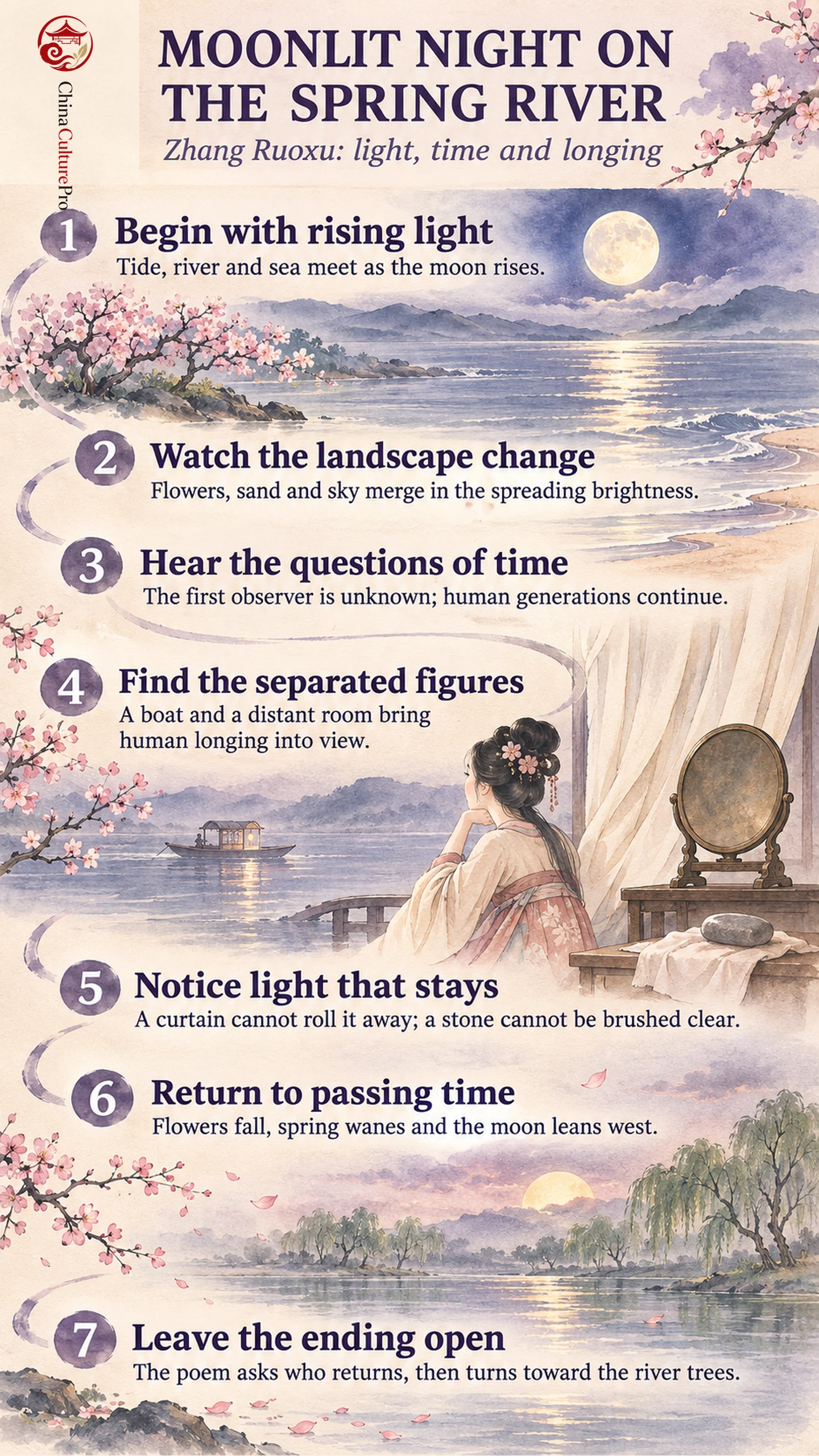
- Track the light: Follow its path from the rising tide across woods and sand, into the room and toward the setting moon.
- Hear the questions: Separate the cosmic questions about first observers from the later questions about travelers and return.
- Notice changes of scale: Move with the poem from sea and sky to a mirror, curtain and cloth-beating stone.
- Keep the ending open: Return to the unknown number of homecomers without inventing a completed reunion.
FAQs About Moonlit Night on the Spring River
Is this a Song dynasty ci lyric?
No. It is a Tang poem in seven-character lines using an older song-poetry title. Its extended structure differs from a Song ci lyric written to a prescribed tune pattern.
Does the poem say human existence simply ends?
The poem distinguishes passing lives from the succession of generations. Its questions allow wonder and continuity alongside awareness of time, rather than a simple declaration that human existence is meaningless.
Can the place names be read as an exact travel route?
They contribute to a poetic geography of separation. The text does not identify a single traveler’s stops, departure point and destination clearly enough to reconstruct an itinerary.
Do we know whom Zhang Ruoxu was addressing?
The poem does not name a recipient or establish the separated figures as a known historical couple. The first-person wording supplied in English should not be treated as biographical evidence.
Sources
[1] Zhang Ruoxu. Chun Jiang Hua Yue Ye
[2] Guo Maoqian, compiler. Yuefu Shiji, Volume 47
[3] Mo Lifeng. An Ever-New Ode to the Moon: Reading Chun Jiang Hua Yue Ye
[4] Peina Zhuang and Steven Tötösy de Zepetnek. Taxonomy in Translation Studies: A Case Study of Xu Yuanchong’s Translation
[5] Ministry of Education, Taiwan. Zhang Ruoxu