

Quick Answer: What Does Mountain Journey Mean?
Mountain Journey (山行, Shān Xíng) by Du Mu (杜牧, Dù Mù) celebrates an autumn mountain scene. Its four lines move from a distant path and cloudside houses to the traveler’s delighted pause before the maple woods.[1]
- The route: A slanting stone path links the high mountain with human dwellings.
- The pause: The carriage stops because the speaker admires the woods in the evening.
- The judgment: Frost-touched leaves are redder than flowers of the second traditional month.
Autumn’s cold supplies a setting for vivid beauty here, rather than requiring a sad ending.[1][2]
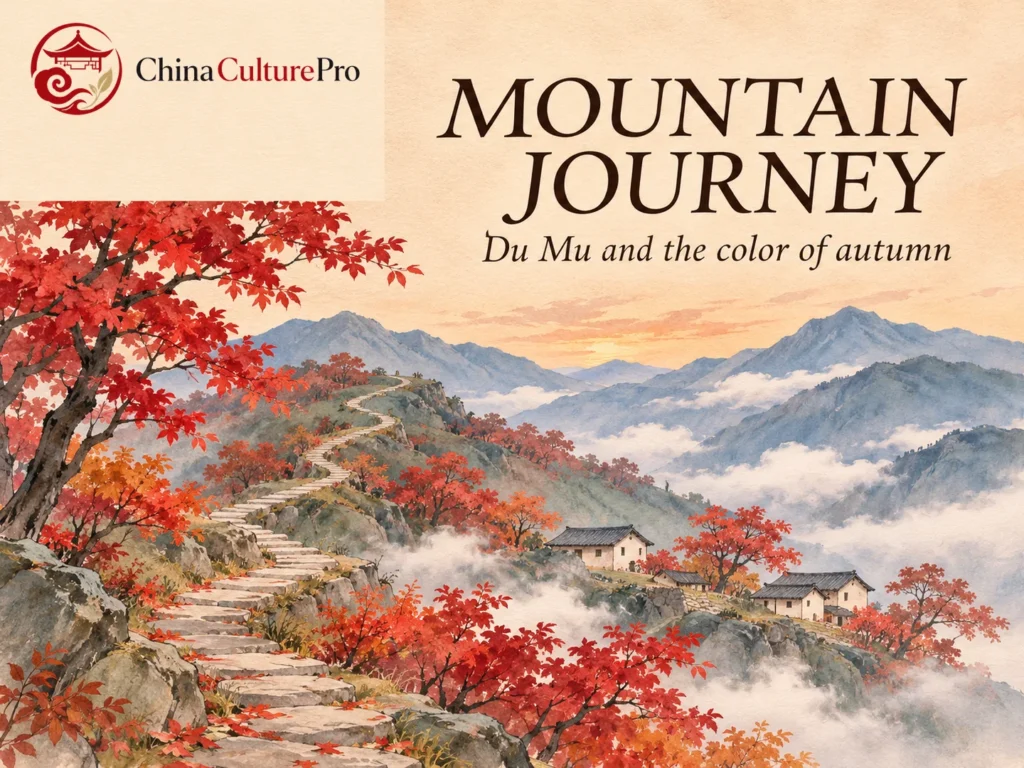
A winding stone path leads into a cold mountain, where houses appear among rising clouds. Then the traveler stops. What arrests his movement is not a destination, but the red of autumn leaves—a color he judges more striking than spring flowers.
The Complete Poem and an English Sense Translation
This seven-character quatrain (七言絕句, qīyán juéjù) contains 28 Chinese characters. The new English sense translation follows the version with 生, meaning that clouds rise or come into being.[1]
| Chinese text | English sense |
|---|---|
| 遠上寒山石徑斜, | Far up the cold mountain, the stone path slopes and winds; |
| 白雲生處有人家。 | where white clouds rise, there are homes. |
| 停車坐愛楓林晚, | I halt my carriage, drawn by the maple woods at evening; |
| 霜葉紅於二月花。 | leaves touched by frost are redder than the second month’s flowers. |
The Path, Clouds and Houses
The first line leads the eye upward. Its path has both direction and texture: it is made of stone and runs slantwise into the mountain. White clouds then extend the sense of height, but the houses prevent the landscape from becoming an entirely uninhabited wilderness.[1]
The words do not tell us that the traveler visits those homes. They provide a distant point within the view before the poem changes its focus. In the last two lines, the most important place becomes wherever the autumn woods persuade the traveler to stop.[1]
For the writer’s wider range of subjects, see Du Mu.
Why the Traveler Stops
The crucial word zuo (坐, zuò) gives a reason: the carriage stops because of the speaker’s delight in the woods. Reading it simply as the modern verb “sit” misses the connection between the halt and the scene that attracts him.[2]
The change of pace is equally important. A mountain journey suggests forward movement; the third line suspends it. The poem lets attention interrupt travel. Evening adds a particular moment to that pause without turning the scene into a view of a completely dark forest.[1]
Redder than Spring Flowers
The final line is a comparison, not just a report that the leaves are red. They are redder than spring flowers. The cold mountain and white clouds prepare a restrained background against which this stronger color can stand out.[1][2]
The reference to frost makes the leaves unmistakably seasonal. Yet the poem values what autumn offers rather than treating it as an inferior remainder after spring. It finds a reason to stop and look in a season often associated with decline.[1]
That feeling should not be imposed on every autumn poem. Autumn Evening by Du Mu offers another setting and emotional situation, while the Tang poetry guide explains the broader reading context.
How to Read the Four-Line Movement
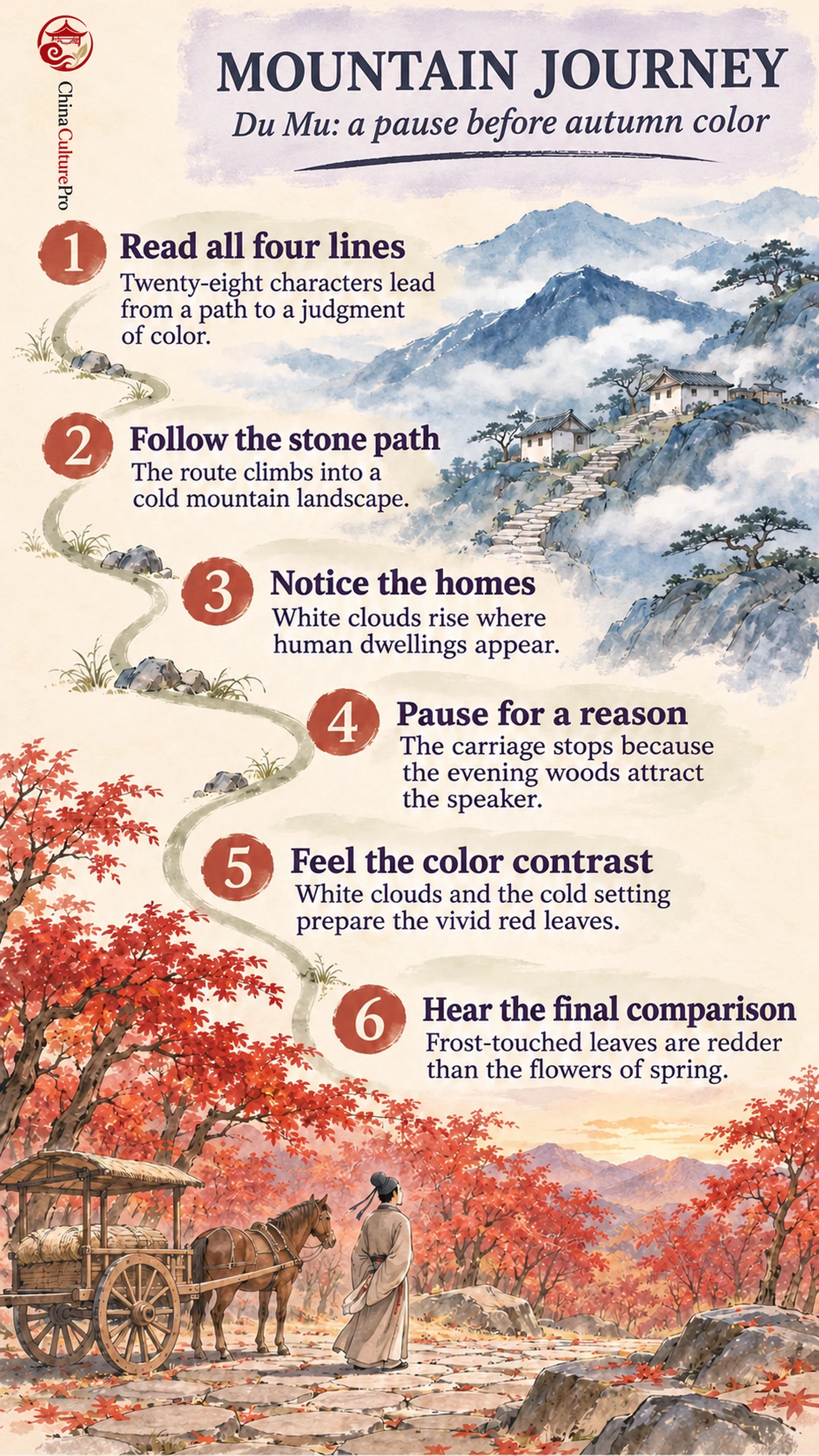
- Follow the path: Let the stone road direct the eye into the height and distance.
- Notice the homes: Keep the human presence within the mountain landscape.
- Pause at the third line: Read the halt as a response to beauty, with a stated reason.
- Give the comparison its force: Hear “redder than,” not merely “as red as,” in the last line.
FAQs About Mountain Journey by Du Mu
Does the poem name a particular mountain?
The text gives a cold mountain, a stone path, homes and woods, but no explicit place name. Those details alone cannot establish a particular modern scenic site.
Why do some versions say deep in the white clouds?
The second line has received variants: 生 means clouds rising, while 深 means deep within them. Both wordings appear in transmitted sources; this guide consistently uses 生.[3]
Does the final line refer to February flowers?
It refers to the second month of the traditional calendar, placing the flowers in spring. Translating that directly as a fixed Gregorian February or May changes the calendar reference.[2]
Is this a poem about autumn sadness?
Its dominant action is delighted attention. The cold and frost remain part of the scene, but the last line praises the leaves through their comparison with spring blossoms.
Sources
[1] Du Mu. Shan Xing
[2] University of Geneva, Poésie Tang. Du Mu, Shan Xing: Text, Translation and Notes
[3] National Central Library, Taiwan. Reference Response on the Sheng and Shen Variants