

Quick Answer: Who Was Fan Chengda?
Fan Chengda (范成大, Fàn Chéngdà; 1126–1193) was a Southern Song poet and official from the Suzhou region. He wrote about rural work and seasonal change, travelled on government service and recorded places in prose. [1][3]
- Begin with a summer poem where children imitate the adults’ farming.
- Compare a poem from his diplomatic journey with the dated observations of his river diary.
- Choose an English book according to whether you want poetry, travel narrative or regional description.
These forms reveal different ways of attending to people and places, from a household’s work to the memory carried by an old capital.
Fan Chengda is often encountered through a few affectionate rural scenes. His writing also asks who works, what people remember and how a traveller makes sense of an unfamiliar place. Reading a seasonal sequence beside diplomatic poetry and descriptive prose gives a fuller picture of that attention.
Official Service and a Home at Stone Lake
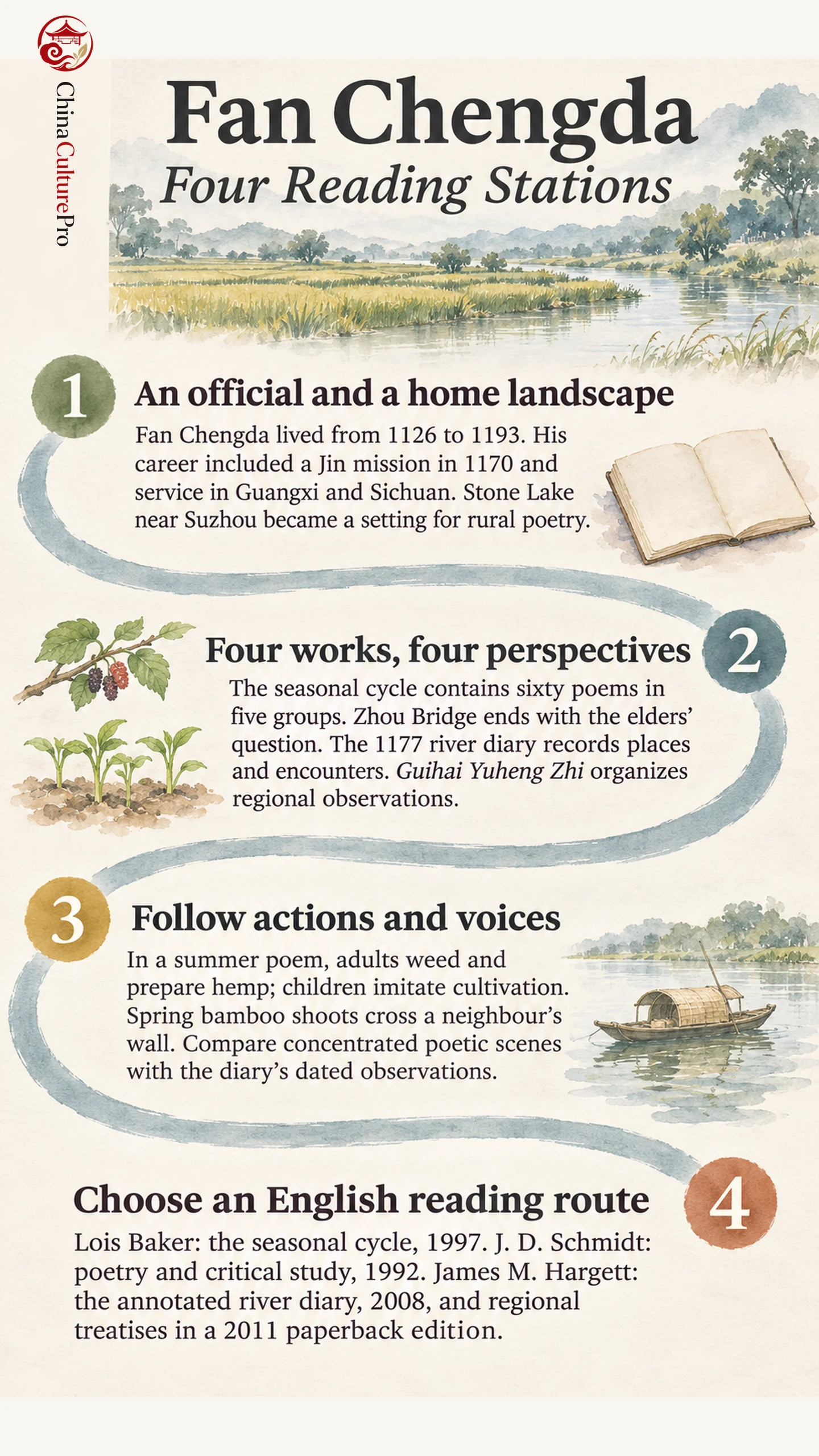
Fan passed the civil examination in 1154. His official career took him beyond his native region: he undertook a mission to the Jin state in 1170 and served in Guangxi and Sichuan. The divided political geography of the Song dynasty matters to the northern journey poems. [3]
In later life he returned to Stone Lake (石湖, Shí Hú), near Suzhou. [1]
That home landscape supplied the setting for the famous rural sequence associated with 1186. Illness and recovery belong to the sequence’s own introductory context. His retirement gave him another position from which to observe a working countryside. [2]
Four Works and Ways of Seeing
Four Seasons of Field and Garden (四时田园杂兴, Sì Shí Tiányuán Zá Xìng) contains sixty poems arranged in five groups of twelve: spring, late spring, summer, autumn and winter. The sequence provides one entry into a wider body of writing. [2]
- Four Seasons of Field and Garden: The seventh summer poem puts weeding in daylight beside preparing hemp at night. Adults have their responsibilities; children, still unable to undertake the work, practise planting melons in mulberry shade. The turn toward imitation gives the scene warmth while leaving labour at its centre. It is a useful literary entry into Chinese agricultural history. [1]
- Zhou Bridge: This poem (州桥, Zhōu Qiáo), associated with the 1170 mission, places elders on the old imperial street in the former capital, present-day Kaifeng. They ask the envoy when the armies will return. The ending gives their question the final emphasis; a diplomatic journey becomes an encounter with unresolved expectation. Notice the difference between describing a place and allowing people there to speak. [3]
- Record of a Boat Trip to Wu: This diary (吴船录, Wúchuán Lù) opens with Fan leaving Chengdu in 1177. An early entry describes running irrigation channels, flourishing rice seedlings and a farmer hopeful after rain ended a dry spell. Travel writing here includes the conditions sustaining a landscape. The dated entries also bring older poetry and local explanations into the traveller’s view. [4]
- Guihai Yuheng Zhi: This work (桂海虞衡志, Guìhǎi Yúhéng Zhì) concerns the natural world and material culture of Guangxi. Its categories include metals and stones, aromatics, wines, implements, birds, plants and peoples. It offers a different reading task: following how an official observer organizes regional knowledge. Those categories also reveal the observer’s interests and position. [6]
Labour, Memory and the Shape of Observation
A spring poem follows rain-stirred growth until a neighbour’s bamboo shoots cross the wall. Seasonal change enters a shared domestic space. The movement from weather and vegetation to a boundary between households connects the landscape with historical daily life. Notice how a particular image makes that connection. [2]
The bridge poem works differently. Its final question leaves the speaker facing an expectation he cannot simply resolve. The river diary, meanwhile, can place rainfall, crop growth, a conversation and an older literary reference close together. Comparing these forms helps a reader distinguish a concentrated poetic encounter from an accumulating account of experience. [3][4]
For readers exploring Chinese poetry, that difference is productive: ask whose attention shapes the scene and what kind of knowledge the form allows.
English Reading: Choose by Text and Scope
- The seasonal sequence: Lois Baker’s Four Seasons of Field and Garden: Sixty Impromptu Poems was published by Passeggiata Press in 1997. It is the focused choice for the sixty-poem cycle. [7]
- Poetry with critical context: J. D. Schmidt’s Stone Lake: The Poetry of Fan Chengda, published by Cambridge University Press in 1992, combines translation with biography and critical study. [8]
- The river diary: James M. Hargett translated the complete annotated travel record as Riding the River Home, published by the Chinese University of Hong Kong Press in 2008. Its subject is the 1177 journey east from Chengdu. [5]
- Regional observations: Hargett also translated Guihai Yuheng Zhi as Treatises of the Supervisor and Guardian of the Cinnamon Sea. The University of Washington Press lists a June 2011 paperback edition, with original Chinese text and annotations among its contents. [6]
FAQs About Fan Chengda
Why are there five groups in a four-season cycle?
Spring and late spring form separate twelve-poem groups. Summer, autumn and winter supply the other three. The result is five groups and sixty poems, while the title still refers to the year’s four seasons. [2]
Are the rural poems simply pictures of leisure?
The familiar summer poem centres on work continuing from day into night, followed by children imitating cultivation. Its affectionate tone and the adults’ responsibilities coexist. Read the actions as carefully as the pleasant setting. [1]
Is the travel diary a guide for a present-day trip?
It records a twelfth-century journey, with historical places, observations and inherited stories. Read it as travel literature and a source for its period. A modern itinerary needs current routes and access information checked separately. [4][5]
Sources
[1] Chinese Classical Literature. Four Seasons of Field and Garden: Summer, Seventh Poem, and Author Profile
[2] Zhong Jin, China Writers. Four Poems from Fan Chengda’s Seasonal Sequence
[3] Suzhou Local History Office. Fan Chengda’s Life: Official Service, the Jin Mission and Zhou Bridge
[4] Fan Chengda, text hosted by Wikisource. Record of a Boat Trip to Wu: Opening Entries
[5] Columbia University Press distribution catalogue. Riding the River Home, Translated by James M. Hargett
[6] University of Washington Press. Treatises of the Supervisor and Guardian of the Cinnamon Sea: Description and Contents
[7] OCLC WorldCat. Lois Baker’s Four Seasons of Field and Garden: 1997 Edition
[8] J. D. Schmidt, Cambridge University Press. Stone Lake: Preface and Book Contents