


Quick Answer: What Is the Daxue Yanyi?
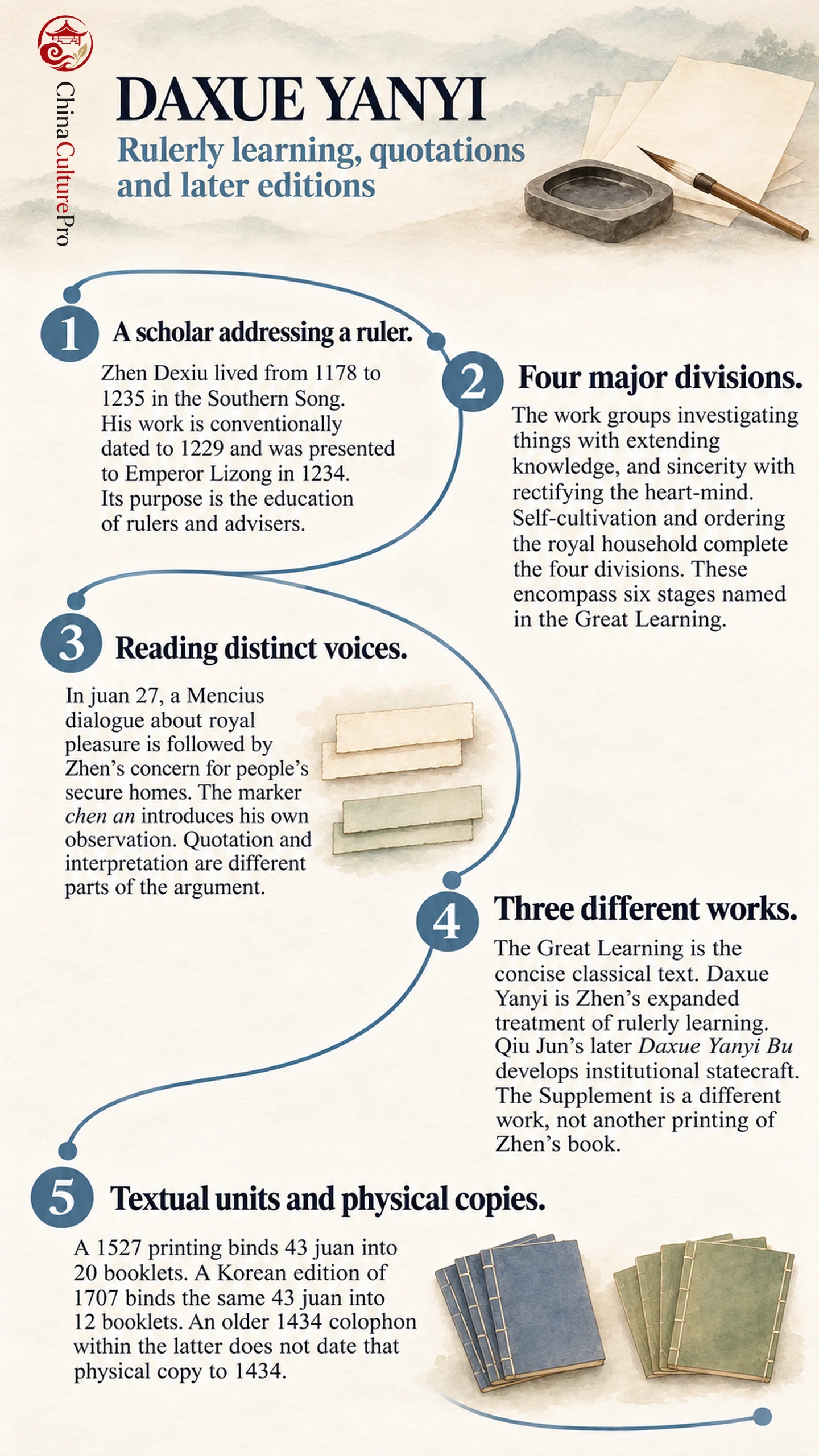
The Daxue Yanyi (大学衍义, Dàxué Yǎnyì) contains 43 juan (卷, juàn), or textual divisions, and was compiled by Zhen Dexiu (真德秀, Zhēn Déxiù), a scholar-official of the Southern Song (南宋, Nán Sòng). It expands the Great Learning (大学, Dàxué) into a guide for educating rulers.[1][3]
- Purpose: Connect a ruler’s moral formation with the exercise of power.
- Method: Arrange classical passages, historical examples and explanatory judgments.
- Structure: Introductory discussions followed by four major thematic divisions.[1]
It is neither the short Great Learning itself nor an ordinary modern university textbook. Here “great learning” names a classical program of ethical and political education.
A ruler’s private choices could have public consequences, from selecting advisers to managing the palace household. Zhen Dexiu organized earlier writings around that problem. Reading his compilation means following both the authorities he quotes and the political lesson he draws from them.
Why Zhen Dexiu Addressed a Ruler
Zhen lived from 1178 to 1235 and worked within the intellectual tradition associated with Zhu Xi (朱熹, Zhū Xī). His book belongs to Neo-Confucian learning (理学, lǐxué) in a Song court setting.[3]
Conventionally dated to 1229, the work was presented to Emperor Lizong (宋理宗, Sòng Lǐzōng) in 1234.[1][6]
The preface treats the Great Learning as essential to both ruler and adviser. Reform begins with the ruler’s understanding and conduct, but the adviser must also know how to correct him. This places the book within the responsibilities of scholar-officials, not simply an individual’s private search for virtue.[1]
The Four Main Divisions
Two opening frameworks concern the sequence of governing and the foundations of a ruler’s learning. Four main divisions then organize the detailed materials:[1][4]
| Division | Questions it develops |
|---|---|
| Investigating things and extending knowledge (格物致知, géwù zhìzhī) | Discern teachings and people, understand governing, and examine the people’s circumstances. |
| Making intentions sincere and rectifying the heart-mind (诚意正心, chéngyì zhèngxīn) | Cultivate reverent attention and restrain indulgent desires. |
| Self-cultivation (修身, xiūshēn) | Attend to speech, action and dignified conduct. |
| Ordering the household (齐家, qíjiā) | Consider consorts, palace governance, succession and imperial relatives. |
The first two divisions pair terms, so four divisions encompass six stages named in the Great Learning. They do not replace its entire sequence with only four stages. The final household division is specifically royal: family relationships, palace influence and succession are matters of political authority.[1]
How Quotations Become Political Arguments
An entry can contain an inherited teaching, an earlier event and a judgment addressed to the ruler. Keeping those voices distinct is central to understanding the book.[1]
Juan 27, on the people’s circumstances, quotes Mencius (孟子, Mèngzǐ) speaking with King Xuan of Qi (齐宣王, Qí Xuānwáng) at the Snow Palace (雪宫, Xuě Gōng). The dialogue asks how the ruler’s pleasures relate to the joys and hardships of the people.[2]
Zhen then develops the implication: enjoying a palace should prompt concern for people’s secure homes, rather than self-indulgence. His observation makes people’s living conditions a test of royal conduct.[2]
The marker chen an (臣按, chén àn) introduces the compiler’s own observation. It helps readers distinguish what Zhen is adding from the older words he has selected. The selection and explanation are part of his argument. They prescribe royal conduct; the examples do not by themselves demonstrate that a court followed his advice.[1][2]
Daxue, Daxue Yanyi and the Later Supplement
| Work | Relationship to the others |
|---|---|
| Great Learning | The concise classical text being interpreted. |
| Daxue Yanyi | Zhen’s expanded treatment of rulerly learning. |
| Daxue Yanyi Bu (大学衍义补, Dàxué Yǎnyì Bǔ) | A later supplement by the Ming scholar Qiu Jun (邱濬, Qiū Jùn), extending treatment of statecraft. |
Qiu’s preface explicitly proposes supplementing the treatment of governing the state and ordering the wider realm. Its topics include offices, public finance, ritual, education and defense. The Supplement is another author’s work, not simply a later printing of Zhen’s book.[5][6]
This distinction should not imply that Zhen ignores government. His chosen moral subjects already address the use of power. Qiu develops institutional and administrative questions more extensively.[1][5]
Reading the Text and Its Later Editions
Begin with the short Great Learning, then read Zhen’s preface for his explanation of the compilation. Choose one topic, such as juan 27, and separate the earlier passage from his own observation. Ask what conduct the example is meant to encourage or prevent.[1][2]
Check the edition as well as the title. Two surviving versions illustrate why the textual count and the physical binding must be distinguished:
- Beijing’s 1527 printing: A Directorate of Ceremonial edition in 43 juan and 20 booklets, associated with renewed imperial lectures.
- Seoul’s 1707 printing: A Korean movable-type edition in 43 juan and 12 booklets; the record also preserves references to older colophons.[3][4]
The Seoul record, for example, includes an older colophon dated 1434 within the 1707 edition. That internal reference does not date the physical copy to 1434. Edition history and original composition need separate attention.[3][4]
FAQs About the Daxue Yanyi
Is the Daxue Yanyi the Great Learning itself?
No. It is Zhen Dexiu’s substantial explication of that shorter classical text.[1]
Was the Daxue Yanyi written by Zhu Xi?
No. Zhen wrote it within a tradition associated with Zhu Xi.[3]
Does 43 juan mean 43 physical books?
No. Different editions can bind the same 43 textual units into different numbers of booklets.[3][4]
Does ending with the household mean it ignores government?
No. Rulerly conduct is already political; the later Supplement expands the institutional treatment.[1][5]
Sources
[1] Zhen Dexiu, public-domain Chinese text. Daxue Yanyi: author’s preface, presentation documents and Siku notice
[2] Zhen Dexiu, public-domain Chinese text. Daxue Yanyi, juan 27: understanding the people’s circumstances
[3] Beijing Ancient Books Protection Center, Capital Library. Daxue Yanyi: the 1527 Directorate of Ceremonial printing
[4] Seoul National University, Kyujanggak Institute for Korean Studies. Daxue Yanyi, GC00538: the 1707 movable-type edition
[5] Qiu Jun, public-domain Chinese text. Daxue Yanyi Bu: author’s preface
[6] China Confucius Foundation, China Kongzi Network. Daxue Yanyi, by Zhen Dexiu