

Quick Answer: What Do Chinese Food Names Tell You?
Chinese food names often identify a dish’s main ingredient, cooking method, flavor or cut. Recognizing these clues helps you understand a menu without translating every character.
- Main ingredient: The name may identify chicken, fish, tofu or a vegetable, helping you recognize the central food.
- Cooking method: A word can tell you whether food is steamed, stir-fried, roasted or braised.
- Flavor: Seasoning words may suggest sweetness, sourness, chili heat, garlic or another flavor profile.
- Cut: Small characters can distinguish strips, slices, cubes, chunks and mince.
A dish name is not a complete ingredient list. Broth, cooking fat, sauces and small amounts of meat may be unmentioned, so a vegetable or tofu name alone cannot confirm a vegetarian dish.
You may recognize Kung Pao Chicken or Peking Duck in English yet struggle to find them on a Chinese menu. Even a translated name may leave you wondering about meat, seafood or cooking fat. This guide explains common Chinese food names through their component words, familiar examples and exceptions. Most examples use simplified Chinese and tone-marked Mandarin pinyin; established English menu spellings are identified separately. For the wider context of meals and dining traditions, see Chinese food culture.
How Chinese Dish Names Are Built
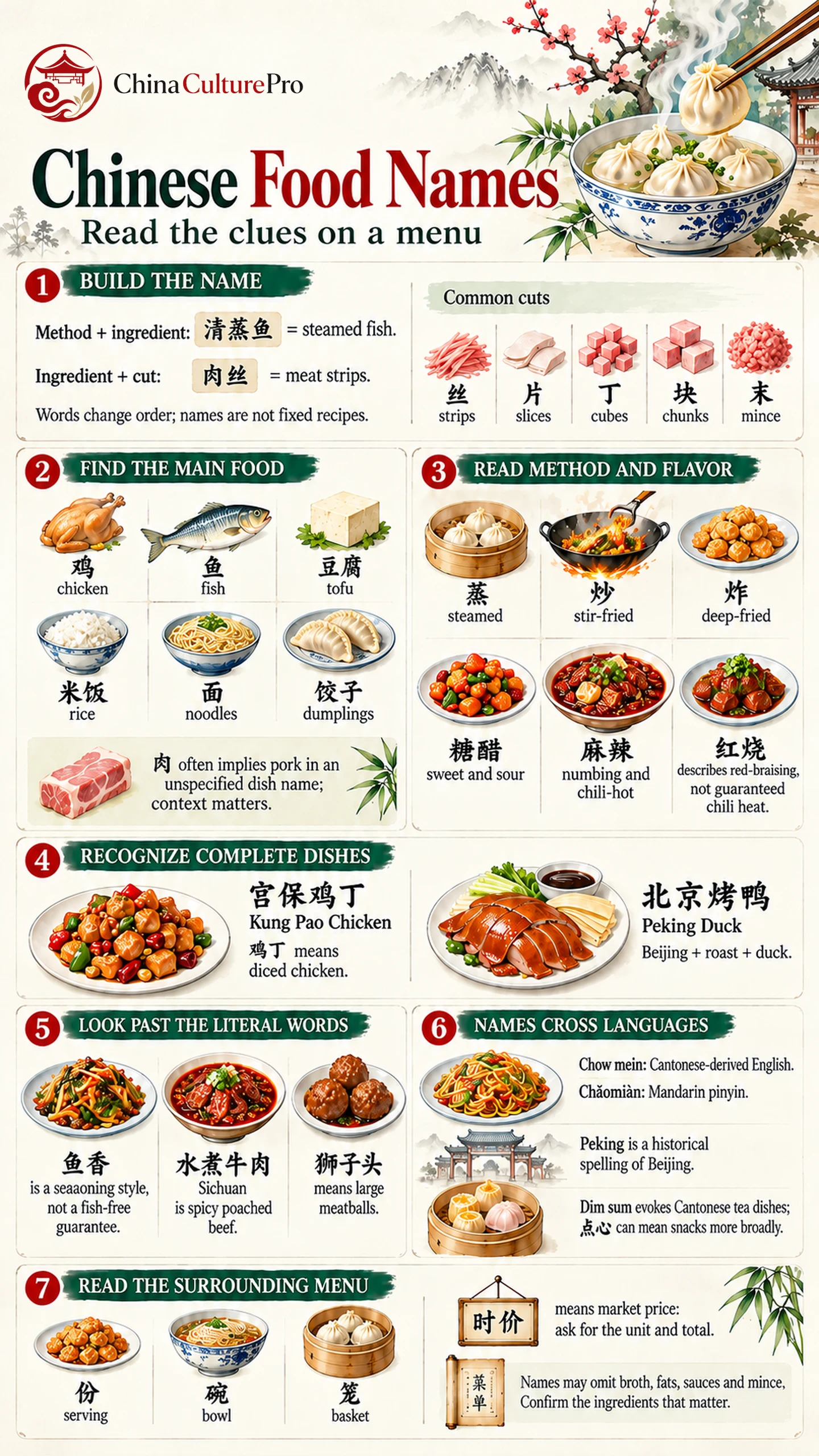
Many descriptive dish names combine familiar building blocks. The following patterns are useful reading aids rather than fixed rules that every restaurant follows. Names can also include a place, person or image, while some omit the cooking method entirely.[1][2]
| Pattern | Chinese example and pinyin | How to read it |
|---|---|---|
| Method + ingredient | 清蒸鱼, qīngzhēng yú | Steamed fish: plain steaming + fish; the name alone does not specify whether the fish is whole. |
| Seasoning or accompanying ingredient + main ingredient | 青椒肉丝, qīngjiāo ròusī | Shredded pork with green pepper: green pepper + meat + strips. |
| Ingredient + method + another ingredient | 西红柿炒鸡蛋, xīhóngshì chǎo jīdàn | Tomato + stir-fry + egg: eggs stir-fried with tomatoes. |
Cutting words often appear at the end of the ingredient they describe: 丝 (sī) means fine strips, 片 (piàn) slices, 丁 (dīng) small cubes, 块 (kuài) chunks, and 末 (mò) mince. Thus, 鸡丁 (jīdīng) is diced chicken, while 肉末 (ròumò) is minced meat, commonly pork in this context.[1]
Read combinations as units. Separating every character mechanically can obscure the meaning of a familiar ingredient or established dish name. A place at the beginning usually adds a regional association, rather than another ingredient.
Essential Ingredient and Staple Words
Find the main food first, then look for words describing its preparation. Some menus organize dishes by protein; others group them by cooking style or restaurant specialty.
Meat, Seafood, Eggs and Tofu
The characters below help identify the central protein. The full word is often more useful than an isolated character: 牛肉 explicitly identifies beef, whereas 肉 on its own usually means pork in many ordinary restaurant dish names.[1] In restaurants serving Chinese Muslim food, confirm the animal instead of assuming that convention applies.
| Chinese and Mandarin pinyin | Common menu meaning |
|---|---|
| 肉, ròu / 猪肉, zhūròu | Meat, commonly pork when unspecified / explicitly pork |
| 牛肉, niúròu | Beef |
| 羊肉, yángròu | Lamb, mutton or goat meat; ask if the distinction matters |
| 鸡, jī / 鸡肉, jīròu | Chicken |
| 鸭, yā | Duck |
| 鱼, yú | Fish |
| 虾, xiā / 虾仁, xiārén | Shrimp or prawns / shelled shrimp or prawn meat |
| 蛋, dàn / 鸡蛋, jīdàn | Egg / chicken egg |
| 豆腐, dòufu | Tofu; the word identifies an ingredient, not the whole recipe |
A familiar ingredient may appear with a more specific cut or part. 排骨 (páigǔ) means ribs, commonly pork ribs on these menus; 五花肉 (wǔhuāròu) identifies pork belly. These terms can explain why two pork dishes have different textures without telling you every seasoning used.
Rice, Noodles, Dumplings and Vegetables
Staple words identify what fills the bowl or wrapper. They are especially helpful when several dishes share the same topping but use different Chinese noodles.
| Chinese and Mandarin pinyin | Common menu meaning |
|---|---|
| 米饭, mǐfàn | Cooked rice, often plain steamed rice |
| 面 / 面条, miàn / miàntiáo | Noodles; often wheat noodles, depending on the full name |
| 米粉, mǐfěn | Rice noodles in a noodle-dish context |
| 粉丝, fěnsī | Thin glass noodles made from starch; not necessarily rice |
| 饺子, jiǎozi | Filled dumplings; filling and cooking method need further clues |
| 包子, bāozi | Filled buns, commonly steamed |
| 饼, bǐng | A broad family of flatbreads, pancakes and other prepared foods |
| 粥, zhōu | Porridge or congee, often rice-based |
| 土豆, tǔdòu / 茄子, qiézi | Potato / eggplant |
| 白菜, báicài / 蘑菇, mógu | Chinese cabbage / mushrooms |
Tomato may appear as 西红柿 (xīhóngshì) or 番茄 (fānqié). The words can identify the same ingredient, so a change in name does not necessarily indicate a different dish. Broader guides to Chinese vegetables and Chinese dumpling types explain distinctions beyond this quick vocabulary reference.
Cooking Methods and Flavor Words
Once you recognize the food, the next useful question is what the kitchen does with it. Method and seasoning can overlap: some established terms describe both preparation and the resulting character.
Words That Describe How Food Is Cooked
Stir-frying, pan-frying and deep-frying are different methods, even when an English menu loosely calls all three “fried.” Recognizing the Chinese word gives a clearer expectation of the dish.[1]
| Chinese and Mandarin pinyin | Menu meaning | Example to recognize |
|---|---|---|
| 炒, chǎo | Stir-fried | 炒饭: fried rice |
| 煎, jiān | Pan-fried | 煎饺: pan-fried dumplings |
| 炸, zhá | Deep-fried | 炸鸡: deep-fried chicken |
| 蒸, zhēng | Steamed | 蒸鱼: steamed fish |
| 烤, kǎo | Roasted or grilled | 烤鸭: roast duck |
| 煮, zhǔ | Boiled or cooked in liquid | 煮鸡蛋: boiled eggs |
| 炖, dùn / 焖, mèn | Stewed or simmered / cooked covered, often braised | 炖牛肉: stewed beef |
| 拌, bàn | Tossed or dressed | 拌黄瓜: dressed cucumber |
| Red-braising (红烧, hóngshāo) | Braising with a dark, often soy-based sauce | 红烧肉: red-braised pork |
| 干煸, gānbiān | Dry-frying to develop a concentrated, browned surface | 干煸四季豆: dry-fried green beans |
The “red” in red-braising refers to the finished color and style, not an instruction to add chili. Likewise, “dry-fried” does not promise an oil-free dish. The technique names help distinguish preparation, but restaurant versions can differ. See Chinese cooking methods for the broader differences between stir-frying, steaming and braising.
Words That Describe Flavor and Seasoning
Flavor words help narrow your choice, but they do not provide a standardized spice rating. A dish can combine sweetness, sourness and heat, while the same named style may taste different between kitchens.
| Chinese and Mandarin pinyin | What it usually signals |
|---|---|
| Mala (麻辣, málà) | Numbing and chili-hot; two different sensations |
| 酸辣, suānlà | Sour and hot; heat may come from pepper, chili or both |
| 糖醋, tángcù | Sweet and sour, associated with sugar and vinegar |
| 蒜蓉, suànróng | Finely minced or crushed garlic |
| 葱油, cōngyóu | Scallion-flavored oil |
| 孜然, zīrán | Cumin |
| 椒盐, jiāoyán | Pepper-and-salt seasoning; the blend varies |
In mala, the tingling or numbing quality is associated with Sichuan peppercorns, while chili supplies heat. Reading 麻 and 辣 as identical loses a useful distinction. Combine the ingredient with its flavor descriptor instead of judging every dish from a region as equally mild or hot.
Common Chinese Food Names Decoded
These examples connect familiar English names with Chinese menu wording. Each row shows what the name reveals and where recognition still depends on knowing the dish. The English labels are useful equivalents, rather than the only acceptable translations; menus may favor description, pinyin or an established name.[3]
| Common English name | Chinese and Mandarin pinyin | What the name tells you |
|---|---|---|
| Kung Pao Chicken | 宫保鸡丁, gōngbǎo jīdīng | 鸡丁 identifies diced chicken; 宫保 is an established style name, not an ingredient list. |
| Mapo Tofu | 麻婆豆腐, mápó dòufu | 豆腐 identifies tofu; the full dish commonly includes minced meat as well as a spicy sauce. |
| Peking Duck | 北京烤鸭, Běijīng kǎoyā | Beijing + roast + duck: place, method and main ingredient. |
| Red-braised pork belly | 红烧肉, hóngshāo ròu | Red-braising + meat; this familiar dish is commonly made with pork belly. |
| Yangzhou fried rice | 扬州炒饭, Yángzhōu chǎofàn | Yangzhou + stir-fried rice; the place name does not list the additions. |
| Egg fried rice | 蛋炒饭, dàn chǎofàn | Egg + stir-fry + rice; other ingredients may still be included. |
| Steamed fish | 清蒸鱼, qīngzhēng yú | Plain steaming + fish; check species, size and whether it is whole. |
| Tomato and eggs | 西红柿炒鸡蛋, xīhóngshì chǎo jīdàn | Tomatoes stir-fried with eggs, often translated as scrambled eggs with tomato. |
| Hot-and-sour soup | 酸辣汤, suānlà tāng | Sour + hot + soup; the name leaves the solid ingredients unspecified. |
| Boiled dumplings | 水饺, shuǐjiǎo | A boiled dumpling form; the name does not identify its filling. |
| Steamed buns | 包子, bāozi | Filled buns; check the filling rather than assuming pork or vegetables. |
Use the last part of an unfamiliar name to identify its food category, then return to the words before it. This works well for many descriptive names, but established names such as Mapo Tofu require dish knowledge too. A menu photograph can support recognition; it cannot reveal an unlisted sauce or cooking fat.
Dish Names That Need More Than a Literal Translation
Some names describe a flavor convention or visual resemblance. Translate the established expression as a unit before drawing conclusions about the ingredients.
- Fish-fragrant pork: 鱼香肉丝 (yúxiāng ròusī) combines shredded pork with fish-fragrant seasoning (鱼香, yúxiāng), a Sichuan flavor style associated with pickled chili, ginger, garlic, sugar and vinegar. It does not mean that fish is the main ingredient. Fish-free versions are common, but fish-associated fermented chilies and other recipe variations mean the name cannot guarantee the absence of fish.[4] The fish-fragrant pork guide explains the dish in more detail.
- Water-boiled beef: 水煮牛肉 (shuǐzhǔ niúròu) uses water-boiling or poaching (水煮, shuǐzhǔ) in its name. In this Sichuan dish, beef is cooked in a strongly seasoned liquid with chili, Sichuan pepper and a hot-oil finish. It is not simply beef boiled in plain water.[5]
- Ants climbing a tree: 蚂蚁上树 (mǎyǐ shàng shù) refers to glass noodles with minced meat. The small pieces of meat against the noodles suggest the image in the name; it does not identify insects as the main ingredient.[2]
- Lion’s head: 狮子头 (shīzitóu) means large meatballs, commonly pork, rather than lion meat. The shape explains the image; the name alone does not identify every ingredient or preparation. The lion’s head meatballs guide covers the regional dish.[2]
These names are useful reminders to check an established dish’s meaning before relying on individual characters. An accurate literal translation can still give an inaccurate picture of dinner.
Why English Spellings and Regional Names Differ
An English menu can mix several naming traditions. Modern Mandarin pinyin is one; Cantonese-derived spellings and older established English forms are others. Different spelling does not automatically mean a different food.
- Chow mein and chǎomiàn: Chow mein is an English borrowing associated with Cantonese speech; 炒面 (chǎomiàn) gives the Mandarin reading. Both names connect to stir-fried noodles, although the dish’s preparation and additions vary by restaurant.[6] The chow mein guide explains the different styles.
- Kung Pao and gōngbǎo: Kung Pao is an older established romanization of 宫保, now written gōngbǎo in Mandarin pinyin. It should not be read as if its letters followed modern pinyin pronunciation.
- Peking and Běijīng: Peking is a historical English spelling of 北京, retained in Peking Duck. It predates modern pinyin and is not the Wade–Giles spelling of Beijing.[7]
Dim sum (点心, diǎnxin in Mandarin) is another Cantonese-derived English expression. In English it usually evokes Cantonese small dishes served with tea. The Chinese word can also mean snacks, light refreshments or pastries more broadly; it is not restricted to sweet cakes in Mandarin.[8] The dim sum guide explains the dining tradition.
Names also travel with recipes. For broader changes in ingredients and presentation, see Chinese food and Chinese-American food.
Reading Menu Sections, Portions and Dietary Clues
After identifying a dish, check the surrounding menu text. Its section, serving unit and optional additions can answer questions that the name leaves open.
Menu Headings and Portion Words
Common headings include cold dishes (凉菜, liángcài), hot dishes (热菜, rècài), staples (主食, zhǔshí), soup (汤, tāng), desserts (甜点, tiándiǎn) and house specialties (招牌菜, zhāopáicài). Their order and availability vary. Cold dishes may include meat as well as vegetables; Chinese cold dishes explains that category.[2]
For portions, 份 (fèn) means a serving; 位 (wèi) indicates a per-person basis; 碗 (wǎn) is a bowl; and 笼 (lóng) is a steamer basket. 小份 (xiǎofèn) and 大份 (dàfèn) distinguish smaller and larger servings without guaranteeing a standard weight or number of diners.
时价 (shíjià) means market price: ask for the current price and its unit. 斤 (jīn) is a weight unit, commonly 500 grams in mainland China. Weight-based seafood pricing occurs in southern China too; it is not a northern-only convention.[9] Confirm the actual weight and total before agreeing to a whole fish or other item priced this way.
What a Dish Name Cannot Confirm
Three kinds of unlisted additions matter: animal broth, cooking fats or condiments, and small pieces of meat. Tofu or greens may be prepared with meat stock, lard, oyster sauce or minced pork. Oyster sauce and fish sauce are condiments, rather than cooking fats; both deserve a specific question when relevant.
- Ingredients: 这道菜有哪些配料?(Zhè dào cài yǒu nǎxiē pèiliào?) — What ingredients are in this dish?
- Meat: 这道菜里有肉吗?(Zhè dào cài lǐ yǒu ròu ma?) — Does this dish contain meat?
- Chili: 可以不放辣椒吗?(Kěyǐ bù fàng làjiāo ma?) — Can you leave out chili peppers?
A meat question does not necessarily clarify the broth or oil, and removing chili does not remove other spicy seasonings. State the particular ingredients you need excluded. For more detailed checks, use Chinese vegetarian food, including its guidance on sauces and stocks.
FAQs About Chinese Food Names
Does Rou Always Mean Pork on a Chinese Menu?
No. 肉 (ròu) commonly implies pork when an ordinary dish name leaves the animal unspecified. Beef, lamb and chicken are usually named explicitly. Context still matters: a halal restaurant’s menu follows different ingredient expectations, so ask which meat is intended rather than applying the convention universally.
Does Fish-Fragrant Sauce Contain Fish?
Not necessarily. Fish-fragrant describes the Sichuan seasoning style, and many versions use no fish. However, the name is not a fish-free guarantee: fermented ingredients, sauces and restaurant adaptations vary. Confirm the actual recipe when the presence of fish matters.
Are Tofu and Vegetable Dishes Always Vegetarian?
No. Tofu and vegetables describe the main ingredients, while meat stock, lard, minced meat or animal-based sauces may be unmentioned. Ask about the preparation and seasonings as well as visible pieces of meat; the name alone cannot settle the question.
Why Is Chow Mein Spelled Differently from Chao Mian?
Chow mein entered English through Cantonese-associated speech and spelling. Chǎomiàn is the Mandarin pinyin for 炒面, often written chao mian without tone marks on English menus. The spellings reflect different language conventions rather than a simple translation error.
Sources
[1] University of Oxford, Centre for Teaching Chinese as a Foreign Language. Information page | 有关信息
[2] Julian K. Wheatley and Tong Chen, MIT OpenCourseWare. The Chinese Menu
[3] Beijing Foreign Affairs Office. 第五期:菜单里的外语便利化服务
[4] Unilever Food Solutions, interview with Tsai Ming-hsiung. 美食家蔡名雄談川菜(三)必備食材
[5] CCTV. [天天饮食]天天美味 水煮牛肉
[6] Collins English Dictionary. Chow Mein
[7] Li Liang, Peking University News. 北大英文校名漫谈
[8] Hong Kong Lexicography. 「點心」
[9] Shanwei Development and Reform Bureau. 汕尾市景区海鲜价格监测日报(2026-09-29)