


Quick Answer: What Is a Chinese Leap Month?
A Chinese leap month (闰月, rùnyuè) is an extra lunar month inserted into the Chinese calendar (农历, nónglì) to keep its months aligned with the seasons. It makes the calendar lunisolar: months follow the Moon, while the year also accounts for the Sun.[1]
- Name: It repeats the preceding month’s number, with “leap” added, rather than receiving the permanent name “month 13.”
- Length: It contains 29 or 30 days, just like an ordinary lunar month.
- Year: A Chinese year containing a leap month has 13 months instead of 12.[2]
A leap month adds an entire month. A Gregorian leap day adds only February 29.
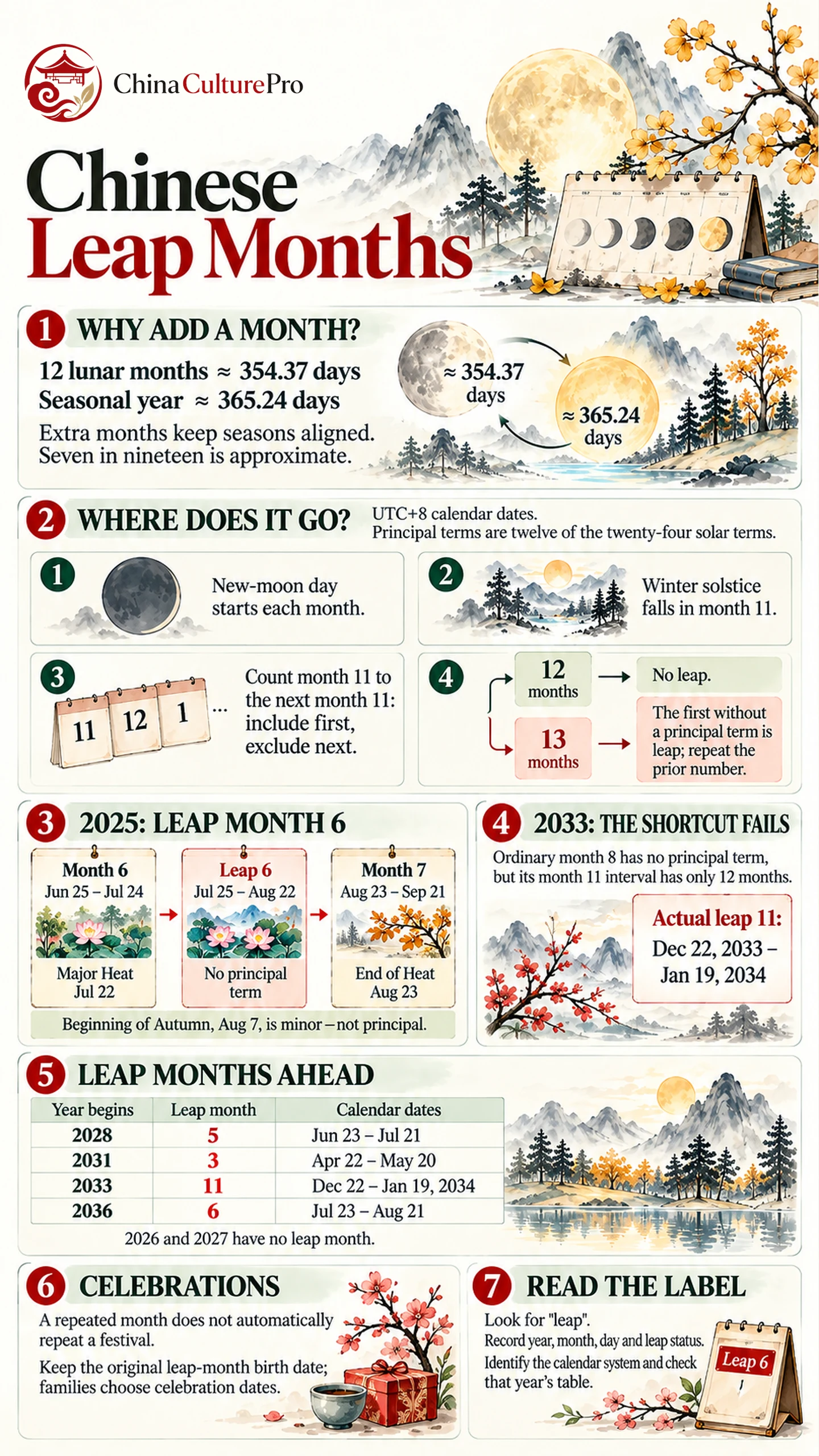
Seeing two sixth months on a lunar calendar can look like a printing mistake. The repeated number marks a deliberate adjustment that connects lunar months with the seasons. This guide explains that adjustment; our Chinese lunar calendar overview covers the wider system, including festival dates and year names.
Why Does the Chinese Calendar Need Leap Months?
Twelve lunar months fall short of a complete cycle of seasons. The average interval between new moons is about 29.5306 days, so twelve such intervals total roughly 354.37 days. A tropical year, which tracks the seasonal cycle, lasts about 365.24 days: a difference of almost eleven days.[1]
Without an adjustment, numbered lunar months would gradually move through the seasons. A New Year associated with winter would eventually occur in summer. Adding occasional whole months keeps the seasonal relationship broadly stable while allowing each month to remain tied to the Moon.
The familiar “seven leap months in nineteen years” describes a close astronomical fit: nineteen solar years are approximately 235 lunar months, or nineteen sets of twelve months plus seven extra months. It is a useful explanation of frequency, not a timetable that repeats unchanged. Modern placement depends on calculated astronomical events, rather than a fixed every-third-year instruction.[4]
How Is a Chinese Leap Month Determined?
Modern placement combines new-moon dates with solar terms (节气, jiéqì), the twenty-four markers of the Sun’s annual progress. Twelve alternating markers are principal solar terms (中气, zhōngqì), also called major solar terms. These occur at 30-degree intervals of solar longitude; the intervening twelve are minor or sectional terms.[5]
The following sequence explains the modern rules using UTC+8 civil dates:[3]
- Mark the month starts: Each month begins on the calendar day containing an astronomical new moon. It does not wait for a visible crescent.
- Anchor month 11: The month containing the winter solstice (冬至, dōngzhì) is month 11.
- Count complete months: Count from the start of that month 11 to the start of the next winter-solstice month 11. Include the first month 11, but exclude the next. Twelve months require no leap month in this interval; thirteen require one.
- Locate and name the extra month: In the thirteen-month interval, the first month without a principal solar term is the leap month. Give it the preceding month’s number and add the leap designation.
This counting interval is different from a Chinese New Year–to–New Year calendar year. Checking only the months between two New Year celebrations misses the rule’s winter-solstice anchor.[3]
Why the Simple Rule Fails in 2033
A month without a principal solar term is not automatically a leap month. In 2033, ordinary month 8 runs from August 25 through September 22 and contains no principal term. Nevertheless, the month-11 interval containing it has only twelve months, so it remains ordinary month 8.[6]
The following interval has thirteen months. Its first month lacking a principal term begins on December 22, 2033, after regular month 11. That becomes leap month 11, ending January 19, 2034. Winter solstice falls on December 21 in regular month 11; the next principal term falls on January 20, in month 12.[6]
The exceptional-looking result follows the full rule. It exposes the missing condition in the shortcut, rather than a broken calendar.
Example: The Leap Sixth Month of 2025
In 2025, the extra month came after the ordinary sixth month. Three neighboring months show how principal terms help distinguish them. These Gregorian date ranges include both their first and last days.[7]
| Lunar month | Gregorian dates in 2025 | Principal solar term inside it |
|---|---|---|
| Ordinary month 6 | June 25–July 24 | Major Heat (大暑, Dàshǔ), July 22 |
| Leap month 6 | July 25–August 22 | None |
| Month 7 | August 23–September 21 | End of Heat (处暑, Chǔshǔ), August 23 |
The leap sixth month still contains Beginning of Autumn (立秋, Lìqiū), on August 7. This is a minor solar term, not one of the twelve principal terms. Saying “a leap month has no solar terms” would therefore be wrong.[5][7]
Notice the boundary on August 23: it is both the opening date of month 7 and the date of End of Heat. A term occurring on a month’s opening civil date belongs to that new month. It does not belong to the month ending the day before.[9]
Recent and Upcoming Chinese Leap Months
As of October 2026, the next Chinese leap month is leap month 5 in 2028. The Chinese years beginning in 2026 and 2027 have no leap month. The table places that next occurrence beside the recent 2025 example and several later dates.[7]
| Chinese year beginning in | Leap month | Gregorian date range, inclusive | Days |
|---|---|---|---|
| 2025 | Month 6 | July 25–August 22, 2025 | 29 |
| 2028 | Month 5 | June 23–July 21, 2028 | 29 |
| 2031 | Month 3 | April 22–May 20, 2031 | 29 |
| 2033 | Month 11 | December 22, 2033–January 19, 2034 | 29 |
| 2036 | Month 6 | July 23–August 21, 2036 | 30 |
The year label refers to the Chinese year that begins in that Gregorian year. It does not mean every day of the leap month stays within the same Gregorian year, as the 2033 row demonstrates. These are calendar dates, not announcements of festival programs or public-holiday leave.
Do Leap Months Change Festivals and Birthdays?
A repeated month does not automatically create a second celebration of a traditional festival. The Dragon Boat Festival is observed on day 5 of ordinary month 5; a leap fifth month does not, by itself, add another Dragon Boat Festival. Family or local observances should be distinguished from this usual festival date.[8]
For someone born in a leap month, keep the leap marker in the original lunar birth record. “Leap month 6, day 1” and “month 6, day 1” identify separate dates. When a later year has no matching leap month, choosing a birthday gathering date is a family decision. That choice does not change the recorded birth date or turn an ordinary month into a leap month.
How to Recognize a Leap Month on a Calendar
Look for 闰, its traditional form 閏, or the English word “leap” before a repeated month number. When saving a lunar date, record the full year, month, day and leap status, and identify the calendar system. Leaving out either the day or the leap marker makes the record incomplete.
For conversion, find the exact month and day in the relevant year’s Gregorian–lunar conversion tables, available for 1901–2100.[7] Do not use a fixed day offset or silently substitute the ordinary month.
Our lunar birthday calculator can recover the original lunar date from a Gregorian birth date. It does not generate future annual birthday dates or decide how to celebrate when the original leap month is absent.
FAQs About Chinese Leap Months
Does a Chinese leap month always have 30 days?
No. A leap month can have 29 or 30 days. Leap month 6 has 29 days in 2025 and 30 in 2036. An ordinary month and its leap counterpart need not have equal lengths.[7]
Is a Chinese leap year the same as a Gregorian leap year?
No. A Chinese leap year contains an extra lunar month; a Gregorian leap year contains February 29. The year 2025 has a Chinese leap sixth month but no Gregorian leap day.[2][7]
Does the calendar repeat exactly every 19 years?
No. Nineteen years provide an approximate fit between lunar and solar cycles, not an exact replay of calculated dates. Neither leap-month placement nor Gregorian–lunar date matches can be assumed to repeat unchanged.[4]
Why does the leap month’s number change?
Its position follows the relationship between new-moon dates and principal solar terms within the winter-solstice framework. There is no fixed rotation through month numbers, so a leap sixth month need not be followed by another leap sixth month.[2]
Sources
[1] Hong Kong Observatory. The Chinese Agricultural Calendar
[2] NASA. Calendars and Their History
[3] Standardization Administration of China. GB/T 33661-2017: Calculation and Promulgation of the Chinese Calendar
[4] Y. T. Liu. Why Do the Rules for the Chinese Calendar Work?
[5] Hong Kong Observatory. The 24 Solar Terms
[6] Y. T. Liu. Examples of Computing the Chinese Calendar
[7] Hong Kong Observatory. Gregorian–Lunar Calendar Conversion Table, 1901–2100
[8] CCTV. Three Days Off: Two Lunar Fifth Months, but Only One Dragon Boat Festival
[9] Y. T. Liu. Rules for the Chinese Calendar