

Quick Answer: How Does the Chinese Calendar Differ from the Gregorian Calendar?
The Chinese calendar (农历, nónglì) is lunisolar: it combines lunar months with the Sun’s seasonal cycle. The Gregorian calendar is solar: its year follows the seasonal cycle, while its months do not track Moon phases. The two systems give the same day different date labels.[1]
| Feature | Chinese calendar | Gregorian calendar |
|---|---|---|
| Astronomical basis | Moon phases and the solar seasonal cycle | The solar seasonal year |
| Month length | 29 or 30 days, determined by astronomical calculations | 28–31 days, following established month lengths |
| Months and days per year | Common: 12 months, 353–355 days; leap: 13 months, 383–385 days | Always 12 months; common: 365 days; leap: 366 days |
| Year begins | First day of the first lunar month | January 1 |
| Leap adjustment | Adds a whole leap month (闰月, rùnyuè) | Adds February 29, a leap day |
The year-length ranges matter: a Chinese common year is not invariably 354 days. These structural differences also mean there is no fixed number of days to add or subtract when converting a date.[2]
Mid-Autumn Festival appears on a different date each autumn, while a phone calendar can show two dates inside the same square. Both make sense once you distinguish the two systems. Our Chinese Lunar Calendar guide covers their wider cultural context; this comparison explains the date labels and how to convert them.
How Months and Years Are Counted
Gregorian months are fixed divisions of the civil year. August 15 identifies a day in August without specifying the Moon’s phase. The date can fall near a full moon, new moon or another phase.
A Chinese month begins on the civil day containing the astronomical new moon, when the Sun and Moon have the same ecliptic longitude as viewed from Earth. The calendar uses a calculated event, not the first visible crescent. Each month continues until the day before the next month begins.[1]
That difference changes how month numbers should be read. Lunar month eight, day fifteen means the fifteenth day of the eighth lunar month, not August 15. A full moon occurs near the middle of a lunar month, but it is not guaranteed to fall on day fifteen. Nor do 29-day and 30-day months follow an unchanging alternating pattern.[2]
The year boundaries differ too. January 1 starts every Gregorian year; Chinese New Year starts the first lunar month and falls in January or February in modern use. A lunar year therefore overlaps two Gregorian years.
Solar terms (节气, jiéqì) provide the seasonal framework. They mark the Sun’s progress through the year rather than phases of the Moon, helping explain how lunar months remain connected with the seasons.[7]
Leap Day vs Leap Month: Two Different Adjustments
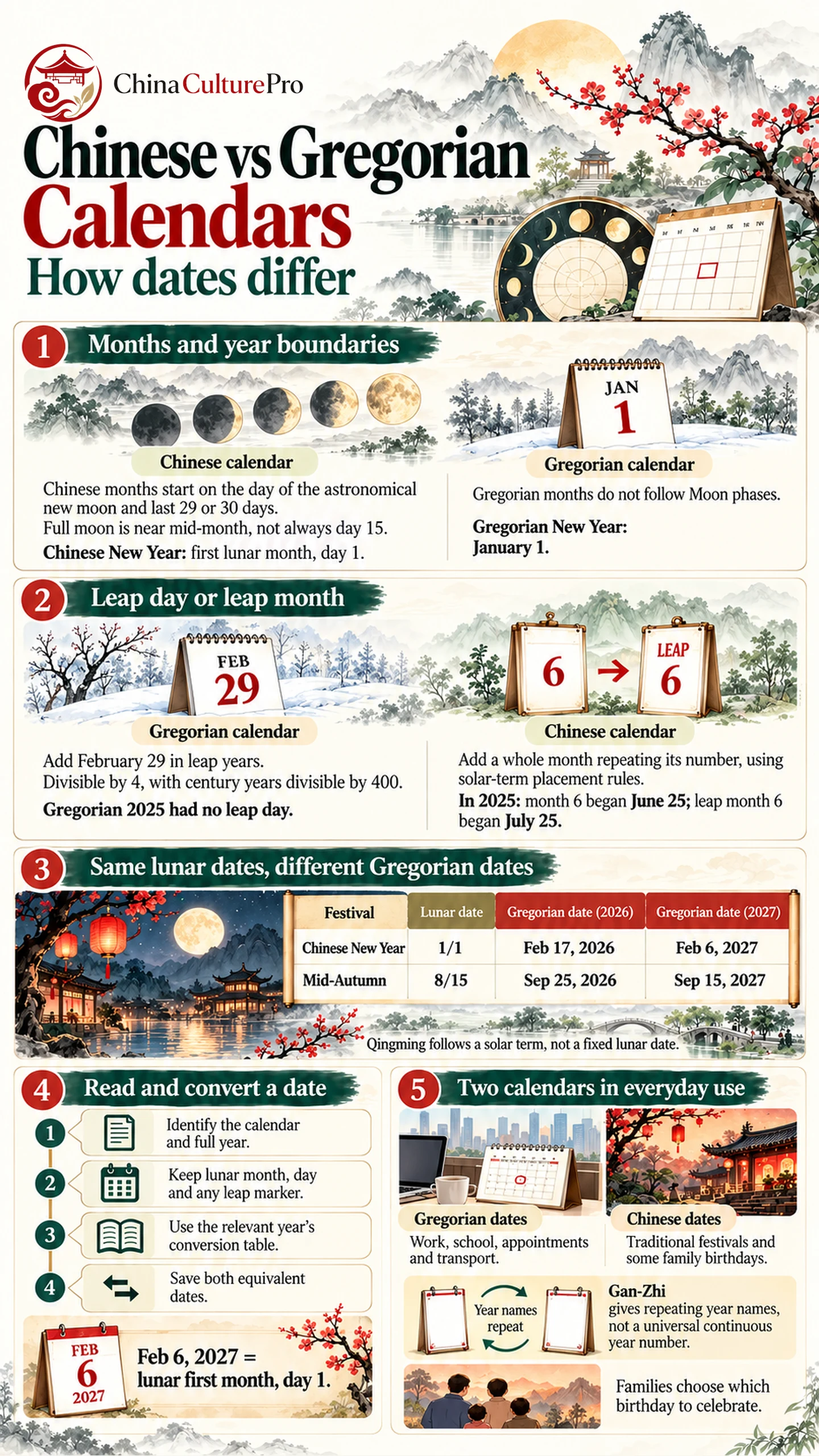
A Gregorian leap day is the extra February 29 in a 366-day year. A year is leap if it is divisible by four, except century years must also be divisible by 400. Thus 2000 was a leap year, while 1900 was not. The rule keeps the average calendar year close to the seasonal year.[3]
A Chinese leap month is an additional 29-day or 30-day month that repeats the preceding month’s number. An ordinary sixth month can be followed by a leap sixth month before month seven. The calendar gains a month without introducing a permanent month numbered thirteen.
Its placement depends on the solar framework. Month eleven contains the winter solstice. When thirteen lunar months lie between the starts of successive solstice-containing months, the first month in that interval without a principal solar term (中气, zhōngqì) is intercalary. A principal term is one of twelve major markers within the twenty-four solar terms. Simply finding a month without one is not a complete placement rule.[2]
The distinction is visible in 2025: ordinary month six began on June 25, and leap month six began on July 25. Yet Gregorian 2025 was a common year with no February 29. A leap month and leap day need not occur in the same year.[4]
The familiar approximation of seven extra months in nineteen years describes the relationship between the cycles. It is not a mechanical conversion formula; use a published calendar for an actual date.
Why Chinese Festivals Change Gregorian Dates
Many traditional festivals keep the same lunar month and day while moving within the Gregorian calendar. The festival has not changed its traditional date: the correspondence between the calendars has changed.
These two festivals illustrate the difference across 2026 and 2027.[5][6]
| Festival | Lunar date | Gregorian date in 2026 | Gregorian date in 2027 |
|---|---|---|---|
| Chinese New Year | First month, day 1 | February 17, 2026 | February 6, 2027 |
| Mid-Autumn Festival | Eighth month, day 15 | September 25, 2026 | September 15, 2027 |
The intervals are not a universal annual subtraction rule. A leap month can shift where a later festival lands, and a date can recur in another year. Check the year you actually need rather than extrapolating from the previous celebration.
Qingming follows a different rule: it is tied to a solar term, not a fixed lunar month and day. Its Gregorian date consequently stays close to the same seasonal point. Traditional Chinese observances therefore cannot all be placed in one fixed-lunar-date category.[7]
These are calendar dates, not predictions of public-holiday leave or local event schedules.
How to Read and Convert a Chinese Calendar Date
A complete conversion needs the year as well as the month and day. When starting from a lunar date, it also needs any leap-month designation. Without those details, the input can identify more than one possible day.
- Identify the source calendar: Establish whether the original date is Gregorian or lunar, and retain the complete year. A bare “8/15” does not tell you which system the writer intended.
- Keep the full lunar label: Record the lunar year, numbered month and day, preserving “leap” when present. An ordinary month and its same-numbered leap month are separate months.
- Use the relevant year’s table: Find the date in a reliable Gregorian–lunar conversion table. Check both year labels, especially around January and February, when a lunar year may continue into the next Gregorian year.
- Save both equivalent dates: Write the Gregorian year, month and day beside the complete lunar record so its meaning remains clear later.
For example, February 6, 2027 corresponds to the first day of the first month of the Ding-Wei (丁未, Dīng-Wèi) lunar year.[6]
Official conversion tables cover 1901–2100.[8] Our lunar birthday calculator can also recover the original lunar date from a Gregorian birth date; it does not generate future annual birthday schedules. Neither method requires an astrology reading or birth-hour calculation for this basic date lookup.
Which Calendar Is Used in China Today?
Modern China uses the Gregorian calendar for ordinary civil scheduling: administrative dates, work and school calendars, business appointments and transport bookings. The traditional calendar remains important for festivals, some family birthdays and other cultural observances.[2]
A person might book a train using its Gregorian departure date while remembering a parent’s birthday by its lunar month and day. Recording one does not cancel the other, and the two labels do not create two separate days.
Calendars can also display Gan-Zhi (干支, gānzhī), the repeating stem-and-branch naming system, or a zodiac animal. Those annotations identify traditional cycles alongside the numerical dates; they are not an alternative Gregorian year number.
Birthday preferences differ between individuals and families. Some follow the lunar date, some the Gregorian date, and some mark both. Neither a compulsory second celebration nor an auspicious-date practice is required to use the calendar.
FAQs About the Chinese and Gregorian Calendars
Is the Chinese calendar always one month behind the Gregorian calendar?
No. Both calendars label the same chronological day. Their month boundaries, year boundaries and leap adjustments differ, so “one month behind” is not a conversion rule. Look up the complete date rather than treating the calendars as a fixed time difference.
Do people in China celebrate lunar or Gregorian birthdays?
Both practices occur, and some families celebrate both. The choice is personal or familial. When an exact lunar anniversary is absent because a leap month or day thirty is missing, a family can choose a substitute celebration date without changing the original birth record.
What year is it in the Chinese calendar?
Traditional years have repeating names rather than one universally used continuous year count. The year beginning February 17, 2026 is Bing-Wu (丙午, Bǐng-Wǔ); Ding-Wei begins February 6, 2027. Those names repeat after sixty years, so there is no universal numerical offset to add to a Gregorian year.[2][5][6]
Sources
[1] Hong Kong Observatory. The Chinese Agricultural Calendar (Nongli)
[2] NASA Goddard Space Flight Center. Calendars and their History
[3] Hong Kong Observatory. Leap Year
[4] Hong Kong Observatory. 2025 Gregorian–Lunar Calendar Conversion Table
[5] Hong Kong Observatory. 2026 Gregorian–Lunar Calendar Conversion Table
[6] Hong Kong Observatory. 2027 Gregorian–Lunar Calendar Conversion Table
[7] Hong Kong Observatory. The 24 Solar Terms
[8] Hong Kong Observatory. Gregorian–Lunar Calendar Conversion Table