

Quick Answer: What Is Zhonghe Festival?
Zhonghe Festival (中和节, Zhōnghé Jié) was an officially established Tang festival, originally assigned to the first day of the second lunar month.
- Establishment: Emperor Dezong instituted it in 789, with Chancellor Li Mi helping design its observances.
- Seasonal purpose: Agricultural offerings, gifts and gatherings expressed spring renewal and ideals of harmony.
- Later usage: The name continued in local traditions, including some associated with lunar February 2.
It should not automatically be equated with Longtaitou (龙抬头, Lóngtáitóu). Historical institutions and later uses of a name require separate explanations; a shared spring setting does not make every custom identical.[1][4]
Why do accounts place Zhonghe Festival (中和节, Zhōnghé Jié) on different lunar dates, sometimes calling it Longtaitou (龙抬头, Lóngtáitóu)? The answer depends on the period and community. This guide separates the Tang institution from later local traditions within the wider calendar of Chinese festivals and holidays.
What Do Historical Sources Tell Us About Zhonghe Festival?
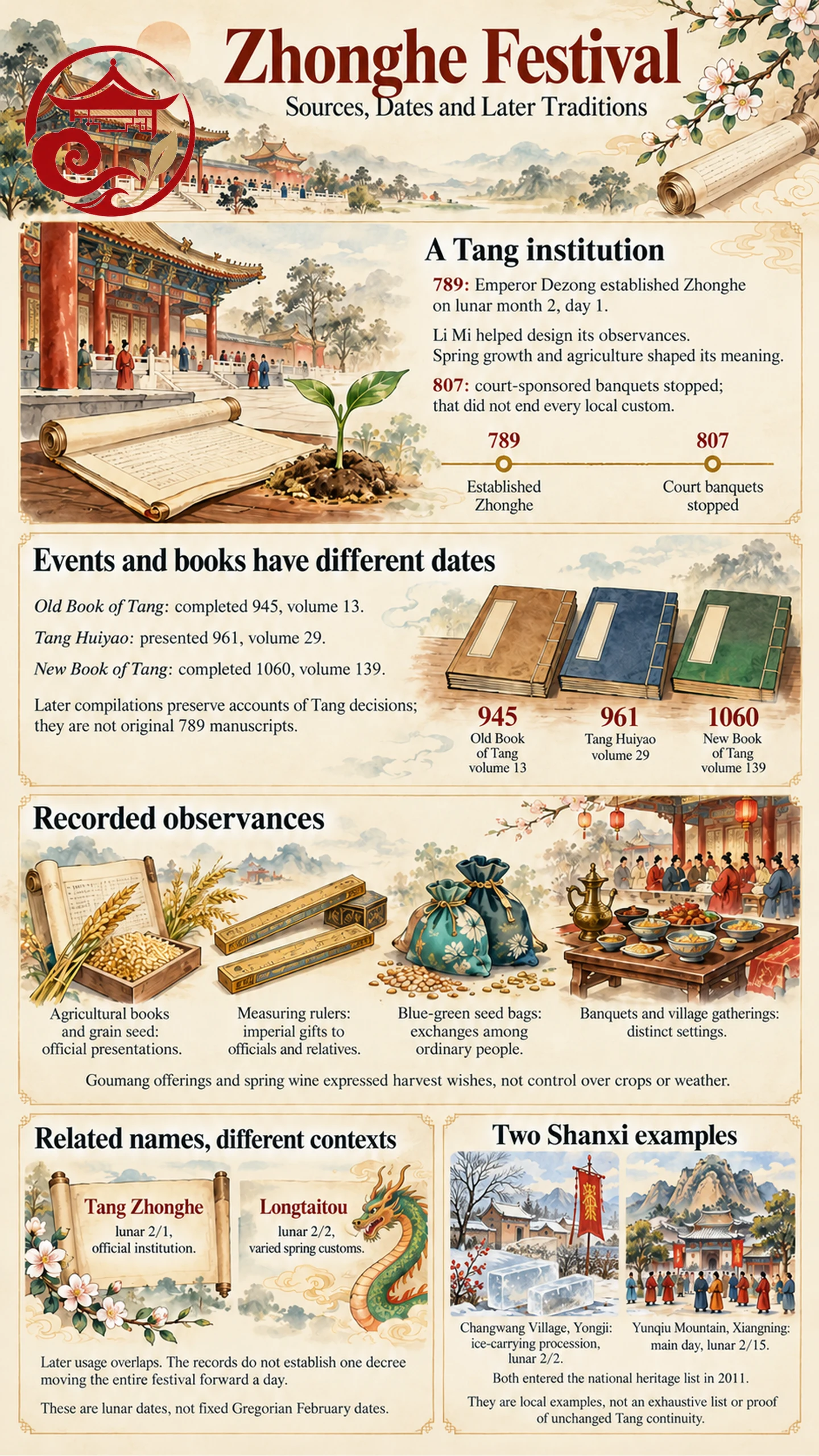
In the fifth year of the Zhenyuan reign, 789, Emperor Dezong designated lunar February 1 as Zhonghe Festival. The decree replaced the previously designated celebration on the last day of the first lunar month and granted government offices a day’s leave. This is a specific institutional change, not evidence that all spring farming customs began that year.[1]
The surviving accounts were compiled after the Tang. Three texts provide useful, different views:
- Old Book of Tang: The Old Book of Tang (旧唐书, Jiù Tángshū), completed in 945, records the decree and related provisions in volume 13, the latter part of Dezong’s annals.[1][7]
- Tang Huiyao: Tang Huiyao (唐会要, Táng Huìyào), presented in 961, organizes institutional material. Volume 29 records festival arrangements and later changes to official banquets.[2][8]
- New Book of Tang: The New Book of Tang (新唐书, Xīn Tángshū), completed in 1060, describes Li Mi’s proposals in volume 139, his biography.[3][7]
These are historical compilations preserving accounts of Tang decisions. Reading their digital transcriptions is not the same as examining an original decree issued in 789. Their agreement on the date is useful; their descriptions of proposed activities do not measure how many households followed them.
Zhonghe joined Shangsi (上巳, Shàngsì) and Chongyang (重阳, Chóngyáng) as the “three appointed festivals” (三令节, sān lìngjié). That grouping concerned official celebration, not a claim that China had only three festivals. The name Zhonghe evokes balance and harmony. The recorded decree describes plants beginning to grow and the world coming into seasonal harmony, placing the new observance within the renewal of spring.[3][4]
What Customs Were Recorded for the Tang Festival?
The records give the festival a concrete identity through books, seeds, measuring tools and gatherings. They also distinguish what officials presented to the ruler from exchanges described among ordinary people. Four groups of observances help explain that distinction.
- Agricultural books and seeds: Officials presented farming texts, while the agricultural administration offered grain seed. In 790, the recorded presentation included the three-volume Zhaoren Benye (兆人本业, Zhàorén Běnyè) and two kinds of millet seed. Books and seed represented support for farming as a foundation of government.[1]
- Rulers and clothing: Gifts of measuring rulers to senior officials and imperial relatives were called caiduo (裁度, cáiduó). The decree also called for royal and elite relatives to present spring clothing to the emperor. Scholarly interpretation connects the measuring ruler with standards and proper government; it was more than a decorative spring souvenir. Rulers granted by the emperor should be distinguished from provisions for exchanging knives and rulers among the population.[3][4]
- Seed-bag exchanges: The custom called xian shengzi (献生子, xiàn shēngzǐ) involved giving blue-green bags containing grain, melon and fruit seeds. Despite the phrase’s possible ambiguity to a learner, the passage describes seed gifts, not presenting babies. Its agricultural objects matter more than a misleading word-for-word translation.[3]
- Banquets and village gatherings: Court-sponsored banquets included officials gathering at Qujiang. The same festival framework also described community wine and offerings to the spring deity Goumang (勾芒, Gōumáng). Yichun wine (宜春酒, yíchūnjiǔ) belonged to wishes for a good harvest within that belief system, not a way to control weather or crop yields.[2][3]
These activities explain the festival’s agricultural and political character without turning the documented program into a uniform household routine.
How Is Zhonghe Festival Related to Longtaitou?
The names overlap in later usage, but a historical explanation must begin with their different date references. Tang Zhonghe is documented as an official observance on lunar February 1. Longtaitou is associated with lunar February 2; contemporary Beijing descriptions, for example, connect that day with haircuts and foods given dragon names.[1][9]
| Comparison | Tang Zhonghe Festival | Longtaitou | How to interpret it |
|---|---|---|---|
| Date | First day of the second lunar month | Second day of the second lunar month | Neither is a fixed Gregorian February date. |
| Historical setting | An official festival instituted in 789 | A name associated with varied spring folk customs | Do not infer two parallel Tang institutions from later naming. |
| Recognizable activities | Agricultural presentations, measuring-ruler gifts and official gatherings | Haircuts and locally named “dragon foods” | These identify the contexts without supplying a universal checklist. |
| Later naming | Retained in some local festival traditions | Sometimes overlaps with Zhonghe terminology | Shared names do not prove identical Tang dates or practices. |
Neighboring dates and agricultural themes help explain the apparent interchangeability. Later records do show overlapping usage. They do not, however, establish a single decree moving the entire Tang festival one day forward. The evidence supports later connections without making the two names identical in every period.[4][5]
For any reference to “Zhonghe Festival,” ask which period and place it describes. A passage about Li Mi’s court proposals and a description of a present-day village procession can both use the name while referring to different observances. Local names preserve cultural relationships without functioning as a nationwide calendar rule.
Where Does the Name Zhonghe Survive Today?
In 807, the court stopped granting official banquets for Zhonghe and Chongyang. The record concerns that form of court-sponsored celebration. It does not say that every associated gift, gathering or local practice ended at once.[2]
Two documented Shanxi examples show why the name remains relevant. Both were included in the third batch of the national intangible cultural heritage list in 2011, under the Zhonghe Festival project.[5][6]
In Changwang Village, Yongji, beibing (背冰, bèibīng), literally “carrying ice on the back,” is a local procession involving ice-carrying performers. The heritage account associates it with lunar February 2. Its origin story is presented as a local legend; the listing does not demonstrate that this performance formed part of Dezong’s original festival or continued unchanged from the Tang.[5]
At Yunqiu Mountain in Xiangning County, the central festival day is lunar February 15. The documented tradition includes mountain gatherings, folk performances and religious observances expressing community wishes. Its calendar therefore differs from both the original Tang date and the February 2 association in Yongji.[6]
These examples are not an exhaustive census of present-day practice. They show that the name survives with local meanings and dates. Heritage recognition records particular traditions; it cannot by itself prove an uninterrupted, identical history or announce a future year’s event schedule.
FAQs About Zhonghe Festival
Is Zhonghe Festival the Same as Longtaitou?
The names can overlap in later local usage, but they are not interchangeable in every historical context. Tang Zhonghe was set on lunar February 1; Longtaitou is associated with lunar February 2.
Is Zhonghe Festival on February 1 or February 2?
Specify the lunar calendar and context. The Tang official date was lunar February 1. Yongji’s local account uses February 2, while Yunqiu Mountain’s main day is February 15. None is a fixed Gregorian date.
Is Zhonghe Festival Still Celebrated Today?
The name remains in documented local traditions, including Yongji’s ice-carrying procession and Yunqiu Mountain’s festival. These examples do not establish one nationwide form of celebration or prove that no other communities use the name.
Sources
[1] Liu Xu and fellow compilers. 旧唐书(四库全书本)卷十三·德宗下
[2] Wang Pu. 唐会要·卷二十九
[3] Ouyang Xiu, Song Qi and fellow compilers. 新唐书·卷一百三十九·李泌传
[4] Zhang Bo, Wenzhou University Folklore Museum. 中和节——一个鲜为人知的节日
[5] China Intangible Cultural Heritage Network. 中和节(永济背冰)
[6] China Intangible Cultural Heritage Network. 中和节(云丘山中和节)
[7] Kindai University Central Library, National Diet Library Collaborative Reference Database. 『唐書』について知りたい。
[8] Chinese Text Project. Tanghuiyao 唐會要
[9] Beijing Municipal Government. 春分至 龙抬头 咬春品鲜莫忘“安全”