

Quick Answer: What Happens on Chinese New Year’s Eve?
Chinese New Year’s Eve, called Chuxi (除夕, chúxī), is the final day of the old year in the Chinese calendar. Family gatherings connect the closing year with the next.
- Family meal: Relatives gather for a reunion dinner (年夜饭, niányèfàn), with food and arrangements chosen by the household.
- Keeping vigil: Shousui (守岁, shǒusuì) is the tradition of staying awake to welcome the new year.
- Household differences: Remembrance, gift money and evening activities vary; some families observe more rituals than others.
These are familiar practices, not a required checklist for every Chinese family.[2][6]
An invitation to a family celebration can leave you unsure which day to arrive, how long to stay, or whether everyone is expected to remain awake. Chinese New Year’s Eve centers on being together, within a wider Chinese New Year season whose customs vary between households.
When Is Chinese New Year’s Eve?
Eve is the last day of the twelfth lunar month, so it can fall on either day 29 or day 30. The familiar name “the thirtieth night” does not mean every year has that date. The final lunar month sometimes ends a day earlier.
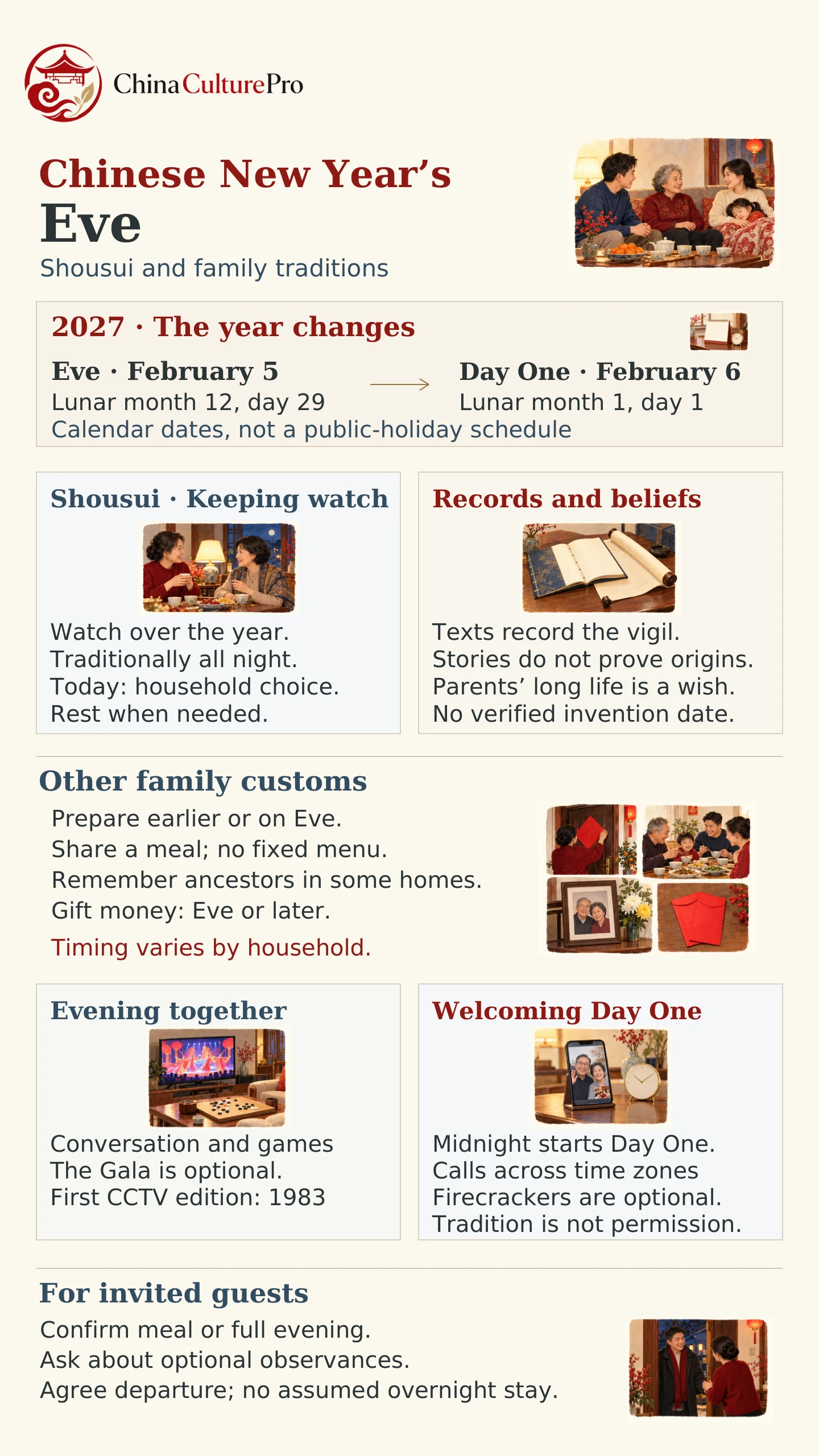
For 2027, the calendar dates are:
- New Year’s Eve: February 5, the 29th day of the twelfth lunar month.
- New Year’s Day: February 6, the first day of the first lunar month.[3]
The evening of February 5 therefore belongs to the old lunar year, even though it is part of the wider festive season. It is not Day One of the new year.
An invitation for Eve and an invitation for New Year’s Day can mean different gatherings. Confirm the calendar date with the host; the cultural date alone does not establish anyone’s statutory holiday or work schedule.
What Does Shousui Mean?
Shousui describes keeping watch as the year ends. Its traditional meaning, associated wishes and modern adaptations are related, but they answer different questions.
Guarding the Year and Wishing Parents Well
The characters explain the name: 守 (shǒu) means to keep watch, while 岁 (suì) refers to the year. In its traditional sense, shousui is an all-night vigil on New Year’s Eve. It is more specific than simply having dinner late or finishing a meal.[2]
The custom also carries wishes for older relatives. In some traditional explanations, younger family members keep vigil as an expression of hope for their parents’ longevity. Other interpretations emphasize cherishing the passing year and welcoming the next. These are cultural hopes, not evidence that staying awake can lengthen anyone’s life.[4]
Family company is central to the occasion: people share the passage of time rather than treating the date change as an ordinary bedtime. How long they actually remain awake is a separate household choice.
Historical Records and Folk Legends
An early description is attributed to the Jin-period writer Zhou Chu (周处, Zhōu Chǔ) and his Fengtu Ji (风土记, Fēngtǔ Jì). It associates remaining awake until dawn with a regional year-end custom. This is a historical reference to the practice, not proof of its first invention.[5]
The Song-period writer Meng Yuanlao (孟元老, Mèng Yuánlǎo), in Dongjing Meng Hua Lu (东京梦华录, Dōngjīng Mènghuá Lù), describes households sitting together through the night in its account of New Year’s Eve.[2]
Protective tales involving frightening creatures offer another kind of explanation. They belong to folklore; a story about keeping danger away cannot establish when the vigil began.[4] No single founder or precise starting year is established here.
Practical Modern Arrangements
A modern household may keep the full vigil, wait until midnight, or share only part of the evening. The older all-night meaning does not create a universal attendance rule for today’s gathering.
Children can go to bed when tired, older relatives can rest, and guests can agree on an earlier departure. There is no nationwide bedtime or minimum number of waking hours that everyone must meet. Sharing part of the evening is an adaptation of the custom, without a universal rule about exactly when someone has “completed” shousui. Ask what the household has planned rather than assuming that the name requires an overnight stay.
Family Customs Beyond Shousui
The vigil sits alongside other family practices. Their timing may overlap, move earlier, or extend into New Year’s Day; this table is not a timetable.
| Practice | What a household might do | Meaning and variation |
|---|---|---|
| Home preparation | Finish tidying or put up festive decorations | Welcoming the new year; substantial preparation may already be complete, rather than beginning on Eve.[1] |
| Shared meal | Gather around food chosen by the family | Reunion matters more than a fixed menu. For example, fish (鱼, yú) can express a wish for surplus (余, yú) through Mandarin wordplay; it is not compulsory.[1] |
| Ancestor remembrance (祭祖, jìzǔ) | Some families remember deceased relatives or make offerings | Respect and family memory; observance varies. Do not infer whether a household practices it from a simple north–south division.[5] |
| New Year gift money (压岁钱, yāsuìqián) | Elders may give money to younger relatives | Affection and goodwill; some give it on Eve, while others do so during New Year visits.[1][6] |
These practices also have local settings. Chinese communities in Singapore, for example, observe Eve meals and keeping vigil, while family food choices and arrangements differ among communities.[7]
After Dinner: How Families Spend the Evening
Conversation, Games and the Spring Festival Gala
The evening may continue with conversation, cards or other games, or television. A family can move between several activities without following a formal programme. The social gathering is broader than any one form of entertainment.[4]
The Spring Festival Gala, often called Chunwan (春晚, Chūnwǎn), is a modern television addition. CCTV’s first edition was held in 1983, making the programme much newer than the vigil itself.[8]
Some households watch it closely; others prefer different programmes or leave the television off. In a simple family evening, adults might catch up while several relatives play a game nearby. Neither a particular channel nor a complete viewing session is required to spend the evening together.
Midnight Greetings and Relatives Far Away
For those still awake, midnight marks the arrival of Day One. Greetings can be exchanged in person, by phone or through a video call. A relative away for work or study may arrange a call before the household’s evening ends rather than wait for an exact countdown.[5]
Across countries, agree on the time and time zone. One family’s midnight may be another relative’s afternoon.
Loud celebratory sounds are associated with the transition in some places, but firecrackers are optional. A tradition does not establish legal permission to use them. A quiet greeting can mark the new year without reproducing every customary sound or activity.
Joining a Family Celebration: What to Ask
Confirm what the invitation includes before making assumptions about the length of the visit. “Come for dinner” may mean something different from an invitation to stay for the evening’s activities.
- Scope of the gathering: Ask when to arrive and whether the host expects guests to remain after the meal. This avoids guessing from a general description of shousui.
- Household observances: Ask whether there will be a family remembrance or other observance, and how guests can take part comfortably. Participation should not be presumed from an invitation to eat.
- Departure or overnight plans: Discuss when you expect to leave. An evening vigil is not automatically an invitation to sleep at the house; overnight arrangements need an explicit invitation.
These are practical suggestions, not formal rules. A short conversation with the host is more useful than trying to reproduce an online “standard” New Year’s Eve.
FAQs About Chinese New Year’s Eve
Is Chinese New Year’s Eve the Same as New Year’s Day?
No. Eve is the final day of the old lunar year; New Year’s Day is the first day of the next. An invitation for one does not automatically include the other.
Is Chinese New Year’s Eve Always the 30th Day?
No. The final lunar month can have 29 or 30 days. In 2027, Eve falls on February 5, the 29th day, followed by New Year’s Day on February 6.[3]
Do You Have to Stay Up All Night for Shousui?
The traditional definition describes an all-night vigil, but modern families adapt it. Children, older relatives and guests need not remain awake until dawn; ask about the household’s actual plans.
Do All Families Watch the Spring Festival Gala?
No. The Gala is one modern entertainment choice. Conversation, games or other programmes can be part of the evening, and a family gathering does not depend on watching television.
Can You Celebrate Chinese New Year’s Eve Away from Home?
Yes. An earlier gathering, phone call or video conversation can maintain family contact. Work, distance or other circumstances may prevent travel; being absent does not establish a lack of care.
Sources
[1] Shanghai Municipal Government. Chinese New Year’s Eve
[2] Ministry of Education, Taiwan. 守歲 — Revised Mandarin Chinese Dictionary
[3] Hong Kong Observatory. Gregorian–Lunar Calendar Conversion Table of 2027
[4] Beijing Tourism. Spring Festival Custom: Staying Up All Night (Shou Sui)
[5] Xiao Fang, hosted by Beijing Normal University. 这些礼仪流传千年,让中国人满怀愉悦与希冀,走过一年又一年
[6] Singapore Federation of Chinese Clan Associations. Culture — Festivals
[7] Singapore Chinese Cultural Centre, Culturepaedia. 农历新年
[8] CCTV. 1983年春晚