


Quick Answer: When Should You Clean for Chinese New Year?
Complete the main deep clean before Chinese New Year begins. Beyond that, household traditions differ:
- Before the holiday: Schedule the larger jobs during the final lunar month, leaving time for washing, drying and rubbish collection.
- New Year’s Day: Some families avoid sweeping floors or taking rubbish outside because these actions symbolically carry away good fortune.
- After the first day: Some resume ordinary cleaning; others wait until the fifth lunar day.
There is no nationwide cleaning deadline or universal restart date. These are folk customs, not rules that determine your luck; necessary cleanup should not wait.
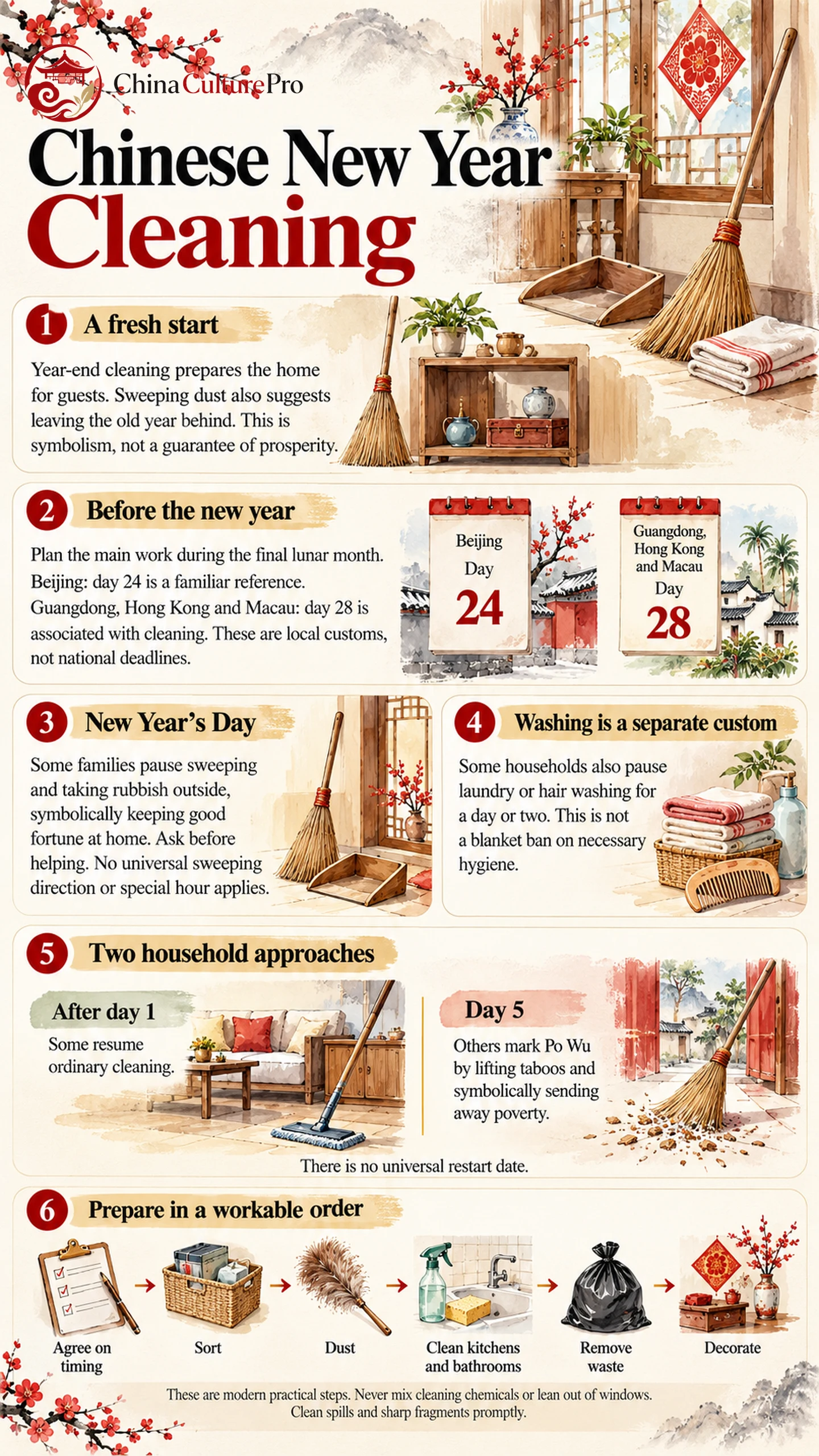
Chinese New Year cleaning raises a practical question: when should the housework stop? Before Chinese New Year, families often prepare their homes for gatherings, yet some avoid sweeping once the holiday begins. Understanding the timing helps you plan your own preparations or respect a host’s household customs.
Why Do People Clean Before Chinese New Year?
Year-end dusting is known as saochen (扫尘, sǎochén), literally “sweeping dust.” It can involve much more than sweeping: removing cobwebs, wiping furniture, cleaning windows and washing household linens. The broader expression dasaochu (大扫除, dà sǎochú) means a thorough clean. These tasks prepare the home for family gatherings and visiting guests.
The familiar cultural explanation rests on a Mandarin homophone: 尘, “dust,” and 陈, “old,” are both pronounced chén. Clearing dust therefore suggests clearing away what belongs to the old year and making a fresh start. The work gives physical form to wishes to leave old troubles behind.[1]
This symbolism can make an ordinary chore feel like a shared seasonal occasion. In an older courtyard home, dusting beams and tending furnishings may also mean caring for a house that holds family memories. In an apartment, the same broad idea can accompany simpler tasks such as clearing shelves or preparing space for guests.
The custom does not require replacing everything you own. Useful possessions can stay, and cleaning is not a way to guarantee prosperity. The symbolic fresh start is the cultural meaning; the clean, usable home is the practical result.
When to Finish Your Pre-New Year Cleaning
Plan the main work during Layue (腊月, làyuè), the twelfth and final month of the Chinese lunar calendar, and aim to finish before the new year arrives. “Spring cleaning” here refers to preparation for the Spring Festival, rather than a requirement to wait for spring weather.
Local reference dates offer useful context, but they do not create one national schedule:
| Time | Custom or practical use | What to remember |
|---|---|---|
| Earlier in the final lunar month | Spread sorting, washing and larger cleaning jobs over manageable sessions. | This is practical planning, not a prescribed ritual timetable. |
| Lunar month 12, day 24 | The saying “On the twenty-fourth, sweep the house” appears in Beijing’s year-end cleaning tradition.[2] | It is a local reference point, not a deadline for every Chinese household. |
| Lunar month 12, day 28 | Cantonese year-end custom associates the twenty-eighth with a thorough clean, notably in Guangdong, Hong Kong and Macau.[3][4][5] | The familiar saying is 年廿八,洗邋遢; families can prepare earlier. |
| New Year’s Eve | Finish any remaining manageable tasks before the celebrations. | There is no universal ban on cleaning throughout the entire day. |
For your own schedule, leave enough time for linens to dry and check local rubbish or recycling collection arrangements. If you are joining another household, ask when they would like the work finished. A lunar month can have 29 or 30 days, so New Year’s Eve is not invariably the thirtieth.
Cleaning Taboos on New Year’s Day and After
The main distinction is between preparation before the holiday and symbolic restraint after the new year begins. Which activities a family pauses, and for how long, varies.
Sweeping, Mopping and Taking Out Rubbish
Some households put away the broom on New Year’s Day and avoid carrying rubbish out of the home. The traditional explanation is that sweeping or discarding things might carry away the good fortune welcomed with the new year.[6]
This does not establish a separate, universal rule for every cleaning tool. If a household includes mopping or vacuuming in its pause on floor cleaning, treat that as its own practice rather than assuming every family does the same. Ask before offering to sweep at someone else’s home. There is also no single direction, number of strokes or special hour that everyone must follow.
Washing Clothes and Washing Hair
Some families also avoid washing clothes or hair on the first day, or the first two days. These are related holiday taboos with their own explanations, rather than extensions of a rule about sweeping rubbish outside.[6][7]
Do not interpret them as a requirement to avoid all water use or necessary hygiene. If you encounter these customs while visiting, ask what the household actually observes instead of inferring a long list of prohibitions. The broader Chinese New Year taboos guide covers customs beyond household cleaning.
When Can Cleaning Resume?
There is no universal restart date. Some families resume cleaning after New Year’s Day; others maintain a longer pause.[7]
For households observing Po Wu (破五, pòwǔ), the fifth day of the first lunar month marks the lifting of various New Year taboos. Cleaning then may be understood as “sending away poverty.” A recorded example from Jixian in Tianjin, describes a family’s older custom of leaving the broom unused through day four and sweeping on day five.[8]
This example explains one tradition without establishing a requirement for all northern families, or for all Chinese communities. Agree on a workable routine within your household, and deal promptly with food waste or hazards rather than keeping them until a symbolic date.
A Practical Chinese New Year Cleaning Checklist
Use this sequence as a modern preparation plan. It is not a set of ritual instructions, and the amount of work can fit your home and available time.
- Agree on timing: Ask which holiday customs your household wants to observe. Schedule the main work before the celebrations and check when rubbish and recycling will be collected.
- Sort before scrubbing: Clear surfaces and decide what to keep, donate or discard. Move useful items back into storage; a fresh start does not require throwing away everything old.
- Dust accessible areas: Work from higher surfaces down toward furniture and floors so you do not repeatedly dirty areas already cleaned. Use suitable long-handled tools rather than stretching to reach high corners.
- Finish kitchens and bathrooms: Clean the surfaces and fixtures that need attention, then complete the floors. Follow product labels, keep the space ventilated and never mix cleaning chemicals to make them stronger.[9]
- Arrange waste removal: Separate rubbish and recyclables and put them out according to local collection arrangements. Allow time for laundry to dry before putting linens away.
- Decorate the clean space: Once surfaces are ready, put up Chinese New Year decorations. If you are replacing spring couplets, clean the relevant doorway surfaces first.
Do not lean out of windows or overreach to finish an awkward job; use appropriate equipment or get suitable help.[9] When visiting, offer assistance before starting. A host may welcome help clearing dishes while preferring to leave floor cleaning for another day. Spills and sharp fragments still need prompt attention.
FAQs About Chinese New Year Cleaning
Can you clean on Chinese New Year’s Eve?
Yes. There is no universal rule against cleaning throughout New Year’s Eve. Some families finish their main deep clean earlier and leave only small tasks for that day. If you are helping in someone else’s home, follow the timing they prefer.
Do you have to wait until the fifth day to clean?
No. Waiting until the fifth lunar day is one tradition, associated with Po Wu. Other families resume ordinary cleaning after New Year’s Day. Neither practice establishes a timetable that every Chinese household must follow, so ask about the custom in the home concerned.
What if you need to clean up a spill or broken glass?
Clean it promptly, keeping people away from sharp fragments or a slippery floor until the area is safe. Practical hygiene and safety take priority. You do not need to perform a special ritual to compensate for necessary cleanup during the holiday.
Do all Chinese families follow the same cleaning taboos?
No. Practices differ between regions and individual households, including within the same community. Some keep several inherited customs; others observe only a symbolic pause or none at all. Age, location or background alone will not tell you exactly what a family does.
Sources
[1] Gaoping Municipal Government. 腊月二十四,扫房子
[2] Capital Civilization Network. “二十四,扫房子”,北京大扫除迎新春
[3] Hong Kong Talent Engage. Embrace Local Festivities: A Guide to Lunar New Year Customs and Etiquette in Hong Kong
[4] Yuexiu District Cultural Center, published on Nanfang Plus. 广府味·幸福年丨“年廿八,洗邋遢” 广府年俗里的除旧迎新
[5] Macau Municipal Affairs Bureau. 市政署:年廿八洗邋遢,打理雪柜有办法
[6] Confucius Institute for Scotland. Taboos During Chinese New Year
[7] SBS Chinese. 6 taboos that you need to avoid during Lunar New Year
[8] City Express, reproduced by CNTV. 正月初五蓟县民俗:“破五” 扫垃圾送穷气(图)
[9] Hong Kong Labour and Welfare Bureau. 年晚掃除 注意職安