

Quick Answer: What Are Chinese New Year Couplets?
Chinese New Year couplets, or chunlian (春联, chūnlián), are paired festive inscriptions commonly displayed on red paper beside a doorway. They express wishes for the coming year.[1]
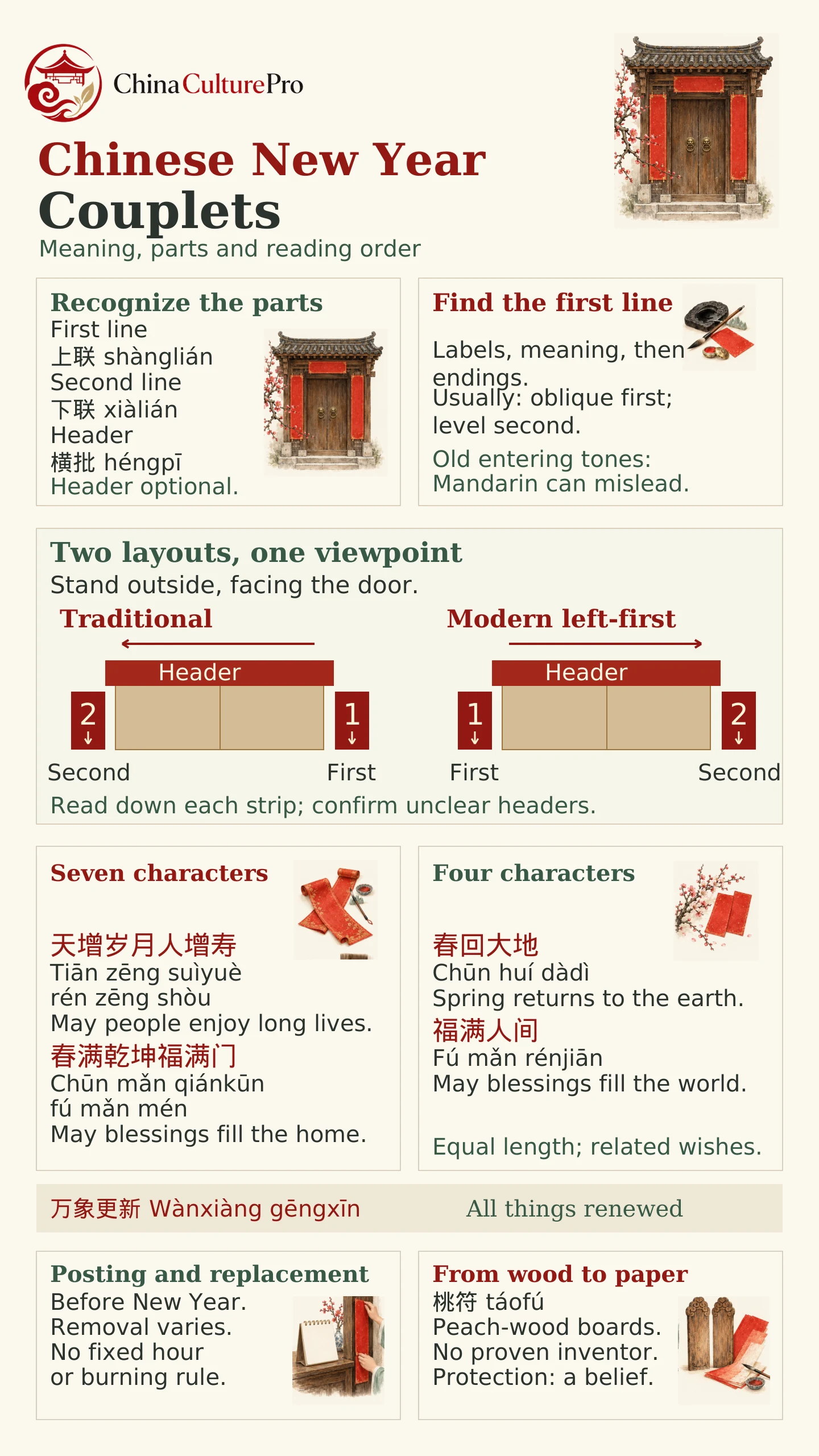
- Form: Two vertical lines make the pair; a horizontal header often accompanies them.
- Meaning: The lines have matching Chinese character counts and related wording, rather than two unrelated greetings.
- Reading: Read each strip from top to bottom, then the first line before the second. Physical left and right depend on the intended layout.
“Upper” and “lower” name the lines’ order, not different mounting heights. Single-character signs and other red-paper wishes are separate forms of decoration.
Two red strips and a short header can raise surprisingly practical questions: which sentence comes first, which side of the doorway does it belong on, and which way does the header read? This guide separates those decisions so that “upper” never becomes a confusing instruction about height.
What Are Chunlian and Their Three Parts?
Chunlian are a seasonal form of duilian (对联, duìlián), the broader category of paired inscriptions. Their wording welcomes Chinese New Year, but the literary form also serves other occasions. Red paper with black or gold lettering is familiar; the wish comes from the actual words, not the color alone.[3][5]
| Part | Function | What to recognize |
|---|---|---|
| Shanglian (上联, shànglián) | The first line | Begins the paired statement; “upper” does not mean physically higher. |
| Xialian (下联, xiàlián) | The second line | Responds to or completes the first line’s meaning. |
| Hengpi (横批, héngpī) | The horizontal header | Commonly four characters summarizing the theme; often included, but not essential to every pair. |
The two lines normally match in Chinese character count and grammatical structure. Their ideas should connect, but they need not be literal opposites. English translations can have different word counts without affecting the original pairing.[3][5]
A lone Fu character (福, fú), meaning blessing or good fortune, belongs among other Chinese New Year symbols. It is not itself a two-line couplet.
Which Couplet Comes First?
Identify the first line before deciding which side it occupies. Use several clues together rather than treating the paper’s current position as proof.
- Check labels: If the original set identifies its first and second lines, start there. Preserve the set’s instructions rather than swapping individual strips from different pairs.
- Check meaning: A time sequence, cause and response, or established phrase order may indicate which thought leads. Related wishes do not always have an obvious narrative sequence.
- Check the endings: The usual pattern is an oblique-tone ending for the first line and a level-tone ending for the second.[2][3]
This distinction is called pingze (平仄, píngzè). Mandarin third and fourth tones often identify oblique endings, while first and second tones often identify level endings. However, historical entering-tone characters, rusheng (入声, rùshēng), were oblique and later dispersed across Mandarin’s four tones. Modern pinyin alone can therefore misclassify a traditional ending.[3]
The examples below use straightforward endings. For an unlabelled, difficult or mixed set, ask someone familiar with couplets to check the wording and relevant tone system. The header can help establish layout, but it cannot tell you which sentence is intrinsically first.
How Do You Read and Place the Couplets?
Keep one viewpoint throughout: stand outside, facing the entrance. “Your right” then means the right-hand side of the doorway as you see it, not the right of someone standing inside.
- Identify the two lines: Establish which sentence is first and which responds to it before assigning sides.
- Check the intended layout: Read the header’s actual wording and consult any original instructions. Its reading direction commonly corresponds to the pair’s arrangement.
- Read each strip downward: Start at its top character and continue to the bottom; read the first line before the second.
- Check the finished display: Keep characters upright, without mirroring them. “Upper” and “lower” do not require staggered heights.
| Intended arrangement | Header reading direction | Your left | Your right |
|---|---|---|---|
| Traditional right-first layout | Right to left | Second line | First line |
| Modern left-first layout | Left to right | First line | Second line |
Both arrangements are described in cultural guidance; one universal right-side rule cannot explain every modern set.[2]
A header is a useful clue, not an infallible test. A reversible phrase, unfamiliar calligraphy or mismatched pieces can make its intended direction unclear. Confirm the original layout instead of automatically reversing the strips.
A separate Fu sign has its own display customs. Turning some Fu signs upside down does not justify inverting whole sentences. The order in which you physically attach the pieces is also separate from their reading order.
Chinese New Year Couplet Examples with Pinyin and English
The first example is a familiar seven-character pair recorded in a dictionary. Each Chinese line contains seven characters; the translations express wishes rather than promises of real-world outcomes.[1]
- First line: 天增岁月人增寿 — Tiān zēng suìyuè rén zēng shòu. “As the years pass, may people enjoy longer lives.”
- Second line: 春满乾坤福满门 — Chūn mǎn qiánkūn fú mǎn mén. “May spring fill the world and blessings fill the home.”
- Suggested header: 万象更新 — Wànxiàng gēngxīn. “All things renewed.” This is a matching header for the teaching example, not a claim about an original historical set.
Notice the endings: 寿, shòu, has Mandarin’s fourth tone, while 门, mén, has the second. They illustrate the usual oblique-first, level-second pattern. Each line can also be grouped into a four-character opening and a three-character closing. That matching rhythm is easier to notice in Chinese than in a word-for-word English translation.
A shorter teaching example uses four characters per line:
- First line: 春回大地 — Chūn huí dàdì. “Spring returns to the earth.”
- Second line: 福满人间 — Fú mǎn rénjiān. “May good fortune fill the world.”
Here 地, dì, is fourth tone and 间, jiān, is first tone. The pair places spring’s return alongside a wish for shared blessings. It demonstrates equal length and related meaning without requiring seven characters. This shorter teaching arrangement is not attributed to an ancient author.
These examples use simplified characters. Traditional forms such as 壽, 門 and 萬 change the written shapes, not the number of corresponding characters. Regular, running and other calligraphic styles are a separate design choice; a flowing script may require a knowledgeable reader to decipher it.
When Should Couplets Go Up and Come Down?
Couplets commonly go up as households prepare for New Year, often after cleaning or on New Year’s Eve. The purpose is to welcome the new year with fresh wishes; there is no single pasting hour that every family must observe.[5]
Removal also varies. Some households take seasonal paper decorations down after the celebrations; others leave their couplets until replacement, sometimes the following New Year. These choices vary between households; the fifteenth day is not a universal removal deadline. Follow the household’s practice and the condition of the paper. Burning the old pair is not a universal requirement.
How Did Spring Couplets Develop from Peach-Wood Charms?
An important predecessor was taofu (桃符, táofú): peach-wood boards bearing guardian names or images at an entrance. Their protective purpose belonged to historical beliefs; it was not a verifiable effect of the wood or writing. Such objects were not automatically the same as today’s paired New Year poems.[4]
Later accounts associate Meng Chang, a tenth-century ruler of Later Shu, with an early New Year inscription on peach-wood boards. This is a familiar milestone in accounts of the custom, not sufficient evidence that one person invented every form of spring couplet.[2]
Over time, written seasonal wishes and paper displays developed into the familiar doorway tradition. Separate that gradual development from claims about a precise first invention. Neither a single dynasty nor a monster story explains the whole custom.
FAQs About Chinese New Year Couplets
Does the Upper Couplet Always Go on the Right?
No. It does in the traditional arrangement, viewed from outside facing the door. Some modern sets use a left-first layout. Check the intended arrangement rather than treating the label “upper” as a side.
Must Chinese New Year Couplets Have Seven Characters?
No. Four-, five- and seven-character lines are among the forms encountered. Matching the two Chinese lines matters more than choosing seven; the number of English words in translation is irrelevant.
Can You Use Printed Couplets Instead of Handwritten Ones?
Yes. Printed and handwritten couplets can both express New Year wishes. Check the wording and intended layout in either format; handwriting alone does not establish authenticity, accuracy or suitability for a household.
Should Spring Couplets Be Hung Upside Down?
Keep the sentences upright and readable. The upside-down custom associated with some Fu signs is a separate practice, not a general instruction for turning Chinese text or whole couplet strips upside down.
What Is the Difference Between Chunlian and a Fu Sign?
Chunlian consist of two related lines; a Fu sign displays one blessing character. They can appear together around an entrance, but identifying one does not tell you the reading order of the other.
Sources
[1] Ministry of Education, Taiwan. 春聯 — 國語辭典簡編本
[2] Shenzhen Municipal Archives. 贴春联到底应从左往右还是从右往左?
[3] Neixiang County. 关于在全县规范春联撰写张贴工作的通知 — appended couplet guidance and 李文郑’s 对联的基本格律(纲要)
[4] Ministry of Education, Taiwan. 桃符 — 重編國語辭典修訂本
[5] Phoebe A. Hearst Museum of Anthropology, UC Berkeley. Chinese Folk Art, Festivals, and Symbolism in Everyday Life