
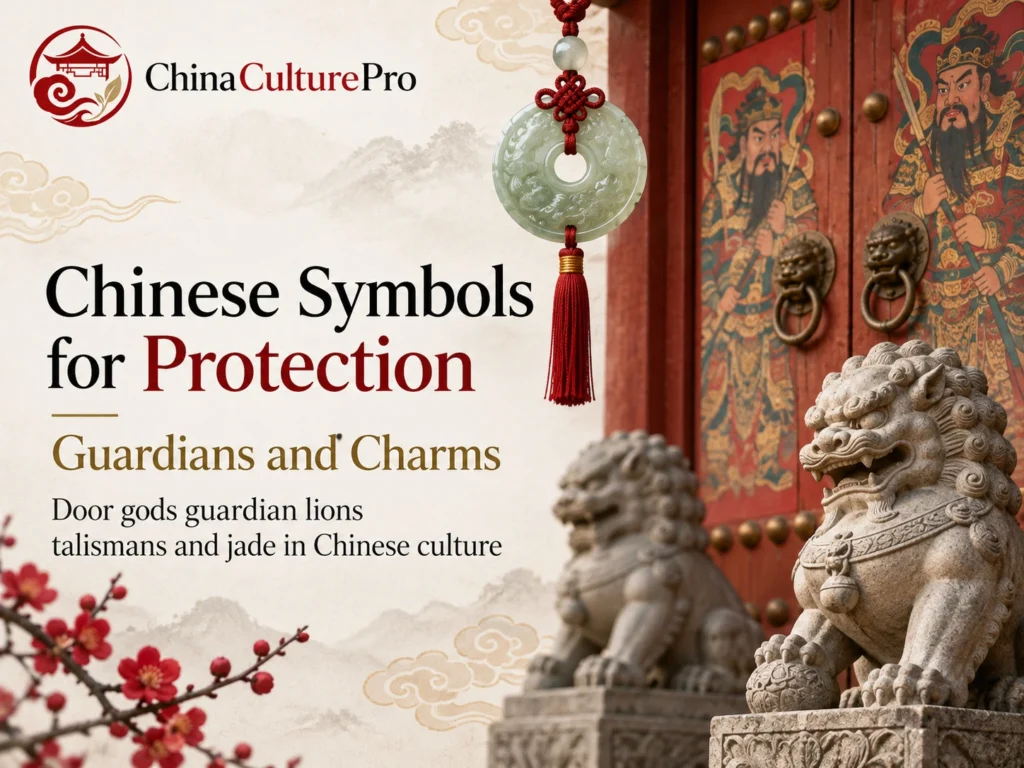

Quick Answer: What Are the Chinese Symbols for Protection?
Chinese symbols for protection express wishes for safety through words, guardians, ritual objects and personal ornaments. There is no single universal emblem: meaning depends on the tradition and the object’s setting.
- Words and wishes: Hu (护/護, hù) means to protect; Ping’an (平安, píng’ān) expresses being safe and sound.
- Entrance guardians: Door gods (门神, ménshén) and guardian lions (石狮, shíshī) symbolically guard households and other spaces.
- Ritual objects: Written talismans, trigram mirrors, peach wood (桃木, táomù) and coin swords (铜钱剑, tóngqián jiàn) belong to particular religious or folk traditions.
- Personal wishes: Tiger motifs, protective locks and jade ornaments can carry wishes for a child’s or wearer’s safety.
These are cultural and religious expressions, without verified powers to prevent disasters, cure illness or repel supernatural harm.
When you encounter protective imagery on a doorway, painting or pendant, first ask what it expresses: an ordinary word, a safety wish or a religious guardian. This distinction helps you interpret an object or choose a meaningful gift within the broader world of Chinese symbols by meaning.
Chinese Protection Symbols at a Glance
This selection is an identification guide, not an official set of twelve protective charms. Read the motif together with its inscription, companion images and setting.
| Symbol | Recognition and setting | Traditional reading | Interpretive limit |
|---|---|---|---|
| Hu / Ping’an | Written characters; greetings | Protection / safety | Wording, not automatically a talisman |
| Door gods | Paired doorway figures | Household guardianship | Several identities and auspicious roles |
| Zhong Kui (钟馗, Zhōng Kuí) | Official’s cap; sword or demons | Demon-quelling | Can also appear as a scholar |
| Guardian lions | Lion sculptures at entrances | Guarding a threshold | Lions, despite “foo dogs” nickname |
| Tiger | Fierce face; children’s garments | Repelling harm | Also courage and military rank |
| Five-Poisons motifs (五毒纹, wǔdú wén) | Creature groups; festival clothing | Countering harmful influences | Members vary between objects |
| Fu talismans (符, fú) | Ritual script, seals or inscriptions | Religious protection | Require tradition and provenance |
| Bagua mirrors (八卦镜, bāguà jìng) | Eight trigrams; mirror objects | Household warding | Diagram and mirror are distinct |
| Peach wood (桃木, táomù) | Boards, figures or wooden swords | Warding off evil | Different from longevity peaches |
| Coin swords (铜钱剑, tóngqián jiàn) | Cash coins bound into a sword | Household talisman | Coin form alone proves little |
| Longevity locks (长命锁, chángmìng suǒ) | Lock-shaped children’s pendants | Keeping a child safe and alive | Also longevity and family hopes |
| Jade / Ping’an kou (平安扣, píng’ān kòu) | Pendants; pierced safety discs | Wishes for safety | Not every jade is an amulet |
How Is Protection Written in Chinese?
Hu means “to protect” or “guard,” while Ping’an describes being safe and sound. If you want a gift to convey “may you be safe,” a safety wish usually expresses your intention more clearly than a lone verb. Neither is inherently a religious inscription.[1][2]
| Word | Meaning | Useful distinction |
|---|---|---|
| Hu (护/護, hù) | To protect or guard | A character used in many ordinary compounds |
| Baohu (保护/保護, bǎohù) | To protect; protection | General care or defense against harm |
| Shouhu (守护/守護, shǒuhù) | To watch over and guard.[18] | Emphasizes keeping something under protection |
| Baoyou (保佑, bǎoyòu) | To bless and protect.[19] | Often used when asking a deity for help |
| Ping’an | Safe and sound | Names the desired condition rather than an action |
For a journey, Yilu ping’an (一路平安, yílù píng’ān) means “have a safe trip.” For an entrance inscription, Churu ping’an (出入平安, chūrù píng’ān) wishes safety when going out and returning. Their wording makes the intended situation clearer than the English label “protection symbol.”
Simplified 护 and traditional 護 are forms of the same character. Preserve the correct strokes and orientation in a design; simplified and traditional writing are not different levels of protective power. A dictionary confirms the word, while the surrounding inscription tells you how it is being used.
For a personal design, decide whether you mean “I protect,” “I am watched over” or “may you be safe.” These are different messages. The wider guide to Chinese character symbols helps separate ordinary language from decorative symbolism.
Door Gods, Zhong Kui and Guardian Lions
Doorway imagery guards a boundary symbolically, but painted figures, carved lions and Buddhist protectors have distinct identities and histories.
Door Gods: Guardians of the Household Threshold
Door gods are a category of doorway guardians, not the name of one deity. Paired prints can show armed figures, but their identities depend on the local tradition, inscription and composition. Some doorway images emphasize blessings and good tidings rather than a threatening appearance.[3]
An early protective story concerns Shenshu (神荼, Shénshū) and Yulü (郁垒, Yùlǜ), guardians associated with a great peach tree and a gate through which ghosts passed. The account describes harmful ghosts being bound and fed to a tiger. The Lunheng (论衡, Lùnhéng) preserves it as a quotation attributed to the Classic of Mountains and Seas (山海经, Shānhǎi jīng). It is a mythic explanation, not a historical encounter.[4]
Later traditions include Qin Qiong (秦琼, Qín Qióng) and Yuchi Gong (尉迟恭, Yùchí Gōng), historical generals represented as door guardians. Their protective biographies belong to legend. Identify the pair from the specific print or inscription; an armed doorway figure is not automatically Zhong Kui.[17]
Zhong Kui: The Demon Queller
Zhong Kui is a named legendary demon-queller who can appear in household protective imagery. An official’s cap, sword and accompanying demons are useful clues, but no single feature establishes his identity. A fierce face alone is especially unreliable.
Stories connect him with an imperial dream and the defeat of troubling spirits. Read these as legend, not evidence that a historical official cured an emperor. His imagery can also carry meanings beyond the confrontation of evil.[20]
In Ren Yi’s 1883 painting, Zhong Kui appears as an eccentric scholar: his sword is sheathed, a flower sits in his hair, and he reads beside archaic vessels holding flowers and fruit. The painting, accession 2002.208.2, demonstrates that a recognized protective figure need not be shown attacking demons.[5]
When reading Chinese symbolism in art, distinguish the figure’s traditional identity from the particular story or attitude the artist gives him.
Guardian Lions and Buddhist Protectors
Chinese guardian lions are lion-shaped sculptures, despite the English nickname “foo dogs.” Their protective history includes tomb settings: pairs are recorded in Han-dynasty tombs, and lion imagery became more widespread with Buddhist cave temples in northern China during the fifth and sixth centuries.[6]
A Northern Qi limestone lion, accession 30.66.1, dates to the mid-sixth century. Its crouching stance, exposed fangs and gripping claws convey force. This early example should not be judged by every convention associated with much later entrance pairs.[6]
The Four Heavenly Kings (四大天王, sì dà tiānwáng) belong to Buddhist protector imagery. They guard the Buddhist world and its directions within a religious cosmology; they are not simply another name for household door gods.[7]
For an architectural guardian, examine the building, original position and period before assigning a meaning. Chinese symbolism in architecture provides the broader setting for that interpretation.
Talismans and Objects Used to Ward Off Evil
Bixie (辟邪, bìxié), “warding off evil,” describes a traditional purpose. It does not identify one shape, material or religious system. Objects given this purpose need to be understood through their own inscriptions and traditions.
Fu Talismans: Religious Script, Not Ordinary Calligraphy
Fu talismans can combine written signs, divine names, instructions and seals within Daoist or folk-religious practice. Hushenfu (护身符, hùshēnfú) means a protective amulet; Ping’an fu (平安符, píng’ān fú) names a talisman for peace and safety. These terms overlap in use, but they do not make every object called an amulet identical.[8]
A talisman’s ritual writing may differ from ordinary readable calligraphy. Its temple or practitioner, stated purpose and local tradition help explain it. The presence of red ink, yellow paper or a seal alone is not enough to establish provenance.
Taiwanese Taigi also uses kǹg-kuānn (貫捾) for protective pendants associated with temple practice. The category can include coins, gold or jade lock pieces, and folded temple slips threaded onto cord. It is broader than one paper-talisman form, and its pronunciation is Taiwanese rather than Mandarin pinyin.[9]
Bagua Mirrors: Trigrams, Objects and Context
Bagua (八卦, bāguà) means the eight trigrams: patterns made from three broken or unbroken lines. A trigram diagram is not automatically a protective object. A Bagua mirror combines that imagery with a mirror, whose shape and use must be checked separately.
In a documented Taiwanese household object, accession AH004978, gold-colored trigrams surround an inset mirror against a red ground with a green frame and hanging tassel. Its recorded folk use concerns warding at the doorway. That record describes a belief and a regional practice, not a proven effect.[10]
Historical bronze mirrors can also carry trigram decoration, zodiac imagery and wishes for protection. Their decoration may be cast on the back, while the other face serves as the reflecting surface. Do not assume that a Song bronze mirror had the same construction or placement as a modern framed glass mirror.
Peach Wood and Coin Swords
Peach wood belongs to protective doorway traditions associated with the peach-tree guardians. Taofu (桃符, táofú) refers to peach-wood doorway charms or boards. In the ancient account, peach figures, guardian images, a tiger and reed bindings work together in an imagined defense against harmful spirits.[4]
The material matters here. A peach fruit in a birthday picture can wish longevity, while peach wood in a doorway or ritual context can carry a warding meaning. Identifying “a peach” without distinguishing fruit, wood and setting loses that difference.
Coin swords bind cash coins into a sword-like object. They were used as household talismans against harmful spirits and illness-causing influences in traditional belief; their protective purpose does not make them working weapons or medical tools.[11]
Chinese coin symbolism also includes coin-shaped charms. Sword construction is one protective form, not the only one; an ordinary coin’s shape alone does not prove ritual use.
Personal Amulets and Symbols for Children
Personal ornaments can turn a household’s hopes into a wearable object. Their meaning may combine safety, long life and family affection, rather than express protection alone.
Tigers and Five-Poisons Motifs
Tiger symbolism includes courage and frightening away harm. On children’s caps or shoes, a tiger face can give the wearer the imagined fierceness of the animal; the protective reading comes from the garment and folk context, not merely the presence of stripes.[12]
Five-Poisons motifs group creatures traditionally treated as harmful, often in clothing associated with the Dragon Boat Festival. Snakes, scorpions, centipedes, lizards and toads appear in familiar versions, while other objects use different members, including spiders. The traditional logic could counter harmful influences through their own images, sometimes combined with a tiger.[12][13]
“Poisons” is a cultural category, not an accurate biological classification of every depicted animal. Nor does depicting a creature show approval of it. These garments expressed hopes for children’s wellbeing; the broader study of Chinese clothing symbolism helps distinguish such wishes from rank or status motifs.
Longevity Locks and Jade Safety Wishes
Longevity locks use the lock as a metaphor for keeping a child’s life secure. Their inscriptions and decoration can combine wishes for survival, long life and future success. A documented metal pendant with paired gourds illustrates that several auspicious motifs may share one ornament.[14]
Jade has carried protective, moral, ritual and status meanings across its long history; material alone cannot tell you which applies to an individual object.[15]
Ping’an kou is a familiar modern jade-disc gift expressing safety wishes. Its round form and central opening may remind viewers of earlier pierced jades, but resemblance does not establish the same date, name or ritual function. Check the inscription, design and gifting context rather than assuming every jade disc is an ancient protective emblem.
Do All Auspicious Symbols Mean Protection?
No. A wish for blessings, wealth or family harmony can overlap with safety, but “auspicious” does not mean that every motif is a protective charm.
- 福 and 符: The Fu blessing character (福, fú) expresses blessings; a Fu talisman belongs to religious or folk practice. Their shared sound does not make them the same word or object. See the separate Fu symbol guide.
- Dragons and Pixiu: A Chinese dragon can carry auspicious power and authority. Pixiu (貔貅, píxiū) has guardian and wealth-related readings. Specify the tradition before calling either a universal protection symbol.
- Red cords and knots: A Chinese knot may express connection and good wishes. Red cord alone does not identify a particular temple practice or protective rite.
- Peaches and peach wood: The fruit’s longevity imagery and the wood’s warding tradition are different uses of the same plant.
Two Worked Examples: A Bronze Mirror and a Child’s Bib
Read an object in four stages: visible facts, supporting context, a reasonable interpretation and the limits of that interpretation. This keeps recognition separate from speculation.
A Song-Dynasty Mirror with a Protective Inscription
- Visible facts: A Song-dynasty bronze mirror in the National Palace Museum, Taipei, accession 中銅000286N000000000, is round. Its back combines a turtle-shaped knob, eight trigrams, zodiac animals and an inscription.[16]
- Supporting context: The inscription’s final phrase, 衛神永長命, expresses guarding the spirit and enduring life. The words provide stronger evidence for a protective wish than the trigrams alone.[16]
- Reasonable interpretation: The mirror joins cosmological imagery with a wish for protection and longevity. Its material and form belong to a historical reflecting object, not a modern glass charm.
- Limits: The record does not establish its owner, a specific household placement or a successful protective effect.
A Qing Tiger-Shaped Bib with Five-Poisons Motifs
- Visible facts: The University of Alberta Museums’ blue silk tiger-shaped child’s bib, accession 2005.5.20, dates to the Qing dynasty. A fierce tiger face and creature motifs share the garment.[13]
- Supporting context: The collection’s interpretation connects the tiger and Five-Poisons imagery with traditional protective wishes for children. Its named creatures include a centipede, lizard, three-legged toad and spider.[13]
- Reasonable interpretation: The combined imagery expresses family hopes for a child’s wellbeing through the visual language of threat and defense.
- Limits: The bib does not reveal a particular child’s identity or exact age. Its decoration cannot demonstrate that the wearer avoided illness or harm.
How to Choose a Chinese Protection Symbol for a Gift or Design
- Define the message: Decide whether you want a safety wish, household guardianship, religious devotion or a child’s protective theme. For an everyday gift, a clear Ping’an inscription can communicate your intention directly.
- Choose the form: Select words, a guardian image or an ornament that suits the recipient and setting. Consider the recipient’s beliefs before choosing a deity or ritual object simply for its appearance.
- Check the context: Confirm the inscription, figure and companion motifs. A combined design should express a coherent wish, and any claimed religious identity should have a traceable source.
- Review the finished design: Have a Chinese reader check the actual artwork, not just the typed text. For engraving or a tattoo, verify strokes, orientation and figure identity before committing to a permanent version.
FAQs About Chinese Symbols for Protection
What Is the Chinese Character for Protection?
Hu, written 护 or 護, means to protect or guard. Baohu is the fuller word for protection. If your intended message is “safe and sound,” Ping’an expresses that wish more directly.
What Is the Strongest Chinese Protection Symbol?
There is no verifiable ranking of protective power. Choose a symbol for its documented cultural meaning, the intended setting and the recipient’s beliefs, rather than claims that one charm provides superior protection.
Are All Chinese Protection Symbols Daoist?
No. Some belong to Daoist ritual, others to Buddhist protector imagery or local household traditions. These traditions can overlap, but a symbol’s religious identity still needs to be established from its specific context.
Is Fu 福 the Same as a Fu 符 Talisman?
No. 福 means blessings, while 符 can mean a talisman in religious or folk practice. Both are pronounced fú, but their shared sound does not give them the same meaning or use.
Can a Chinese Protection Symbol Be Used in a Tattoo?
A protective motif can be a personal artistic expression. Check the wording, orientation, figure identity and religious background before using it permanently. A tattoo does not provide verified protection against illness, disasters or supernatural harm.
Sources
[1] Ministry of Education, Taiwan. Hu 護
[2] Ministry of Education, Taiwan. Ping’an 平安
[3] Columbia University Libraries. Chinese Paper Gods: For Display
[4] Academia Sinica, Institute of History and Philology. Shenshu 神荼
[5] The Metropolitan Museum of Art. Zhong Kui by Ren Yi (2002.208.2)
[6] The Metropolitan Museum of Art. Guardian Lion (30.66.1)
[7] Tsz Shan Monastery Buddhist Art Museum. Four Seated Heavenly Kings
[8] Taiwan Historica. Ping’an fu 平安符
[9] Ministry of Education, Taiwan. Kǹg-kuānn 貫捾
[10] National Taiwan Museum. Protective Bagua Object (AH004978)
[11] The Stirling Smith Art Gallery & Museum. Coin Sword (04932)
[12] National Library Board, Singapore. The Tiger Within
[13] University of Alberta Museums. Ferocity and the Five Poisons: Symbolism on Qing Dynasty Children’s Clothing
[14] National Museum of Taiwan History. Double-Gourd Lock Pendant Necklace (2002.004.0342)
[15] Museum of Fine Arts, Boston. Chinese Jades from the Hartman Collection
[16] National Palace Museum, Taipei. Mirror with Eight Trigrams Decoration
[17] National Museum of Taiwan History. Door-God Painting of Yuchi Gong
[18] Ministry of Education, Taiwan. Shouhu 守護
[19] Ministry of Education, Taiwan. Baoyou 保佑
[20] The Metropolitan Museum of Art. Demon Queller Zhong Kui with Demons (2008.636)