

Quick Answer: What Are the Five Blessings in Chinese Culture?
The Five Blessings (五福, wǔfú) are a classical Chinese framework for a complete and fortunate life. The received list considers a long life, material sufficiency, physical well-being and peace, virtuous conduct, and a life brought to its natural completion.[1]
- Classical source: The list appears in the Book of Documents (尚书, Shàngshū), specifically the Great Plan (洪范, Hóngfàn) chapter.
- Scope: It covers material security, physical well-being, moral character, and the shape of a completed life—not five random strokes of luck.
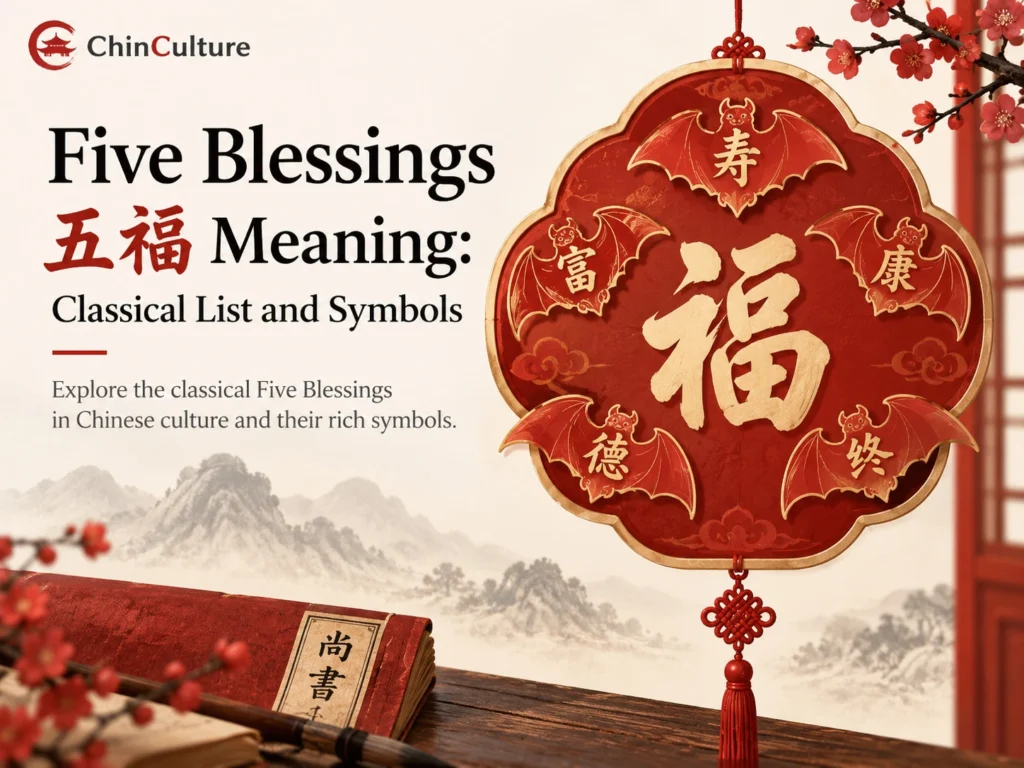
- Visual form: Five bats (五蝠, wǔfú) can represent the Five Blessings because 蝠, “bat,” and 福, “blessing,” are pronounced fú.
- Important distinction: The classical list should not be replaced by a later popular five-character auspicious grouping.
Wufu expresses a cultural wish or ideal; a word, number, or design does not guarantee those outcomes.
English-language explanations often flatten Wufu into “five kinds of good luck” or replace its classical terms with a more marketable collection of auspicious characters. Both shortcuts hide what makes the idea distinctive. The Five Blessings join material security and physical well-being with ethical conduct and a life brought to its natural close. They also show how Chinese symbols and meanings can move between text, spoken wordplay, and decorative art.
What Are the Five Classical Blessings?
The Great Plan gives the blessings in a fixed sequence. The English wording varies because the last three expressions are compact Classical Chinese, but the underlying categories should not be replaced with modern lifestyle terms.[1]
| Classical blessing | Practical English meaning | What it includes | What it does not mean |
|---|---|---|---|
| Longevity (寿, shòu) | A long life | Living out a full span rather than dying young | Immortality, or health by itself |
| Wealth (富, fù) | Material sufficiency | Resources and security needed for a stable life | Guaranteed riches or random luck |
| Health and peace (康宁, kāngníng) | Physical well-being and a settled life | Freedom from serious affliction and disruptive hardship | Happiness in every modern psychological sense |
| Love of virtue (攸好德, yōu hào dé) | Valuing and practicing good conduct | An ethical orientation expressed through how one lives | A vague promise of kindness or good fortune |
| Natural completion of life (考终命, kǎo zhōng mìng) | Reaching life’s allotted end | Completing one’s life without an untimely or violent end | “Death” in the abstract or a morbid curse |
The list is therefore broader than a collection of favorable events. It moves across life span, material conditions, bodily and social stability, moral choice, and the final shape of a life. “Wealth, health, happiness, love, and luck” may sound smoother in modern English, but it is not a faithful translation of this particular five-part system.
Where Do the Five Blessings Come From?
The best-known classical list appears in the received Great Plan chapter of the Book of Documents. The chapter presents an ordered account of government, natural and social patterns, and the conditions under which people experience flourishing or hardship. Its Five Blessings are paired with the Six Extremes (六极, liùjí), a contrasting list of severe human misfortunes.[1]
The received text is ancient, but its formation, dating, and attribution are scholarly questions. It is safer to say that the classical list is recorded in the received Great Plan than to assign the concept to one securely known inventor or exact year. Later literature, ritual language, and decorative art carried Wufu far beyond the chapter’s political setting. That wider cultural life includes a familiar New Year wish for all five blessings to reach the household.[5]
Why Do Virtue and Life’s End Count as Blessings?
The two least familiar entries reveal why Wufu is more than a wish for comfort.
- Love of virtue is an inner good: 攸好德 uses 好 in the sense of “to value” or “to be fond of.” It treats the desire to live well and act well as a benefit in its own right. Wealth and long life are not presented as a complete ideal when moral orientation is absent.
- A natural completion is part of life’s shape: 考终命 does not praise death. It describes completing one’s allotted life rather than having it cut short by calamity. English sources variously render it as a natural end, peaceful death, or an end crowning the life. “Natural completion of life” keeps the focus on completion rather than on death alone.[1][5]
These entries make the Five Blessings a view of human flourishing with material, physical, ethical, and temporal dimensions. A modern reader does not need to adopt every ancient assumption to see that the list asks a larger question than “Am I lucky?”
How Are the Five Blessings Shown in Chinese Art?
Wufu can be written as text, but Chinese decorative art often converts it into a visual sentence. The most recognizable version uses bats, while companion motifs specify whether the object emphasizes general blessing, birthday wishes, or longevity.
Why Do Five Bats Represent the Five Blessings?
The design is a rebus: an image stands in for a similar-sounding word. In Mandarin, 蝠 (fú), the second character in “bat,” is an exact homophone of 福 (fú), “blessing” or “good fortune.” A bat can therefore evoke fu without writing the character. A counted group of five bats can evoke the complete Five Blessings.[2]
The concept and the image should still be kept separate. The Great Plan names five human blessings but does not prescribe a five-bat design. Later artists made the abstract list visible through sound-based wordplay. One bat usually conveys a broad wish for blessing; five clearly presented bats make the Wufu reading much stronger. The wider system of bat symbolism in Chinese culture also depends on color, number, companion motifs, and the purpose of the object.
What Does “Five Blessings Surrounding Longevity” Mean?
Five Blessings Surrounding Longevity (五福捧寿, wǔfú pěng shòu), also written as 五蝠捧寿 when the pictured bats are emphasized, places five bats around the character 寿 or another long-life motif. The bats supply the Five Blessings, while the central longevity emblem makes the birthday or long-life wish dominant. Longevity is not a sixth blessing; it is one member of the classical five and the visual focus of this composition.
The motif appears on ceramics, textiles, jade, lacquer, and other decorative objects. The Palace Museum describes it as a common traditional birthday theme and catalogs Qing objects bearing the design.[2][3] An eighteenth-century ceremonial robe at the Metropolitan Museum of Art likewise uses five interlocking bats around a longevity character and identifies the composition with the Five Blessings.[4]
How Are the Five Blessings Used in Wishes, Gifts and Modern Design?
Five Blessings Arrive at the Door (五福临门, wǔfú línmén) is a familiar wish that imagines the complete set of blessings reaching a household. It is especially visible in Lunar New Year greetings and decoration, although it can also function as a general family blessing.[5]
Other uses depend on the occasion:
- Birthday and elder gifts: Five-bat-and-longevity designs emphasize a full life and continued well-being.
- Household decoration: Paper cuts, paintings, ceramics, woodwork, and textiles can express a broad wish for family flourishing.
- Celebratory gifts: Wufu may appear on objects given for a birthday, housewarming, or major family occasion, but no single object or price is required.
- Modern design: Jewelry, logos, graphic art, and tattoos may adapt the imagery. A modern work should preserve the intended count and visual relationship if it claims to depict the classical Five Blessings.
There is no nationwide rule requiring a particular color, direction, room, or display date. Those details may reflect a local custom, family preference, or contemporary design choice rather than the definition of Wufu.
Are the Five Blessings the Same as Fu Lu Shou Xi Cai?
No. Fu Lu Shou Xi Cai (福禄寿喜财, fú lù shòu xǐ cái) is a later popular grouping of auspicious characters: blessing, rank or emolument, longevity, joy, and wealth. It appears in contemporary decorative and commercial contexts, but it is not the five-part list recorded in the Great Plan.
| System | Members | Main function | Interpretation limit |
|---|---|---|---|
| Classical Five Blessings | Longevity, wealth, health and peace, love of virtue, natural completion of life | A classical model of a complete fortunate life | Its ethical and end-of-life terms should not be replaced with more commercial words |
| Fu Lu Shou Xi Cai | Blessing, rank, longevity, joy, wealth | A popular auspicious-character grouping | It should not be presented as a quotation from the Great Plan |
| Fu Lu Shou (福禄寿, fú lù shòu) | Blessing, rank or livelihood, longevity | A three-part blessing system, also personified as three star deities | It has three members and is not an abbreviated classical Wufu list |
These systems overlap because they belong to the wider vocabulary of Chinese auspicious culture. Their shared positive tone does not make their membership, textual history, or artistic form interchangeable.
How Should You Interpret Wufu in Context?
Use the complete composition rather than treating every group of five as a code:
- Written 五福 usually names the classical framework or, in looser speech, a complete set of blessings.
- Five clearly counted bats in an auspicious Chinese design commonly point to Wufu.
- Five bats around 寿, a peach, or another long-life emblem usually make longevity and birthday wishes more prominent.
- Five 福 characters, five objects, or an arbitrary group of animals do not automatically represent the classical list.
- 福禄寿喜财 identifies the later popular character grouping, not the Great Plan list.
Context still matters. A natural-history image of bats may have no auspicious purpose, while a museum label can confirm a reading that is not obvious from an object photograph alone. Likewise, the meaning of number 5 in Chinese culture depends on the system around it; the bare digit does not contain all five blessings.
Common Misreadings of the Five Blessings
| Misreading | More accurate interpretation |
|---|---|
| Wufu simply means “good luck five times” | It is a named five-part framework with a textual list. |
| The classical members are Fu, Lu, Shou, Xi, and Cai | That is a later popular auspicious grouping, not the Great Plan list. |
| Five written 福 characters equal the five classical blessings | Repetition can intensify a general blessing, but it does not identify the five separate categories. |
| Bats naturally possess five kinds of luck | The design works through the 蝠/福 homophone and a counted group of five. |
| Any appearance of the digit 5 invokes Wufu | The term, inscription, or recognized motif must supply the connection. |
| Natural completion of life is a death curse | It values an uncut, completed life rather than death itself. |
| Wufu is exclusively Buddhist, Daoist, or feng shui doctrine | Its classical list is recorded in the Book of Documents and later entered wider auspicious culture. |
| A Wufu design causes wealth or longevity | It communicates a cultural wish; it does not control real outcomes. |
FAQs About the Five Blessings
What Do the Five Blessings Mean in English?
The closest compact translations are longevity, wealth or material sufficiency, health and peace, love of virtue, and the natural completion of life. Translations vary, but a version that substitutes love, luck, or generic happiness loses parts of the classical list.
Are the Five Blessings a Buddhist or Taoist Concept?
Not exclusively. The classical list is recorded in the Book of Documents, a foundational Chinese text later associated with the Confucian canon. Wufu imagery subsequently entered broader Chinese art and popular custom, where traditions can overlap.
Are the Five Blessings the Same as Fu Lu Shou?
No. Fu Lu Shou combines blessing, rank or livelihood, and longevity in a three-part system that can also appear as three star deities. The classical Five Blessings contain five different categories, including virtue and the natural completion of life.
Do Five Bats Always Mean the Five Blessings?
Five bats in a clearly auspicious Chinese composition commonly represent Wufu, but interpretation should still consider the count, companion motifs, object type, and museum or historical context. A random group of bats is not automatically a formal Five Blessings design.
Sources
[1] Chinese Text Project. Book of Documents: Great Plan
[2] The Palace Museum. 五蝠
[3] The Palace Museum. 黄地粉彩五福捧寿纹奓斗
[4] The Metropolitan Museum of Art. Woman’s Ceremonial Robe
[5] Xinhua, reprinting Guangming Daily. 新春说“福”