


Quick Answer: What Sources Did Chinese Historians Use?
Chinese historians drew on earlier books, court records and other written accounts. They selected and arranged that material in forms such as dynastic histories or chronological narratives. A court diary, a later compilation and a source note each tell the reader something different about when and why a claim entered the record.[1][2][3][4][5]
- Creation: Identify who made the source and for what purpose.
- Compilation: Check how a later historian chose or arranged the material.
- Survival: Identify which copy, draft or edition you are reading.
Several surviving accounts may ultimately rely on the same source.
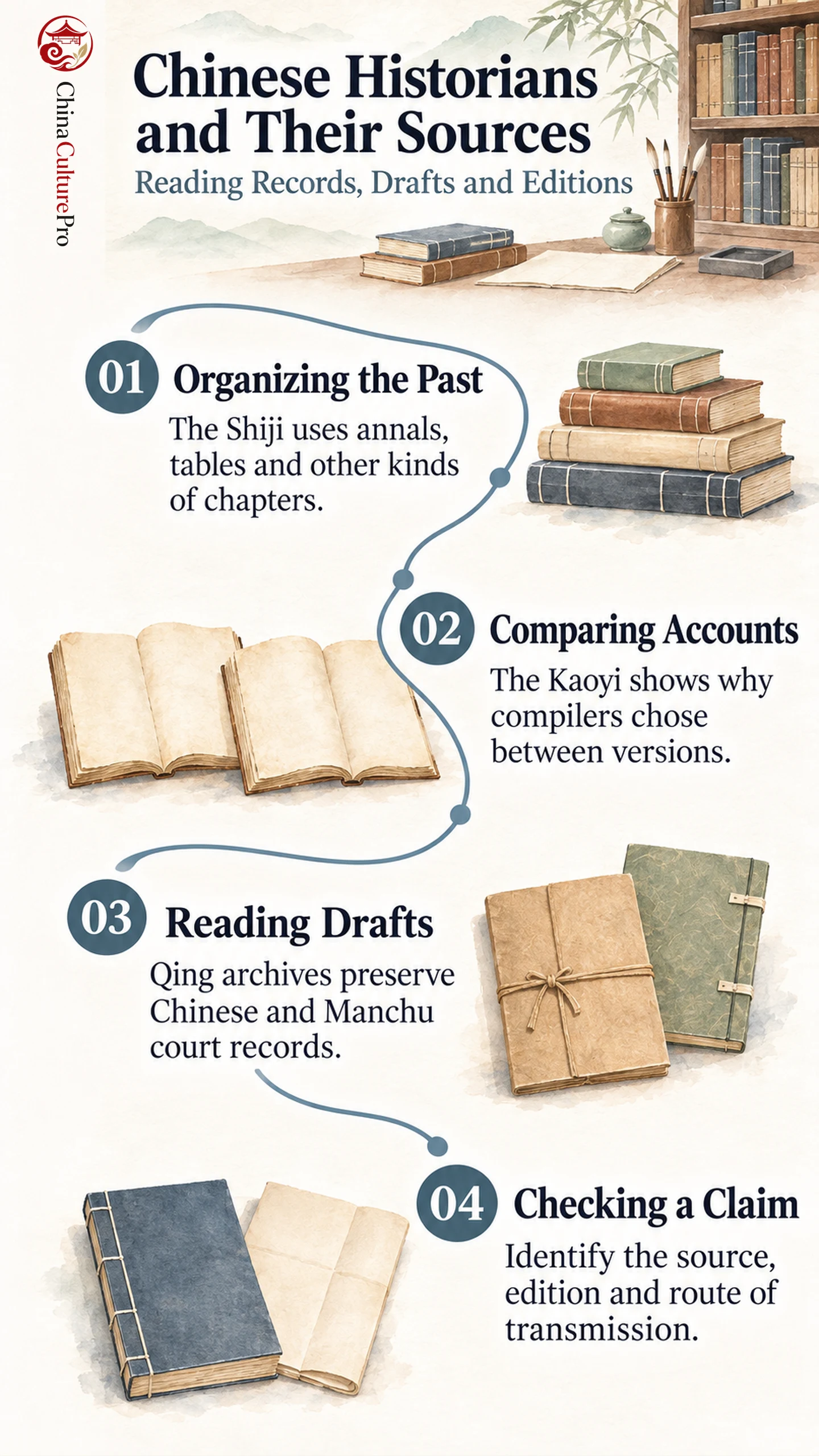
A date in a Chinese chronicle might come from an earlier court record, a calendar or an editor’s choice between them. Some historians preserved notes explaining those choices. Their notes let readers follow the evidence instead of seeing only the finished narrative.
Sima Qian and the Structure of the Shiji
The Shiji (史记, Shǐjì), or Records of the Grand Historian, associated with Sima Qian, organizes the past into several kinds of chapters. Basic annals track rulers and reigns. Tables align events in time. Treatises address subjects such as ritual and calendars. Hereditary houses and biographies organize accounts around families, states and people.[1][2]
Those divisions help a reader find the same period from different angles. They give the reader several routes into the same work. A finished passage may name some sources and leave others unstated. Modern researchers compare quotations, parallels and earlier books to investigate what materials the compiler could have used.[2][3]
Sima Guang and the Record of Disagreements
Sima Guang (司马光, Sīmǎ Guāng) and his collaborators arranged their Zizhi Tongjian (资治通鉴, Zīzhì Tōngjiàn) as a chronological history. The accompanying Kaoyi (考异, Kǎoyì), or notes on differences, gives readers examples of sources that disagreed and records which version the compilers preferred.[4]
For a sacrifice at the southern outskirts in the eleventh year of Kaiyuan, the notes compare the court chronicle, the Veritable Records (实录, shílù), with the Tang Li, a chronological work. The former puts the winter solstice before the sacrifice, while the latter gives them the same date. The compilers consider the leap months in nearby years and judge the second account more plausible. For an imperial order in the following year, they instead take the date in the court chronicle over the one in the old dynastic annals. The history of Chinese calendars explains why those calendrical details mattered.[4]
Qing Court Drafts and Compiled Histories
Academia Sinica’s archives include separately catalogued Chinese and Manchu drafts of Kangxi imperial diaries from 1685. The object records distinguish the Manchu draft, numbered 167307, from the Chinese draft, numbered 167022. To establish which events the drafts share, compare the entries themselves. A finished chronicle can then show whether the wording changed.[6][7]
Compiled reign histories could also be revised after their initial preparation. Academia Sinica describes the Veritable Records of the Qing founder as first compiled in 1636 and revised again in later reigns. Cite the version as well as the reign it covers.[5]
How to Check a Claim in a Historical Work
Find the passage in a specific edition. Then check what kind of document lies behind it, when it was created and who could have known the details. A memorial from the Censorate might preserve an accusation. A separate appointment or dismissal record could establish the administrative outcome.[3][4][5]
Ask whether the sources are independent. Two county gazetteer editions can reproduce the same earlier text. An imprint helps identify a printing, as the history of Chinese bookshops illustrates. Establishing independent testimony requires tracing where the account came from.[3][4][5]
FAQs About Chinese Historians and Their Sources
Does official history mean an eyewitness account?
An official history could be compiled later, using earlier court papers or other accounts. Identify the date of the event, the date of the source and the date of compilation separately.
Why can accounts of the same event differ?
Writers may use different sources, adopt different dates or include different details. Notes comparing versions can reveal where an editor made a choice.
How do historians tell whether two sources are independent?
They check citations, shared wording, dates and routes of transmission. If two works copy one earlier account, their agreement preserves that account without supplying two independent witnesses.
Sources
[1] Oxford University Press. Traditional Historiography
[2] Sima Qian, Wikisource. Shiji, juan 130, Historian’s Postface
[3] Trever McKay, Early China. Identifying the Textual Sources of Shi Ji
[4] Sima Guang, Wikisource. Zizhi Tongjian Kaoyi, juan 13
[5] Museum of the Institute of History and Philology, Academia Sinica. Court Chronicle and Draft Revisions, archival item 161205
[6] Museum of the Institute of History and Philology, Academia Sinica. Manchurian Version Draft of the Imperial Diaries of Emperor Kangxi, 1685
[7] Museum of the Institute of History and Philology, Academia Sinica. Chinese Version Draft of the Imperial Diaries of Emperor Kangxi, 1685