

Quick Answer: What Were Chinese Guilds and Gongsuo?
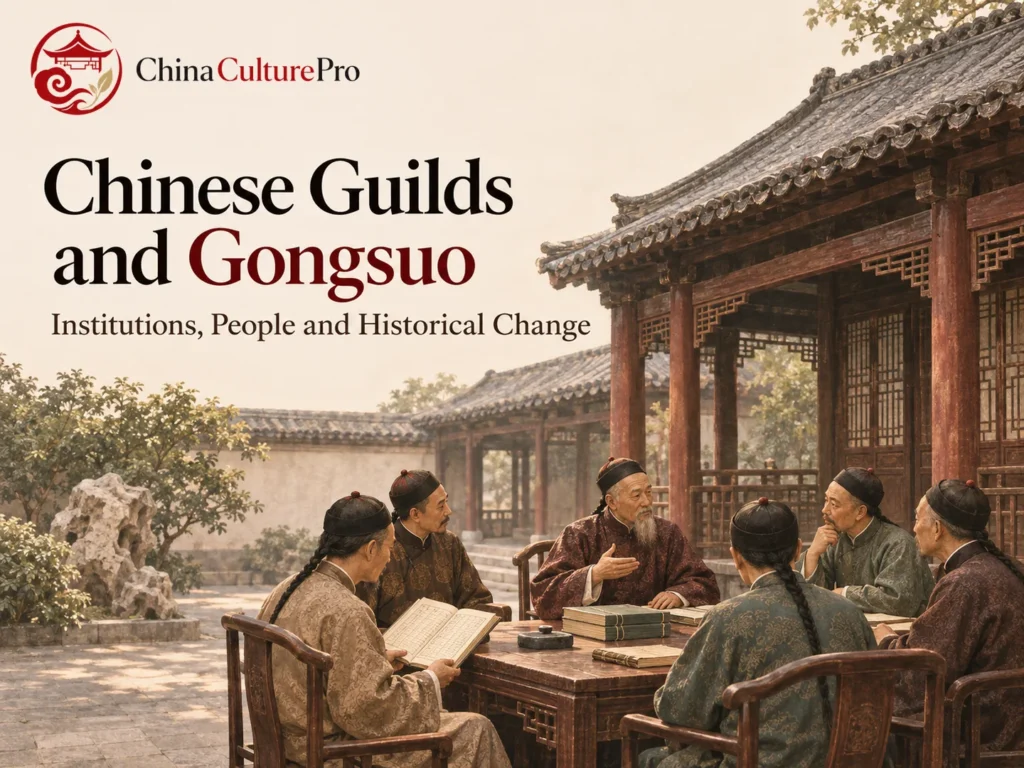
Historical Chinese guilds brought merchants or artisans together around a shared trade, place of origin or both. A gongsuo (公所, gōngsuǒ) often served an occupational group, while a huiguan (会馆, huìguǎn) often served people from the same region. Either name could refer to a group or its premises, and membership did not always follow the label.[1][2][4][5]
- Membership: Check who belonged and what connected them.
- Work: Groups could make trade rules, mediate disputes or provide support.
- Premises: A hall could accommodate meetings, worship and other shared activities.
Membership rules and accounts can show what an individual group actually did.
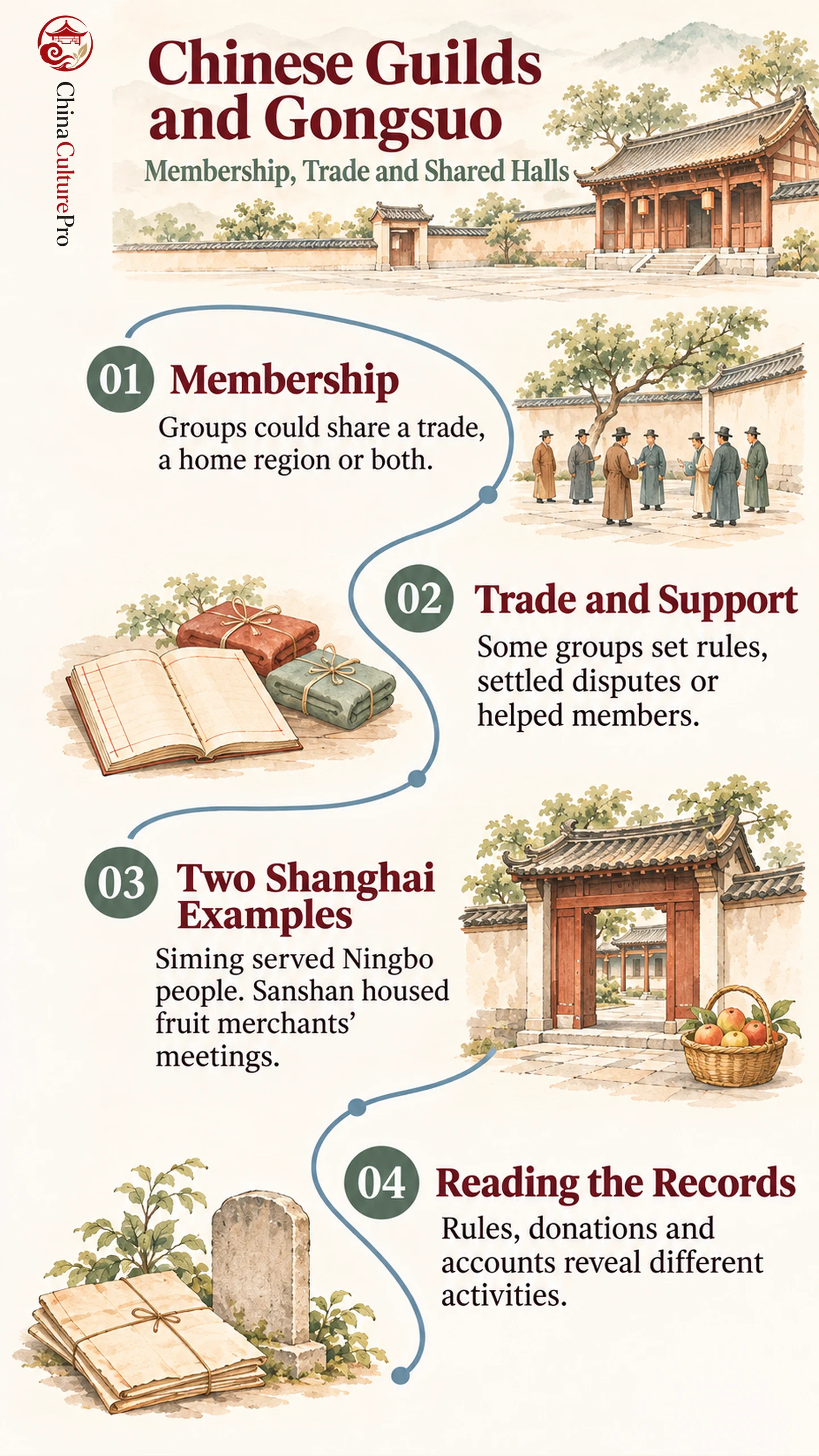
A hall name can suggest who organized it, but the people and activities inside are better evidence. One Shanghai gongsuo supported people from Ningbo, while a huiguan founded by fruit merchants combined trade meetings with worship. Their names tell only part of the story.
Gongsuo, Huiguan and the Basis of Membership
Native-place associations connected people living or working away from a shared home region. Occupational associations could link businesses in the same line even when their owners came from different places. Some groups combined the two ties. Merchant and craft associations of these kinds became more numerous under the Qing dynasty.[1][2]
Guild is an English comparison that covers several historical Chinese names. It can be useful if a group had an organized membership and handled collective affairs. Local evidence is needed to tell whether a historical label referred to a loose network, an association with officers and property or simply the building where a group met.[1][2][3]
What Merchant and Craft Associations Did
A merchant association could develop rules for a particular market, settle disputes among members and negotiate with officials. In some places, authorities dealt with an association to arrange tax collection collectively. That role could grow out of a relationship with a local government without making every association part of the government.[1][3]
The needs of the membership shaped the work. Businesses might coordinate trading practices, while a native-place group might maintain a hall or provide help for people away from home. The licensed firms of the Canton system operated under a particular set of state trade rules. Their organization should be read in that setting, even when English sources also use the word guild.[1][3][4]
Two Shanghai Halls That Complicate the Labels
Shanghai’s Siming Gongsuo (四明公所, Sìmíng Gōngsuǒ) was a native-place organization associated with people from Ningbo. Its work included arranging for the remains of people from Ningbo to be returned there after death. The people it served show that a gongsuo could organize around a shared home region.[4]
The Sanshan Guild Hall (三山会馆, Sānshān Huìguǎn) in Shanghai was built in 1909 by people in the fruit trade. Its institutional history describes both business discussions and worship of Mazu. The huiguan label here belonged to a building used for both business and worship.[5]
How to Read a Guild Rule or a Hall Record
A set of rules identifies what members were expected to do. A record of donations can show who supported the group or its premises. A dated account can establish that the association mediated a particular dispute or made a payment. Compare these types of evidence before treating a rule as proof of regular practice.[1][2][3]
Local histories and county gazetteers can help locate a building or identify an older name. Records of the association show more about its membership and authority. Use the period as a check because a building could keep its name as its users or functions changed.[1][2][5][6]
FAQs About Chinese Guilds and Gongsuo
Was every gongsuo a trade guild?
Some gongsuo organized people in one occupation. Shanghai’s Siming Gongsuo shows that the same label could also belong to a native-place association.
Were guild halls only for business meetings?
Some halls hosted meetings and commercial activities as well as worship or assistance for members. The surviving building and accounts can help identify the mix.
Were guilds the same as chambers of commerce?
Chambers of commerce developed in the late Qing as organizations with different institutional roles. Older associations and newer chambers could exist at the same time.
Sources
[1] Christine Moll-Murata, International Review of Social History. Chinese Guilds from the Seventeenth to the Twentieth Centuries
[2] Studies in Qing History, Renmin University of China. Merchant Association as a Conceptual Tool: Chongqing’s Case
[3] Meng Zhang, Yale University research repository. Merchant Guilds and Collective Taxation in Nineteenth-Century China
[4] Hiroyuki Hokari, Socio-Economic History. The Formation of the Coffin Sending Network of Siming Gongsuo
[5] Shanghai Sanshan Guild Hall. Sanshan Guild Hall, Historical Introduction
[6] Shanghai Municipal Government. Shanghai General Chamber of Commerce