


Quick Answer: What Did Historical Chinese Bookshops Do?
Historical Chinese bookshops sold reading materials. Some also selected texts, paid for engraving and issued their own editions. The older term shusi (书肆, shūsì) can refer to a bookselling establishment. Commercial publishing could take place in a city shopping district or in rural workshops linked to distant sellers.[1][2][3]
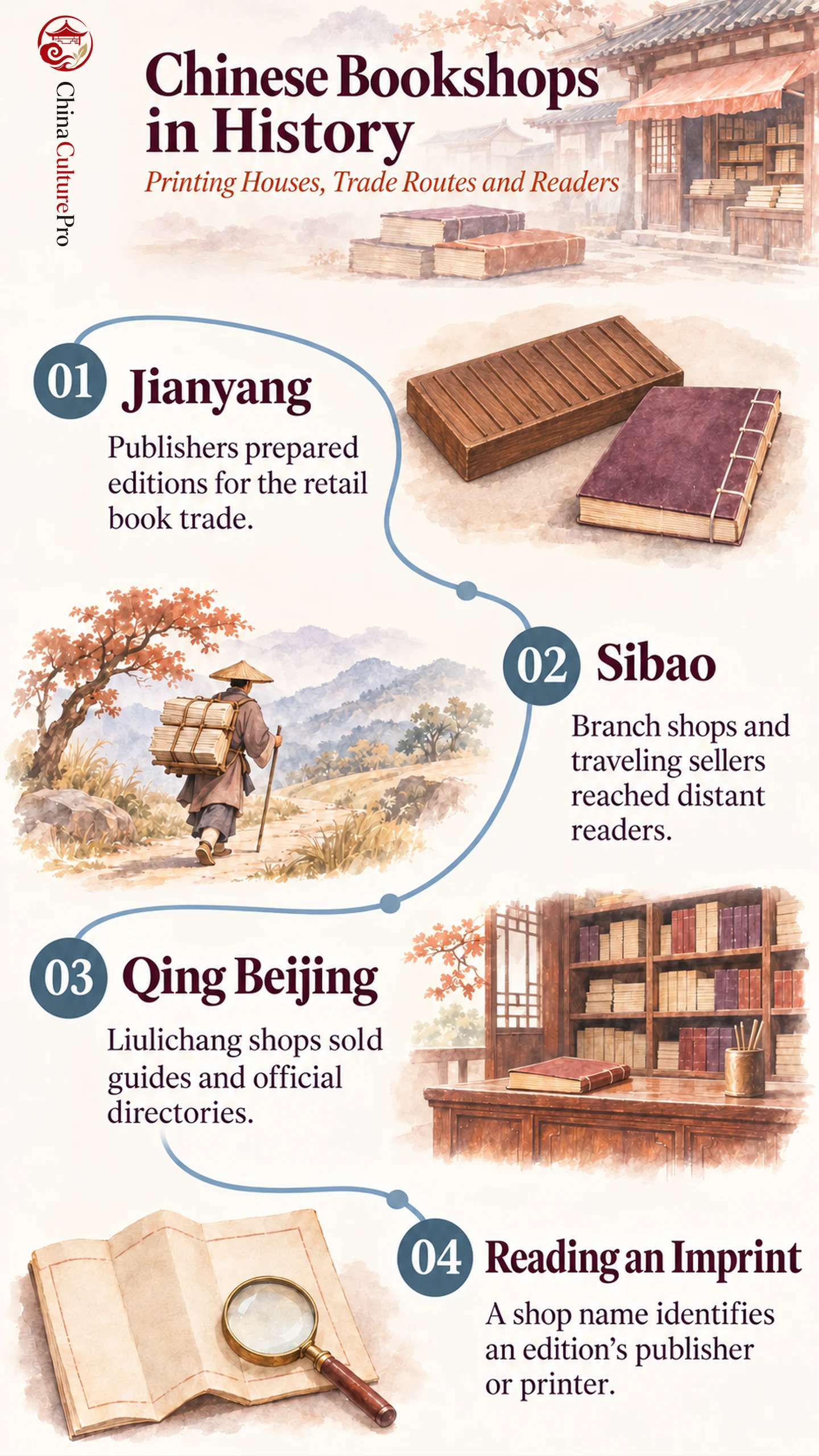
- Jianyang: Printing houses produced books for retail customers.
- Sibao: Traveling sellers and branch shops carried locally printed books across southern China.
- Qing Beijing: Booksellers offered new directories and guides alongside older books.
A book’s imprint can identify its publisher, while its route to a reader may require other evidence.
A book bought in a city shop might have come from a village workshop hundreds of miles away. Other shops printed titles for customers nearby. Surviving editions help identify the people who made the books, and records of distribution show how they reached readers.
Jianyang: Publishers Making Books for Sale
Jianyang in Fujian was a commercial publishing center from the eleventh through the seventeenth century. In the Song dynasty and later periods, businesses invested in editions they expected to sell. Publishers used woodblock printing for dictionaries, study books, medical texts and fiction. Blocks could be kept for another printing, a useful option when demand continued.[1]
A surviving copy of the play Yu chu ji in the Library of Congress comes from the Xiao family’s Shijian Tang in Jianyang. The catalogue dates it to the Wanli reign, 1573–1620, and notes the distinct upper and lower sections on each page. Its account also identifies four missing leaves at the beginning of this copy. The copy shows how a specific shop name, a text and a page design can be linked in one edition.[4]
Sibao: Selling Books Beyond the Printing Village
Sibao in western Fujian became an important printing center from the late seventeenth century. Its merchants used itinerant selling and branch shops to supply readers in other regions. A buyer could obtain a Sibao edition without going to the villages that produced it. Affordable textbooks, medical handbooks and practical guides were important parts of the trade.[2]
Sibao’s printers could reach readers through sellers with and without fixed premises. A shop held stock for customers in one place. A bookseller traveling along a route could bring the titles to buyers elsewhere. Tracing those channels helps explain how an ordinary manual could travel much farther than its place of production suggests.[2]
Liulichang: What Readers Bought in the Qing Capital
Liulichang (琉璃厂, Liúlíchǎng) in Qing Beijing is associated with collectors and rare books. Its commercial presses also printed information for readers working or doing business in the capital. Their customers included clerks, merchants and men seeking official posts. A directory called a jinshen lu (缙绅录, jìnshēn lù) gathered information about officials and posts.[3]
Booksellers could also issue guides, administrative handbooks and results for the imperial examinations. A clerk looking up an official post and a collector looking for an old edition came to the district for different reasons. Publishers drew on sources inside and outside official circles and reworked existing texts for their buyers.[3]
How to Read a Shop Name in a Surviving Book
Read the edition’s imprint before assuming a shop name identifies one individual. Research on the Jianyang publisher Yu Xiangdou traces the house name Shuangfeng Tang across his family. Yu also issued books under the separate name Santai Guan. A named house could represent a family enterprise, and one publisher could use more than one name.[1][5]
When the opening leaves are missing, as in the Library of Congress play, a catalogue can point to evidence elsewhere in the copy or in comparable editions. Look for the edition statement, preface, imprint, cataloguer’s notes and any later ownership marks. Together they can help separate who issued the edition from who later owned or sold the copy.[4][5]
FAQs About Historical Chinese Bookshops
Did a bookshop also print its own books?
Some booksellers were also publishers or printers. Others handled books made elsewhere. A publisher’s name in the book is more direct evidence than the place where the book was purchased.
Were commercial books mostly for examination candidates?
Examination materials were one market. Publishers also sold plays, stories, books for beginners and guides for everyday work.
Does the place printed in a book tell us where it was sold?
A place in the imprint usually describes some part of production or publication. Sellers and readers could carry copies far away from it.
Sources
[1] Lucille Chia, Harvard University Asia Center. Printing for Profit: The Commercial Publishers of Jianyang, Fujian
[2] Cynthia J. Brokaw, Harvard University Asia Center. Commerce in Culture: The Sibao Book Trade in the Qing and Republican Periods
[3] Emily Mokros, University of Kentucky research portal. Reading the Guides, Directories, Manuals, and Anthologies of Liulichang
[4] Library of Congress. Yu chu ji: er juan
[5] Akira Isobe, Tohoku University Repository. About Colophons with Publication Dates in Jianyang Imprints