
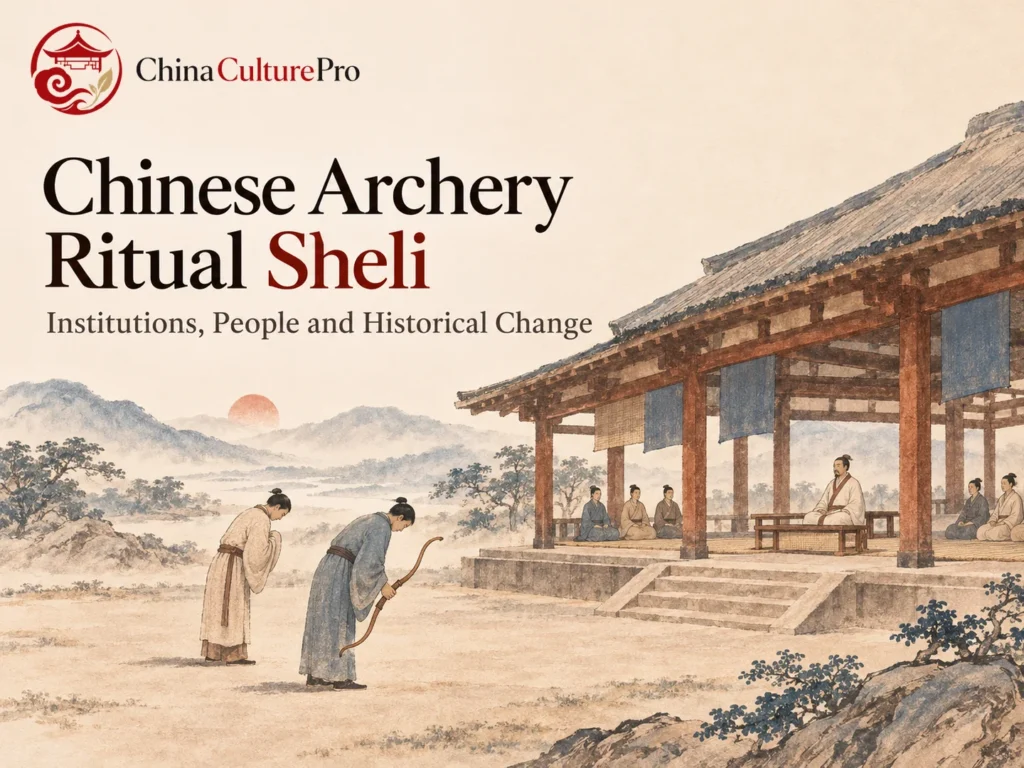

Quick Answer: What Was Chinese Ritual Archery?
Chinese ritual archery, or sheli (射礼, shèlǐ), brought shooting into a formal gathering with assigned roles, gestures and rules for keeping score. Classical texts describe both a local rite with hosts and guests and a larger assembly under a ruler. The way participants competed expressed their relationships as well as their skill.[1][2][3][6]
- Roles: Hosts, guests, archers and attendants had assigned duties.
- Competition: Participants could shoot in pairs and have hits counted.
- Conduct: Courtesy and timing mattered alongside accuracy.
Ritual texts describe prescribed forms. Objects and inscriptions can preserve evidence of particular events.
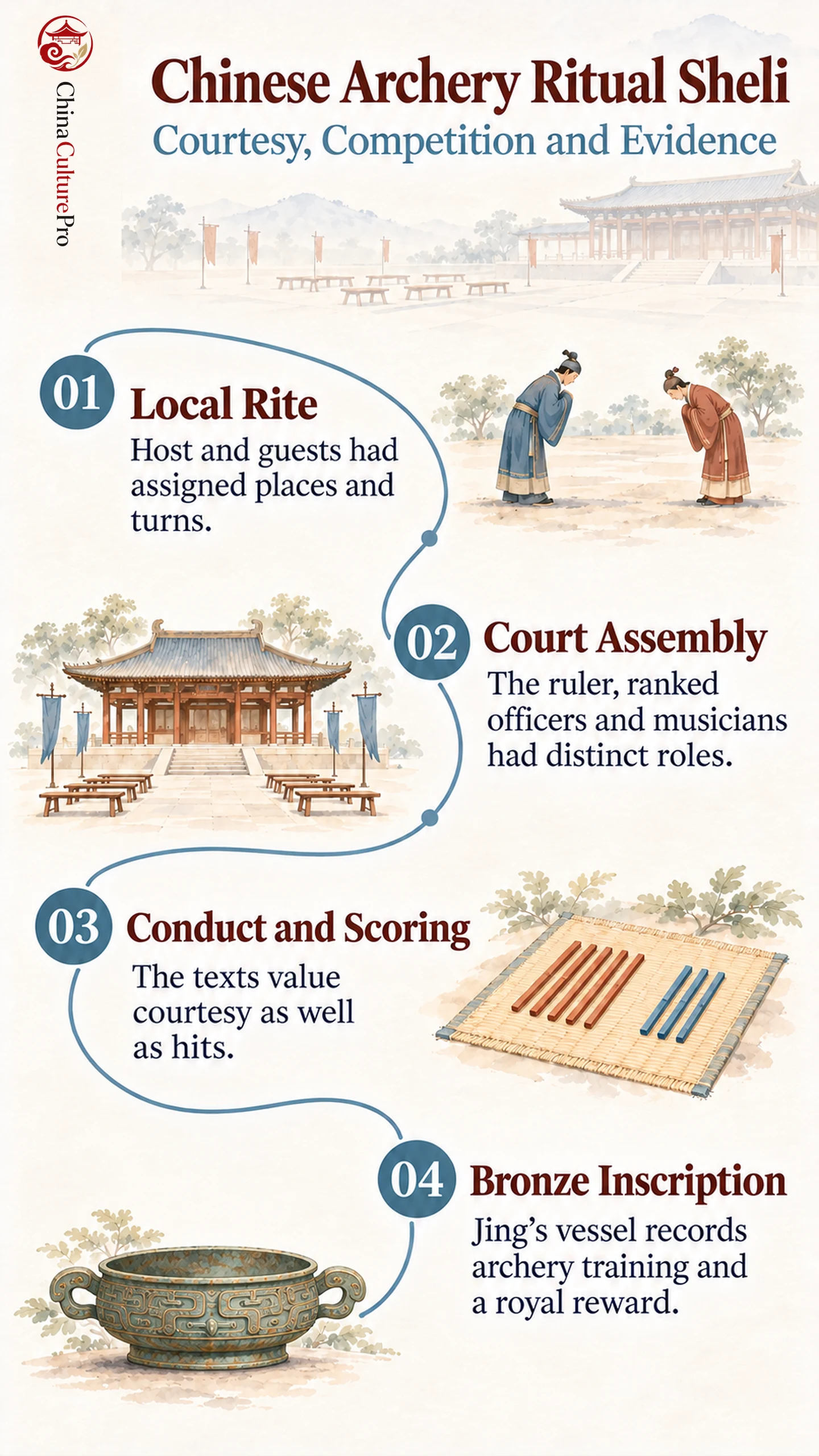
At a formal archery gathering, participants could bow to each other, shoot in pairs and return to their places while officials counted hits. A Western Zhou bronze records a royal contest and honors the person who trained the archers.
The Local Archery Rite in the Yili
The Yili (仪礼, Yílǐ), or Book of Etiquette and Rites, sets out a local archery ceremony called xiangshe li (乡射礼, xiāngshè lǐ). A host and a principal guest have assigned places. In the sequence the text describes, participants yield and bow before taking their positions. The host and guest shoot as a pair, and the other guests have their turns.[1][6]
One official directs the shooting, while another keeps count with tallies. When a senior official shoots with a lower-ranking partner, the commentary explains differences in how they approach the platform and take their places. The ceremony made rank visible through the participants’ movements.[1]
How the Great Archery Meet Displayed Rank
The chapter on Great Archery (大射, dàshè) opens with a ruler giving the order to assemble. Different officers summon ranked participants, supervise preparations and set out targets. The plan gives the ruler and guests assigned seats and sets different distances for the targets. The text calls for music in a later round of shooting, with an officer directing the musicians.[2][6]
The local and court chapters share features such as designated roles, paired shooting and a tally of hits. Their arrangements differ in how they stage differences of rank. For the broader uses of bows, including other forms of training and competition, see the guide to traditional Chinese archery.[1][2][6]
What Confucian Texts Ask of an Archer
The Sheyi (射义, Shèyì), or “Meaning of Archery,” is a chapter of the Record of Rites. It connects ceremonial shooting with bodily bearing and attention to music. The chapter also uses the example of missing a target to urge an archer to reflect on personal conduct rather than blame the person who shot better.[3]
Book 3 of the Analects uses archery as an example of how a cultivated person can compete. The passage mentions bowing and yielding on the way up and drinking after coming down. Read alongside the tallies in the ritual manual, it shows why an account of the score alone misses much of the ceremony.[1][4]
What a Western Zhou Bronze Can Tell Us
The Smithsonian’s Jing gui (簋, guǐ), a bronze food vessel dated to the tenth century BCE, preserves a different kind of evidence. Its inscription recounts a king ordering Jing to oversee archery instruction. It describes a subsequent contest involving the ruler and a royal gift to Jing of an archer’s arm guard. The vessel was dedicated to Jing’s mother.[5]
This inscription records a claim about a specific training assignment, contest and reward in the Western Zhou dynasty. The bronze shows how a court honored someone for organizing and teaching archery. Its evidence concerns Jing’s assignment and reward. Details such as where participants bowed or how hits were counted come from the received ritual chapters.[2][5][6]
FAQs About Chinese Archery Ritual
Was ritual archery a form of military training?
Bow skills mattered in multiple settings. The ceremonies described in the Yili had their own goals and rules of etiquette. Other records, such as the Jing inscription, provide evidence of court training.
Did ceremonial archers compete for a score?
Yes. The Yili prescribes officials to record hits. The formalities around taking a place, shooting and concluding the gathering were also part of how participants were expected to compete.
Is the Yili a record of one archery event?
The Yili preserves procedures for ritual occasions. To study a particular contest, compare such texts with evidence that refers to a specific time, place or set of people.
Sources
[1] Yili Jishi, Shidian Classics. Yili, Local Archery Rite
[2] Yili, Wikisource. Yili, Great Archery
[3] Liji Zhengyi, Wikisource. Record of Rites, Meaning of Archery
[4] Analects, Book 3, section 7. Analects 3.7
[5] Arthur M. Sackler Gallery, Smithsonian Institution. The Art and Archaeology of Ancient China, Jing gui inscription
[6] Springer. Archery Rites: Remaking Confucian Rites