


Quick Answer: Who Was Zhou Fang?
Zhou Fang (周昉, Zhōu Fǎng) was a Tang-dynasty artist especially associated with court-lady painting (仕女画, shìnǚhuà): images of elegantly dressed elite women. [1]
- Full figures, fine contours and carefully balanced color characterize the tradition associated with him. [1]
- His reputation also included Buddhist and Daoist imagery. [2]
- Paintings carrying his name have different attribution histories; a traditional attribution does not establish a surviving autograph. [3][4][6]
Read the artist’s reputation alongside each museum’s account of the physical work.
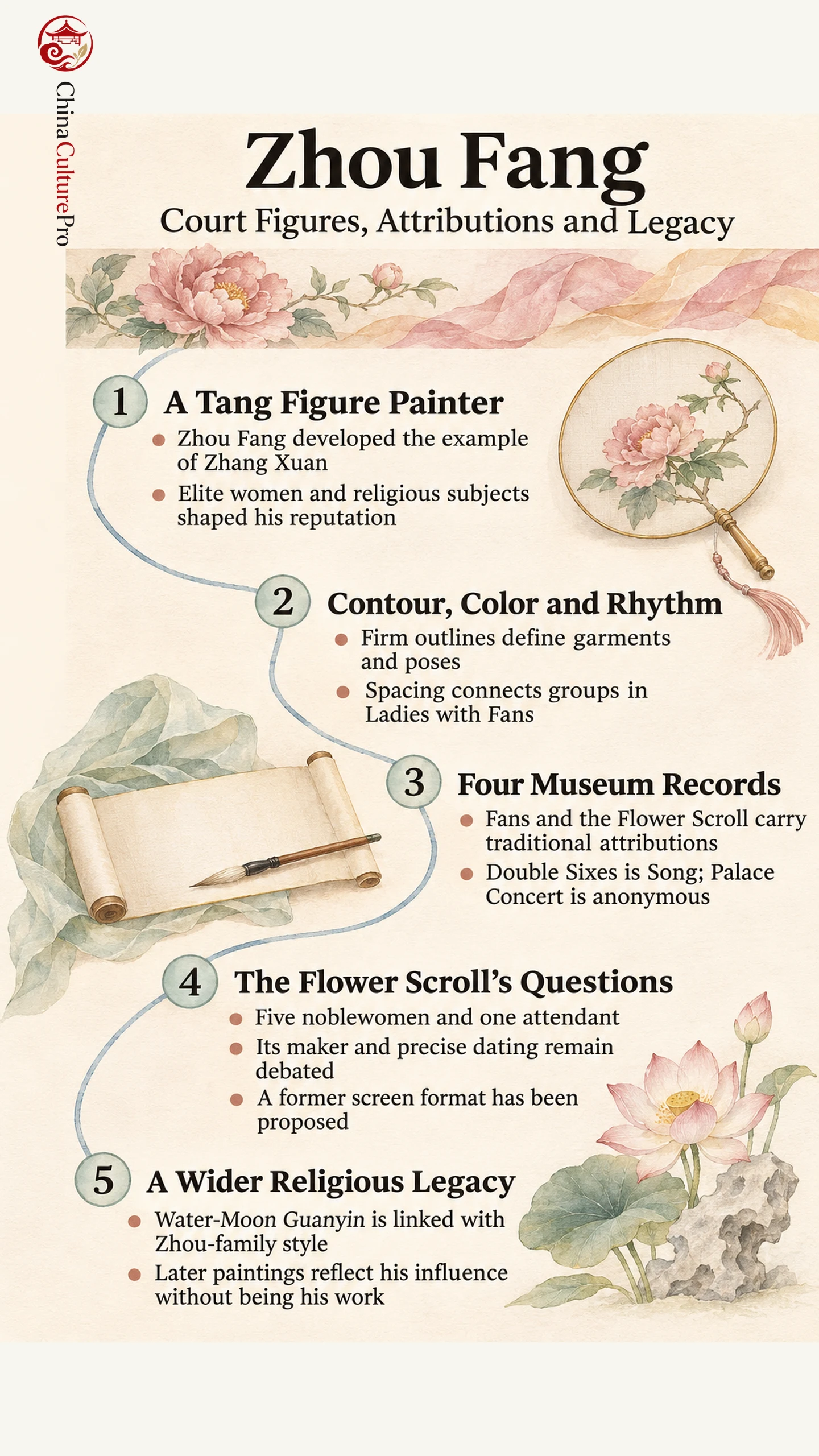
A sleeve, a fan and a turn of the head can organize an entire group of figures. Zhou’s place in Chinese figure painting becomes clearer when you follow these relationships, then check how the surviving object is dated and attributed.
A Tang Painter of Elite Life
Zhou came from Jingzhao, in present-day Xi’an, and an official family. He held provincial posts; his birth and death dates remain unknown. [2]
He first followed Zhang Xuan, then developed his own approach to painting aristocratic women. [1] Compare him with Wu Daozi to explore another strand of Tang painting.
Contour, Color and the Rhythm of Figures
Ladies with Fans (挥扇仕女图, Huīshàn shìnǚ tú) shows thirteen women resting with fans, handling a zither, using a mirror and doing needlework. Firm, rounded garment contours and spaced groups create rhythm. Red combines with blue, gray, purple and green. [3]
Follow one clothing outline from shoulder to hem, then compare it with the next figure’s posture. The gaps between groups matter as much as the decorated garments. Guides to painting techniques and meticulous and freehand painting provide context for reading those controlled marks.
Four Paintings and Their Different Statuses
The following examples distinguish traditional attributions from a later painting and an anonymous work influenced by the same tradition. Dimensions are height × width in centimetres.
| Work | Collection and attribution | Format and image dimensions |
|---|---|---|
| Ladies with Fans | Palace Museum, Beijing; traditionally attributed to Zhou Fang | Color on silk handscroll, 33.7 × 204.8 cm. [3] |
| Ladies Wearing Flowers in Their Hair (簪花仕女图, Zānhuā shìnǚ tú) | Liaoning Provincial Museum; traditionally attributed to Zhou Fang | Color on silk handscroll, 46 × 180 cm. [4] |
| Palace Ladies Playing Double Sixes | Smithsonian’s National Museum of Asian Art; traditional Zhou attribution, dated late twelfth to mid-thirteenth century | Ink and color on silk handscroll; overall image 30.5 × 69.1 cm. [6] |
| Palace Concert (宫乐图, Gōngyuè tú) | National Palace Museum, Taipei; anonymous | Silk hanging scroll, 48.7 × 69.5 cm. [7] |
Why the Flower Scroll’s Attribution Matters
The Liaoning scroll depicts five aristocratic women and one attendant, with two dogs and a crane. Its traditional Zhou attribution relies on recorded collection history and stylistic comparison, rather than an artist’s signature. The women’s precise identities remain uncertain; their aristocratic appearance does not establish that they were palace residents. [4]
Dating also remains a research question. In a 2006 study’s published abstract, Li Xingming argued for a late-Tang date through comparisons with tomb murals, archaeological material and historical texts. This is a specific scholarly proposal. [5]
Its format has a history too: seams observed during the 1972 remounting prompted the suggestion that separate vertical silk sections once belonged to a screen. That reconstruction remains a proposal. [4] Later collection seals and inscriptions should be read as evidence of transmission, with their dates kept distinct from the painted image.
Religious Painting and a Wider Legacy
Zhou’s reputation extended to Water-Moon Guanyin (水月观音, Shuǐyuè Guānyīn), associated with the Zhou-family style (周家样, Zhōu jiā yàng). Historical accounts credit him with a distinctive religious manner as well as portraits and court figures. [2] The contexts of Guanyin, Chinese Buddhism and Daoism broaden the picture beyond aristocratic leisure.
Later objects show why influence and authorship need different labels. The Smithsonian’s double-sixes scroll is dated to the Southern Song period. [6] Taipei’s anonymous Palace Concert is described as influenced by Zhang Xuan and Zhou Fang. Its musicians and tea gathering also offer a visual context for exploring tea culture. [7]
FAQs About Zhou Fang
Did Zhou Fang paint Palace Concert?
The Taipei museum lists its painter as anonymous and discusses the influence of Zhang Xuan and Zhou Fang. It does not identify Zhou as its maker. [7]
Is Ladies with Fans a signed work?
No artist’s signature or seal survives on the Beijing scroll. Its traditional attribution and later collectors’ marks should be distinguished. [3]
What can the flower scroll tell us about Tang dress?
It shows elaborate aristocratic clothing, including light outer garments and high coiffures. Use it alongside other evidence for clothing history and silk dress while keeping its attribution and the women’s identities in view. [4]
Sources
[1] Tsinghua University Art Library. Figure Painting Exhibition: Zhou Fang
[2] Palace Museum, Beijing. Zhou Fang
[3] Palace Museum, Beijing. Ladies with Fans
[4] Dong Baohou, interviewed by China News Service; republished by the National Ethnic Affairs Commission. Discussion of Ladies Wearing Flowers in Their Hair
[5] Li Xingming, Journal of Hubei Institute of Fine Arts. A Study of the Date of the Flower Scroll, 2006: Abstract
[6] Smithsonian’s National Museum of Asian Art. Palace Ladies Playing Double Sixes, F1939.37
[7] National Palace Museum, Taipei. Palace Concert