

Quick Answer: Who Was Feng Zikai?
Feng Zikai (丰子恺, Fēng Zǐkǎi; 1898–1975) was a Chinese artist, essayist and educator, and a pioneer of modern manhua (漫画, mànhuà). His abbreviated brush drawings make ordinary scenes carry feeling, poetic meaning or an ethical question.[1][2][4][5]
- Subjects: Children, family life, common people and scenes inspired by poetry.
- Method: A few expressive marks work together with a title or inscription.
- Outlook: Sympathy for people and other living beings connects much of his art.[1][5]
Manhua here can be lyrical or reflective; it need not deliver a joke or caricature.
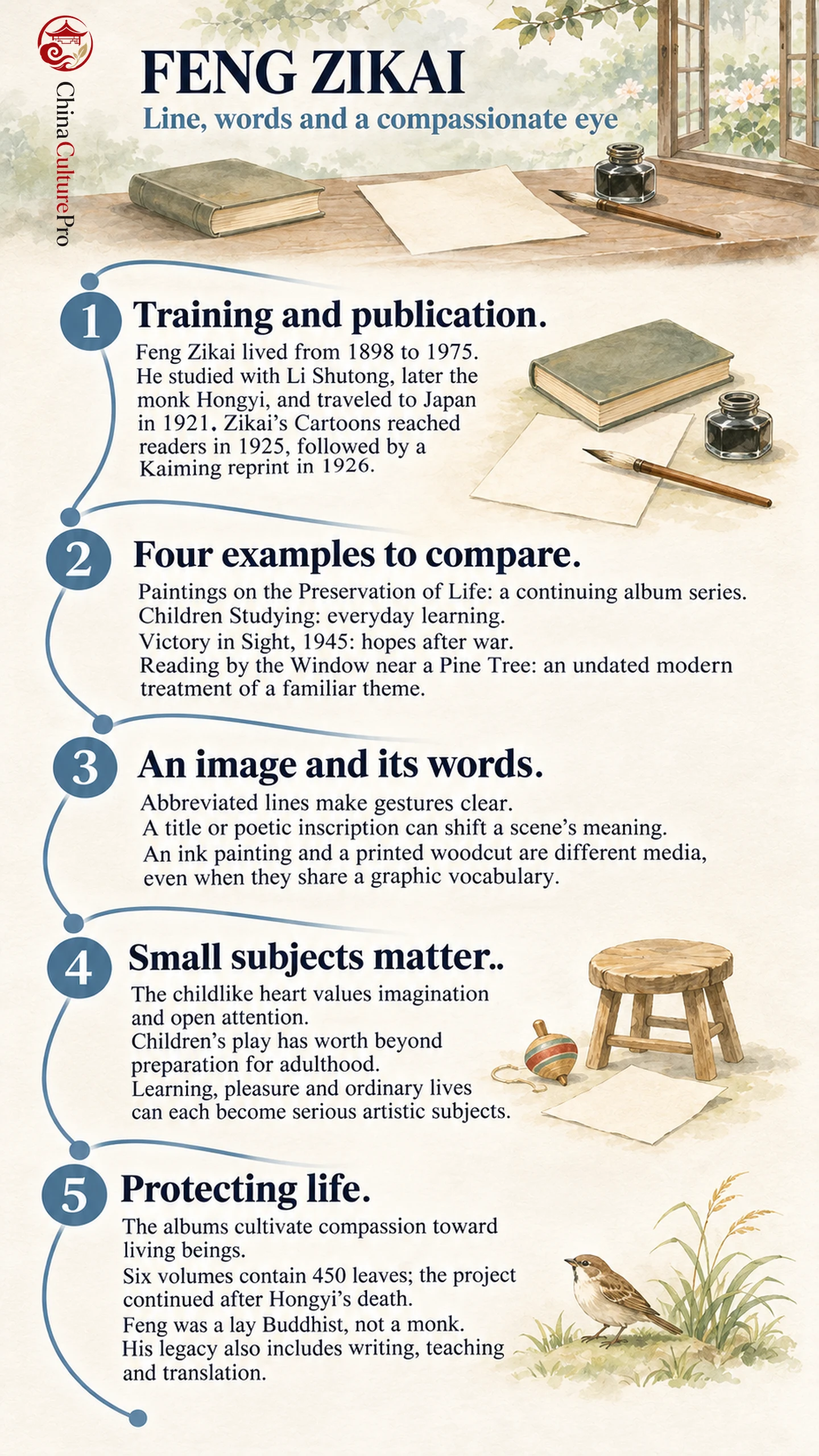
A small gesture can carry an entire story in Feng Zikai’s pictures. The spare drawing is only part of the effect: a caption can change how a scene feels. Looking at the image and its words together reveals an art of attention to ordinary life.
Training, Teaching and the Rise of Zikai’s Cartoons
Born in the Tongxiang (桐乡, Tóngxiāng) area of Zhejiang (浙江, Zhèjiāng), he learned painting and music from Li Shutong (李叔同, Lǐ Shūtóng), later the monk Hongyi (弘一, Hóngyī). Study in Japan in 1921 brought further encounters with drawing, music and Japanese graphic art.[1][2]
In 1925, editor Zheng Zhenduo (郑振铎, Zhèng Zhènduó) presented his drawings as Zikai’s Cartoons (子恺漫画, Zǐkǎi Mànhuà). A collection followed, with a Kaiming (开明, Kāimíng) reprint in 1926. Teaching and publishing connected his art with modern Chinese cultural life. War displaced his family, and he later faced persecution during the Cultural Revolution (文化大革命, Wénhuà Dà Gémìng).[2]
Selected Paintings and Publications
A publication series and individual scrolls reveal different sides of his practice. An undated work should remain undated; a later gift to a museum is not its creation date.[1][3][4][7]
| Work or publication | Date and form | Point of attention |
|---|---|---|
| Paintings on the Preservation of Life (护生画集, Hùshēng Huàjí) | A long-running series begun around 1929; six volumes. | Images and written texts cultivate compassion. |
| Children Studying (儿童读书图, Értóng Dúshū Tú) | 20th century; hanging scroll (立轴, lìzhóu), ink and color on paper. | Children learning outdoors; everyday life becomes a subject for painting. |
| Victory in Sight (胜景在望图, Shèngjǐng Zàiwàng Tú) | 1945; hanging scroll, ink on paper. | A lakeside scene expresses hopes after war. |
| Reading by the Window near a Pine Tree | Undated; framed hanging scroll, ink and color on paper. | An old scholar-in-a-pavilion theme receives an abbreviated modern treatment. |
How Line and Caption Work Together
An illustration-like line can clarify gesture. The connection with woodblock imagery does not make these brush paintings printed woodcuts.[3]
A title can redirect attention; a poetic inscription can open an emotional association beyond the scene. Consider how the text changes what you see, rather than expecting it to describe every visible detail.[5]
Reading by the Window near a Pine Tree keeps a familiar landscape-painting subject while using an accessible, cartoon-like manner. Traditional themes and a modern audience can therefore meet within the same work.[4]
Children and Everyday Life as Serious Subjects
The childlike heart (童心, tóngxīn) values imaginative, open engagement with the world. Play has worth beyond preparation for adulthood; a small game can question adult assumptions about what deserves attention.[5]
Children Studying makes youthful learning a subject of public hope. In Victory in Sight, the lakeside figure and setting instead evoke a return to ordinary life after war. His humane outlook could address education, pleasure and historical experience without making every picture serve the same lesson.[3][7]
Protecting Life and a Continuing Legacy
Protecting life (护生, hùshēng) means cultivating compassion toward living beings. The albums developed through Feng’s relationship with Hongyi and his lay Buddhist commitments. The project continued after Hongyi’s death in 1942, reaching six volumes and 450 leaves. Its concern connects the treatment of animals with human relationships.[1][2]
This was a collaborative meeting of pictures and written texts, not simply a set of animal illustrations. A 2026 exhibition brought the six volumes’ original works together, examining their artistic, literary and ethical connections.[6]
His writing, teaching and translation place him within modern Chinese literature. The picture-book award bearing his name continues his concern for children’s perspectives.[2]
FAQs About Feng Zikai
Does manhua mean only a funny or satirical cartoon?
No. In his practice it also includes poetic, humane and reflective images.[5]
Was Feng Zikai a Buddhist monk?
No. He was a lay Buddhist; his teacher Li Shutong became the monk Hongyi.[2]
Did he paint only children?
No. Adults, everyday social scenes and subjects inspired by old poetry also appear.[1]
Are all his paintings black and white?
No. Both ink-only works and paintings using ink and color survive.[4]
Sources
[1] Hong Kong Museum of Art / Hong Kong Government. Feng Zikai’s cartoon works and Paintings on the Preservation of Life
[2] Feng Zikai Chinese Children’s Picture Book Award. The Award and Feng Zikai: biography and family testimony
[3] The Metropolitan Museum of Art. Children Studying
[4] The Metropolitan Museum of Art. Reading by the Window near a Pine Tree
[5] Chengcheng You, Humanities and Social Sciences Communications. Beyond triviality barriers: the transcendent poetics of play in Feng Zikai’s manhua legacy
[6] China Federation of Literary and Art Circles. An academic exhibition of Feng Zikai’s Paintings on the Preservation of Life
[7] The Metropolitan Museum of Art. Victory in Sight