


Quick Answer: Who Was Fu Baoshi?
Fu Baoshi (傅抱石, Fù Bàoshí; 1904–1965) was a major modern Chinese painter of landscapes and historical figures, and an art historian and teacher. His ink painting (水墨画, shuǐmòhuà) joined a study of older art with new brush methods and twentieth-century subjects.[1][3][5]
- Brushwork: Broken, splayed marks help build energetic rock and mountain textures.
- Range: Atmospheric landscapes coexist with emotionally charged historical figures.
- Context: War, travel and public commissions shaped different phases of his career.[1][2][3][6]
His work cannot be reduced to a single texture technique or to landscapes alone.
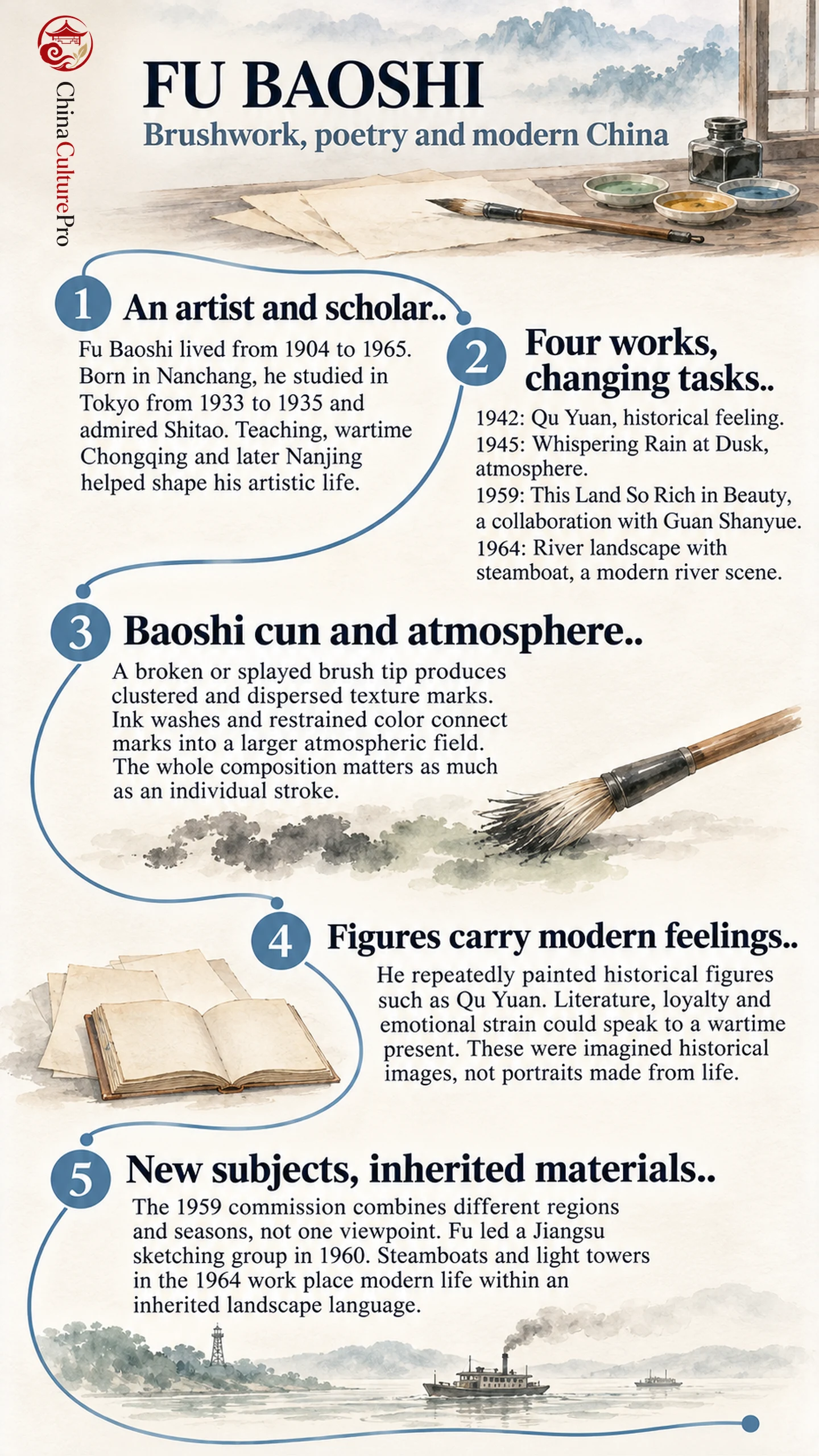
Fu Baoshi’s mountains can feel wet with rain, while a historical figure may carry the tension of the painter’s own century. Looking across different works shows how he renewed inherited subjects through brushwork, atmosphere and a changing relationship between personal expression and public life.
An Artist, Art Historian and Teacher
Born in Nanchang (南昌, Nánchāng), Jiangxi (江西, Jiāngxī), he studied in Tokyo from 1933 to 1935. He admired Shitao (石涛, Shí Tāo), an earlier artist whose biography he wrote.[1][5]
During the war against Japan, teaching and painting brought him to Chongqing (重庆, Chóngqìng). He later returned to Nanjing (南京, Nánjīng). These settings belong to the development of his art: the study of tradition continued alongside direct encounters with place, weather and historical upheaval.[1][3][5]
Four Works from Poetry to Modern Landscape
These examples connect a date with a different artistic task. The first two featured in the 2012 retrospective at the Met.[3]
| Work | Date and setting | What it demonstrates |
|---|---|---|
| Qu Yuan (屈原, Qū Yuán) | 1942; a historical figure painting. | An ancient poet becomes a vehicle for contemporary feeling. |
| Whispering Rain at Dusk (潇潇暮雨, Xiāoxiāo Mùyǔ) | 1945; landscape painting. | Layered ink washes and pale color create rain-laden atmosphere. |
| This Land So Rich in Beauty (江山如此多娇, Jiāngshān Rúcǐ Duōjiāo) | 1959; made with Guan Shanyue (关山月, Guān Shānyuè) for the Great Hall of the People. | A collaborative, monumental vision combines landscapes and seasons. |
| River landscape with steamboat | 1964; ink and color on paper, Ashmolean Museum. | Modern vessels enter a landscape expressed through traditional materials. |
Baoshi Cun and the Building of Atmosphere
Baoshi cun (抱石皴, Bàoshí cūn) is a texture method that uses a broken or splayed brush tip to create clustered and dispersed marks. It reworks older painting techniques rather than discarding every inherited method. The marks give rock faces structure while keeping the movement of the brush apparent.[2]
Ink wash and restrained color can connect textured forms into a larger atmospheric field. In Whispering Rain at Dusk, layers of wash and pale color make the landscape seem heavy with moisture; the effect depends on relationships across the painting, not just an isolated signature stroke.[3]
Spontaneity therefore need not mean random marks. Look for how brush clusters, wet passages and the arrangement of forms work together. A close view of texture and a wider view of the whole composition answer different questions.
Historical Figures as Contemporary Expression
His figure painting deserves equal attention. He returned to Qu Yuan, the ancient poet, from the 1940s onward. The subject connected literary achievement, loyalty and personal distress with a modern wartime setting. These are imagined historical images, not portraits painted from life.[6]
The Palace Museum’s Qu Yuan shows the poet standing by a river, withdrawn in troubled thought. Its catalogue gives no exact year. It should not be confused with the 1942 portrait listed above.[3][6]
Travel, Public Commissions and Artistic Legacy
The 1959 Great Hall commission drew on a poem by Mao Zedong (毛泽东, Máo Zédōng). Fu and Guan combined different regions and seasons in a single expansive vision. It is a constructed national landscape, not a record of one visible viewpoint, and both painters belong in its attribution.[4]
Fu became head of the formally established Jiangsu Provincial Chinese Painting Institute (江苏省国画院, Jiāngsū Shěng Guóhuàyuàn) in 1960 and led a sketching group that year. Travel and observation helped enlarge the subjects available to modern ink painting.[1]
In the 1964 river scene, steamboats and light towers enter an inherited landscape language. This is part of his significance within modern Chinese cultural history: individual brushwork and older models could accommodate contemporary places, public meanings and new visual demands.[3][5]
FAQs About Fu Baoshi
What is Baoshi cun?
It is Fu’s named landscape-texturing method using a broken or splayed brush tip.[2]
Did Fu Baoshi paint only landscapes?
No. Historical and literary figures form another major part of his work.[6]
Did he use color as well as ink?
Yes. Ink wash and color work together in many of his paintings.[5]
Did Fu Baoshi paint This Land So Rich in Beauty alone?
No. The 1959 Great Hall painting was a collaboration with Guan Shanyue.[4]
Sources
[1] National Art Museum of China. Fu Baoshi and the New Jinling painters
[2] The Palace Museum. Baoshi cun
[3] The Metropolitan Museum of Art. Chinese Art in an Age of Revolution: Fu Baoshi
[4] Guangdong Museum of Art. Guan Shanyue: This Land So Rich in Beauty
[5] Ashmolean Museum. River landscape with steamboat
[6] The Palace Museum. Qu Yuan: historical figure painting