

Quick Answer: Who Was Guan Tong?
Guan Tong (关仝, Guān Tóng), also romanized Kuan T’ung, was a tenth-century painter important to the development of Chinese landscape painting. Early histories associate him with imposing mountains, autumn woods and inhabited valleys.[1][6]
- Training: He followed Jing Hao (荆浩, Jīng Hào).
- Reputation: Strong mountain forms coexist with roads and rural life.
- Evidence: Famous works bearing his name have disputed attributions.[1][2][3][4]
His historical importance is better established than the authorship of any particular surviving scroll.
A museum label may preserve an old artist attribution while the accompanying description questions it. Guan Tong is a useful case: imposing peaks, mountain inns and ferry crossings survive under his name, but they do not form an unquestioned collection of tenth-century originals.
A Landscape Painter Known Through Early Records
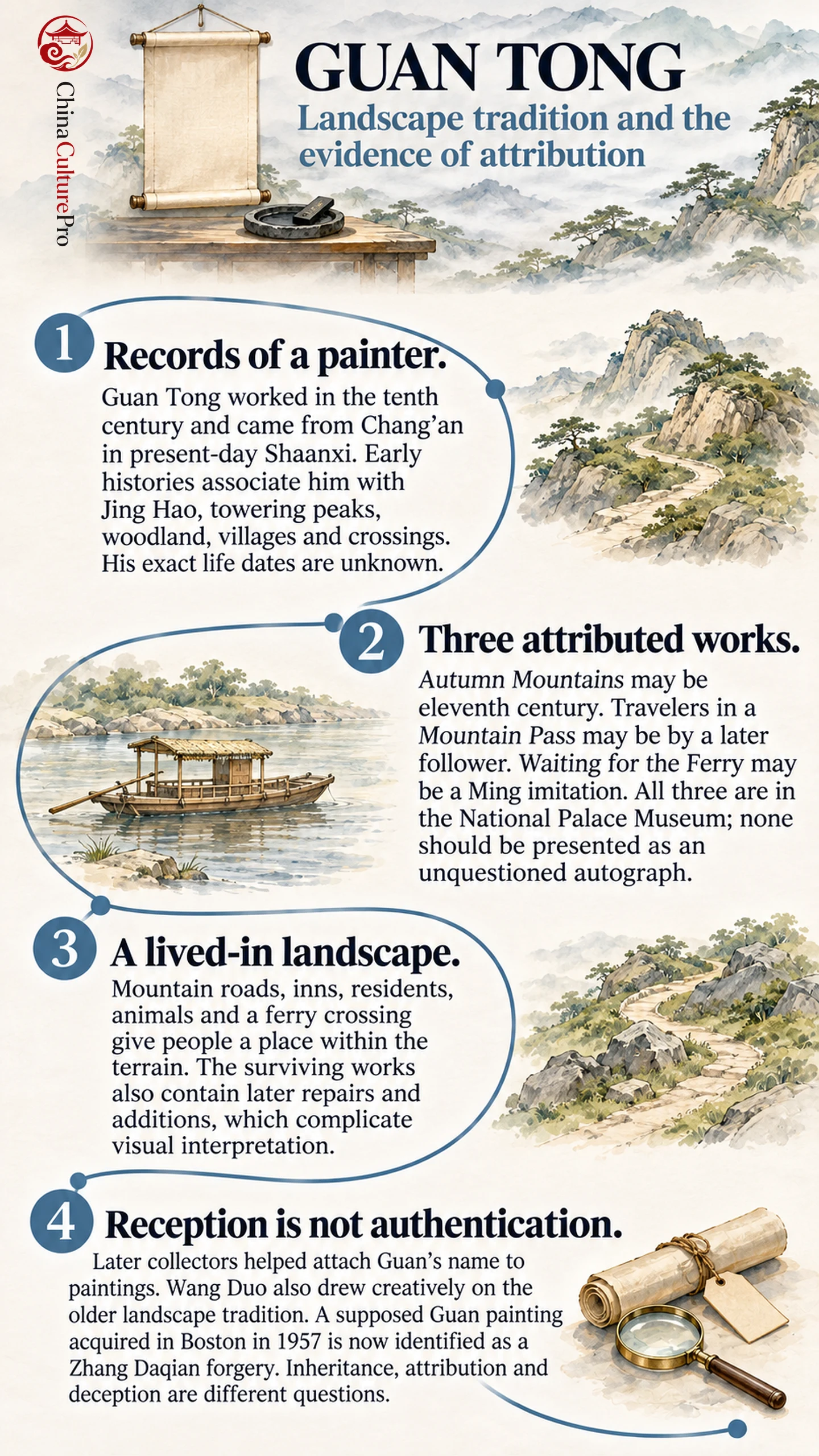
A native of Chang’an (长安, Cháng’ān), in present-day Shaanxi (陕西, Shǎnxī), Guan was active during the Five Dynasties period. His exact life dates are unknown. Some older English records confuse Shaanxi with Shanxi; the Chang’an association concerns the former.[6]
Early painting histories describe his studies with Jing Hao. They praise steep peaks, deep valleys, woodland and passages through the terrain. Accounts also associate his pictures with villages, ferry crossings and roadside settlements.[1]
One record says that Hu Yi (胡翼, Hú Yì) supplied figures for his landscapes. This reports a division of artistic labor; it does not establish who painted every figure in the surviving attributed works.[1]
Three Attributed Paintings and Their Evidence
These three silk hanging scrolls are in the National Palace Museum, Taipei. Their familiar titles preserve a tradition of attribution, rather than a uniform verdict about authorship.[2][3][4]
| Work | Curatorial qualification |
|---|---|
| Evening Colors over Autumn Mountains (秋山晚翠图, Qiūshān Wǎncuì Tú) | Possibly eleventh century; unsigned. |
| Travelers in a Mountain Pass (关山行旅图, Guānshān Xínglǚ Tú) | Possibly a mid-eleventh-century follower. |
| Waiting for the Ferry (山谿待渡图, Shānxī Dàidù Tú) | Possibly a Ming-period imitation. |
The first two proposals place the objects in the Song dynasty; the ferry painting’s proposed date is later still.[2][3][4]
Mountains, Roads and Human Activity
In Autumn Mountains, a path winds behind a massive rock. Some upper rock connections and buildings are later repairs, complicating a reading of the original design.[2]
Travelers places an inn, residents and animals within a mountain valley. Their activities turn the terrain into a place of livelihood and passage.[1][3]
Waiting for the Ferry makes the relationship particularly clear: a traveler with a bundle drives a donkey toward the water and calls for a boat, while peaks and a concealed temple rise above. Its human activity remains legible even though the museum questions the traditional authorship.[4]
Later Collectors, Followers and Forgeries
Wang Duo (王铎, Wáng Duó) helped shape the reception of the first two paintings through later inscriptions. The Autumn Mountains attribution rests on his 1649 colophon. A collector’s conviction is evidence of reception, not conclusive authentication.[2][3]
Creative inheritance is another part of the legacy. The Palace Museum describes Wang Duo’s own 1649 landscape as combining the commanding effects associated with Jing Hao and Guan Tong with other traditions. Following an old master could produce a new painting.[6]
Deception is a separate case. The Museum of Fine Arts Boston identifies a supposed Guan Tong painting acquired in 1957 as a forgery by Zhang Daqian (张大千, Zhāng Dàqiān). This case does not make every later imitation a deliberate forgery.[5]
FAQs About Guan Tong
When did Guan Tong live?
He was active in the tenth century; precise birth and death dates are unknown.[6]
Are his famous paintings securely authenticated originals?
No. The museum discusses later dates or followers for the three works above.[2][3][4]
Was Guan Tong from Shaanxi or Shanxi?
Shaanxi. The Chang’an association refers to the region of present-day Xi’an, not Shanxi.[6]
Did Guan Tong’s landscapes exclude people?
No. Early records mention settlements and crossings, and attributed works show travelers and rural activity.[1]
Sources
[1] Gujin Tushu Jicheng, Arts section, volume 771. Guan Tong: excerpts from early painting histories
[2] National Palace Museum. Evening Colors over Autumn Mountains
[3] National Palace Museum. Travelers in a Mountain Pass
[4] National Palace Museum. Waiting for the Ferry
[5] Museum of Fine Arts Boston. Zhang Daqian: painter, collector and forger
[6] The Palace Museum. Wang Duo: Purple and Green Mountains beside a Stream