


Quick Answer: Who Was Yun Shouping?
Yun Shouping (恽寿平, Yùn Shòupíng; 1633–1690) was an early Qing painter celebrated for flowers formed through sensitive applications of ink and color. He also painted landscapes. [1]
- Technique: Washes can define a petal without a strong enclosing outline.
- Range: Flower studies and inherited landscape styles belong to the same career.
- Legacy: Later paintings after Yun document his influence, with different authorship status.
Use attribution labels alongside technique when identifying a work.
A pale petal can remain distinct against unpainted paper without a dark border. Yun’s flowers invite close attention to that meeting of color, edge and empty space. His landscapes reveal another side of the same sensitivity to the brush.
How Boneless Flowers Take Shape
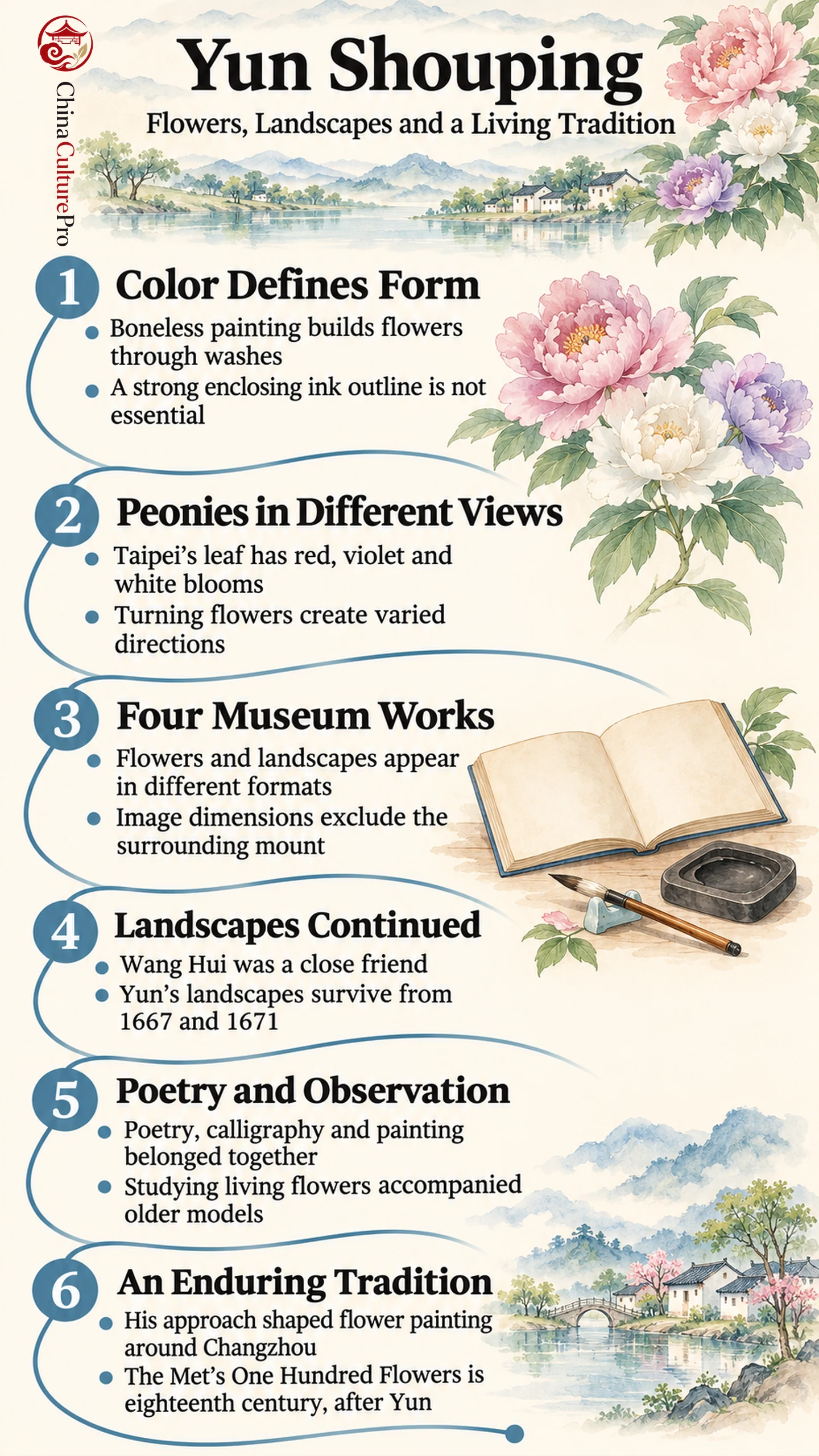
Boneless painting (没骨, mògǔ) constructs forms through washes rather than relying on enclosing ink outlines. Sketching from life (写生, xiěshēng) also mattered to Yun: observation of living flowers informed his engagement with older painting methods. [6]
In the Taipei peony leaf from an Album of Flowers and Landscapes, red, violet and white flowers turn in different directions. Their varied orientations animate a composition that remains poised despite its bright colors. [2]
Look at one petal edge, then the neighboring petal. A change in tone or color can make their surfaces separate. Follow the stem back toward the leaves to see how the flower is supported within the composition. These are useful viewing questions for Chinese painting techniques, rather than a formula every work must follow.
The distinction between careful description and expressive brushwork helps frame the discussion, but an individual flower painting may combine precision with apparent ease.
Four Works Across Flowers and Landscape
The measurements refer to the image or individual painting leaf, excluding its mount. These works show why subject, date, support and format should stay together.
| Work | Collection and format | Date and image size |
|---|---|---|
| Peonies from Album of Flowers and Landscapes | National Palace Museum, Taipei; color on paper album leaf | Qing dynasty; 28.5 × 43.1 cm. [2] |
| Landscapes in the manner of Song and Yuan masters | Metropolitan Museum of Art; album of ten paintings, ink and color on paper | 1667; 27 × 39.7 cm. [3] |
| Sunset along the Floral Embankment | Kyoto National Museum; ink and light colors on paper handscroll | 1671; 24.2 × 106.1 cm. [4] |
| Herbaceous Peony | Cleveland Museum of Art; ink and color on silk hanging scroll | 1685; 118.7 × 71.8 cm. [5] |
Wang Hui, Earlier Masters and a Continuing Landscape Practice
From Wujin, now Changzhou in Jiangsu, Yun was also known as Yun Ge (恽格, Yùn Gé) and used the sobriquet Nantian (南田, Nántián). He is grouped with the Four Wangs and Wu Li among the leading painters of the early Qing dynasty. [1]
His friend Wang Hui supplied an appreciative inscription beside the Taipei peonies. That pairing makes the album a record of artistic exchange as well as flower painting. [2][3]
The familiar story that Wang’s landscapes encouraged Yun to concentrate on flowers should not erase his surviving landscape work. Kyoto’s 1671 handscroll follows the earlier painter Hui Chong and depicts lakeside villages in gentle evening light. [4]
The 1667 Met album ranges from monumental scenes in the manner of Wang Meng to small studies of trees and rocks associated with Cao Zhibo. Its varied compositions preserve a sustained engagement with landscape painting. [3]
Poetry, Observation and an Enduring Flower Tradition
Yun’s reputation embraced poetry, calligraphy and painting together. His flower studies combine attention to nature with knowledge of earlier art. [6] Reading inscriptions alongside the image can therefore change what the subject means.
Peonies commonly carry associations with prosperity and wealth. Cleveland’s interpretation of Herbaceous Peony adds a possible reference to Ming loyalism: pale flowers and damaged stems may convey memory of a lost past. This is a reading of a particular work, not a code that explains every peony. [5]
Such connections place flowers within the concerns of literati painting, where a subject can carry personal and cultural meaning beyond its appearance.
His approach helped establish a flower-painting tradition around Changzhou. [1]
Influence also continued through later painters. The Met’s One Hundred Flowers is an eighteenth-century silk handscroll catalogued as after Yun Shouping. That label preserves the relationship to his tradition without identifying the painting as his own execution. [7]
FAQs About Yun Shouping
Did Yun Shouping invent boneless painting?
No. He developed an earlier tradition associated with the Song painter Xu Chongsi, adapting it through his own observation and handling of ink and color. [1]
Did he stop painting landscapes?
A permanent abandonment would be misleading. His surviving works include a 1667 landscape album and a 1671 landscape handscroll. [3][4]
Is One Hundred Flowers an autograph painting?
The Met currently identifies it as an eighteenth-century work after Yun Shouping, rather than an autograph by the seventeenth-century painter. [7]
Sources
[1] Palace Museum, Beijing. Yun Shouping
[2] National Palace Museum, Taipei. Peonies from Album of Flowers and Landscapes
[3] Metropolitan Museum of Art. Landscapes in the manner of Song and Yuan masters
[4] National Institutes for Cultural Heritage, Japan. Sunset along the Floral Embankment
[5] Cleveland Museum of Art. Herbaceous Peony
[6] Ashmolean Museum, University of Oxford. Flowers
[7] Metropolitan Museum of Art. One Hundred Flowers