

Quick Answer: What Is the Xici Commentary?
The Xici (系辞, Xìcí), or Xici zhuan (系辞传, Xìcí Zhuàn), is a two-part commentary within the Yijing (易经, Yìjīng), the Book of Changes. Also called the Dazhuan (大传, Dàzhuàn), it appears in English as the Great Commentary, Great Treatise or Commentary on the Appended Statements.[1][3]
- Place in the collection: Its upper and lower parts count as two of the Ten Wings (十翼, Shíyì).
- Central questions: How can figures and words disclose change, guide conduct and help people respond to circumstances?
- Reading scope: It combines cosmological reflection, ethical examples and discussions of divination; it is neither the complete Changes nor merely a list of predictions.[1][2]
The most useful starting point is a small group of linked passages, read with their explanatory context.
The Xici asks what a symbolic book can do. Its answer moves between the changing world, the figures used to represent it, and the judgments people make before acting. Reading those connections reveals more than collecting isolated sayings about an endlessly changing universe.
Two Parts and Several Names: Locate the Text
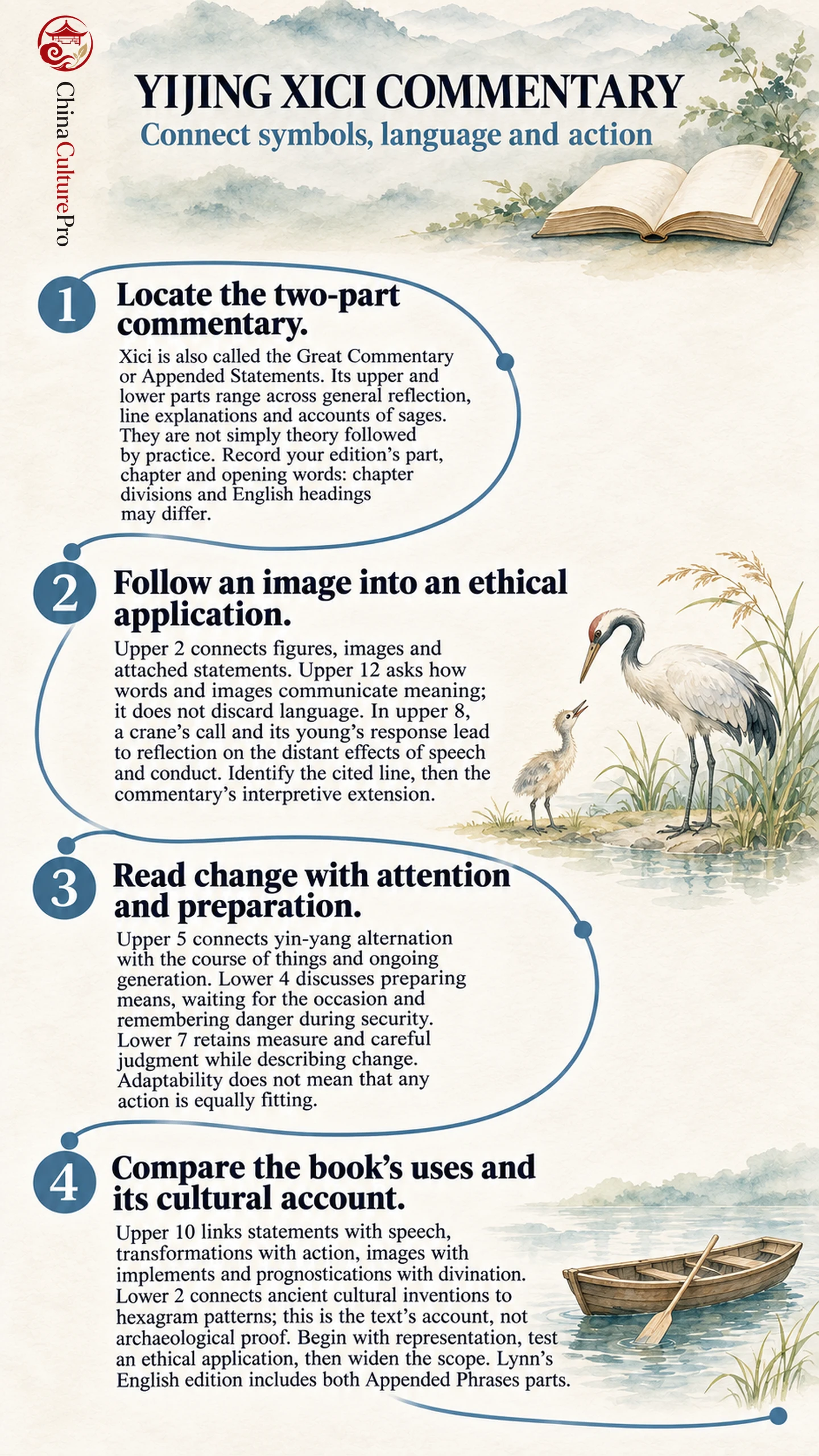
The received text has upper and lower parts. Their passages include general statements, explanations of particular lines, accounts of ancient sages and discussions of the book’s use. The two parts should not be reduced to “theory first, practice second”: both move among several kinds of argument.[1][2]
Chapter divisions and English headings can differ between editions. When recording a passage, note the part, your edition’s chapter number and its opening Chinese words. Here, references such as “upper 12” follow the linked Chinese text. They are reading locators, not a claim that every translator uses identical divisions.
Traditional attribution associates the commentary with Confucius (孔子, Kǒngzǐ), and some passages introduce the Master’s speech. Such features do not prove that he composed every received passage. Keep traditional attribution distinct from verified authorship; no exact composition year is established here.[4]
Images and Words: How the Commentary Explains Meaning
Two recurring terms are xiang (象, xiàng), images or symbolic configurations, and ci (辞, cí), statements or wording. In upper 2, sages establish figures, observe images and attach words that clarify favorable and unfavorable possibilities. The activity of reading therefore involves both configurations and language.[1]
Upper 12 raises a difficulty: writing does not exhaust speech, and speech does not exhaust meaning. The response is not to abandon words. Images, figures, attached statements and responsive transformation work together. Read this as an argument about complementary expressive resources, rather than a slogan declaring language useless.[1]
Upper 8 supplies a concrete example. A line about a crane calling in seclusion and its young responding becomes a discussion of the reach of a person’s speech and actions. Words spoken privately can have distant consequences; conduct nearby can become visible far away. The commentary turns an image of response into a lesson about responsibility.[1]
The interpretive move matters as much as the lesson. First identify the cited line, then mark where explanation begins. Ask which feature of the image—here, an answering response—supports the moral extension. This keeps the underlying statement distinct from the commentary’s application and makes a translation easier to follow.
Change, Timing and Human Responsibility
Upper 5 connects the alternation of yin and yang (阴阳, yīn yáng) with dao (道, dào), the way or course of things. The surrounding passage also discusses goodness, human character and ongoing generation. This is a connected account of processes and conduct, not a detachable claim that every event has the same meaning.[1]
The lower part repeatedly tests response against circumstances. In the group of sayings placed in lower 4 here, a person should prepare the means for action and wait for the appropriate occasion. Another saying urges remembering danger during security and disorder during good government. Change calls for attention and preparation, not indiscriminate activity.[2]
Likewise, the passage in lower 7 describes movement without a permanently fixed position while still speaking of measure, apprehension and careful reading. Adaptability is not permission to ignore judgment. Ask what changes in the situation, what obligations remain, and which action the commentary presents as fitting.[2]
A Reading Route Through Divination and Cultural Invention
Upper 10 identifies four kinds of engagement with the Changes: attending to statements in speech, transformations in action, images in making implements, and prognostications in divination. These uses are related in the commentary’s account; excluding consultation entirely would distort its scope.[1]
Lower 2 associates the achievements of ancient culture heroes with hexagram patterns: nets, agriculture, markets, boats and other institutions appear in a retrospective account of cultural invention. Read the connections as the text’s explanation of civilization. They do not establish archaeological dates or prove that a named figure personally invented each technology.[2]
- Begin with representation: Read upper 2 and upper 12 together, asking how figures and words communicate.
- Test an application: Read the crane passage in upper 8, then the discussions of preparation and caution in lower 4.
- Widen the scope: Compare the four uses in upper 10 with the account of inventions in lower 2.
Richard John Lynn’s The Classic of Changes includes both parts as Commentary on the Appended Phrases. Check its introduction and notes to distinguish the canonical text from later explanations.[3] Return to the I Ching overview for the larger book, or use the Chinese literature guide to place commentary beside other prose traditions.
FAQs About the Xici Commentary
Is the Xici the whole I Ching?
No. It is one commentary in two parts. It discusses the Changes broadly, but it does not replace the sixty-four hexagrams and their line statements.
Is the Xici only about fortune-telling?
No. Divination is one of its concerns alongside interpretation, conduct and the making of useful things. Studying those historical claims does not require treating forecasts as scientifically established.
Does the Xici describe the familiar yin-yang symbol?
Upper 11 names taiji (太极, tàijí) in a sequence leading to paired modes, four images and eight trigrams. That passage should not be presented as a description of the familiar black-and-white swirling emblem: the text gives a verbal account, not that drawing.[1]
Sources
[1] Public-domain Chinese text. Xici, upper part
[2] Public-domain Chinese text. Xici, lower part
[3] Richard John Lynn, Columbia University Press. The Classic of Changes: A New Translation of the I Ching as Interpreted by Wang Bi (1994)
[4] Edward L. Shaughnessy, Brill. The Origin and Early Development of the Zhou Changes, chapter 12 (2022)