


Quick Answer: Who Was Yelü Chucai?
Yelü Chucai (耶律楚材, Yēlǜ Chǔcái, 1190–1244) was a Khitan scholar and administrator in the early Mongol Empire. He advised Chinggis Khan and Ögedei and helped organize regular revenue collection in Mongol-controlled North China.[1][2][3]
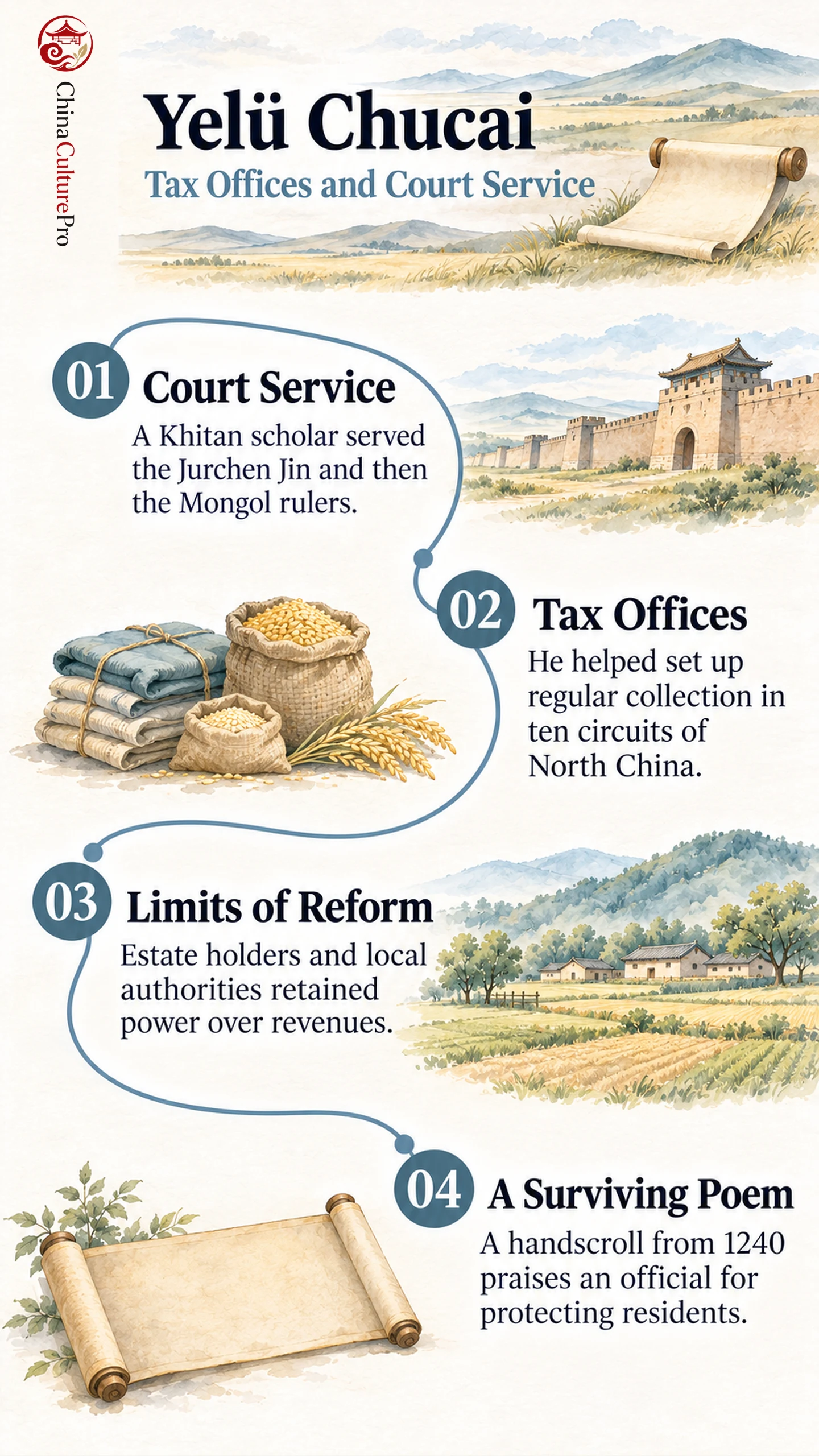
- Career: He began in the service of the Jurchen Jin before joining the Mongol rulers.
- Fiscal work: He helped create collection offices in ten circuits of North China.
- Evidence: A dated handscroll survives alongside later accounts of his administrative work.
His influence was substantial in North China. The reach of his reforms depended on the cooperation of other officials and the Mongol ruling elite.
When conquest brought large settled populations under Mongol rule, the new rulers needed a way to collect revenue. Yelü Chucai’s career shows how officials proposed and built tax offices, why powerful people resisted them, and how a poet wrote about local government.
A Khitan Official Across Three Political Worlds
Yelü descended from the royal clan of the Khitan Liao dynasty. He was born after the Liao had fallen. His father held office under the Jurchen Jin, and Yelü himself began his career in that government. Ancestry and service point to different political relationships. The History of the Yuan uses his family background to frame the story of his recruitment.[1][2]
Yelü entered the service of Chinggis Khan and accompanied the western campaign. He held his most important administrative responsibilities under Chinggis’s successor Ögedei. Both phases predate the formal establishment of the Yuan dynasty under Kublai Khan. The later dynastic history includes Yelü because it traces the ruling house and its institutions back into the earlier empire.[1][2][3]
What He Changed About Tax Collection
The History of the Yuan gives Yelü a speech in which he opposes converting settled land to pasture. His argument is fiscal. Cultivated land and existing markets could provide grain, silver and silk, while taxes on commodities such as salt and liquor could support the government. The biography’s speech is a later account of the debate. The ensuing tax offices give more concrete evidence of the policy.[2][3]
The project established collection offices in ten circuits. The biography says experienced clerks served under officials recruited to run the new offices. Their reported deliveries in 1231 helped secure Ögedei’s support. Yelü took a leading role in the Central Secretariat (中书省, Zhōngshū Shěng), and he advocated separating civil and revenue duties from military command. A military commander could direct troops, while civil officials handled government and tax offices collected the revenue. Yelü pressed for these jurisdictions to remain separate.[2][3]
Why His Influence Had Limits
Regular offices competed with military commanders and powerful households. After the Jin defeat, a census recorded households across North China. Many were attached to estates assigned to members of the conquest elite. Yelü proposed that officials collect revenue in those territories and send it to the central government for redistribution, a proposal that put the interests of officeholders and estate holders at odds.[3]
The proposal won approval, but systematic efforts to enforce it came later under Kublai Khan. Local powers continued to impose levies, and Yelü’s influence declined in the later years of Ögedei’s reign. The central government had offices and procedures, but collection still depended on its ability to make local powers follow them.[3]
A Poem in His Own Hand
The Metropolitan Museum of Art holds Yelü’s Poem of Farewell to Liu Man (赠别刘满诗, Zèngbié Liú Mǎn Shī), written on a handscroll dated 1240. The poem praises an official for protecting people in his jurisdiction while residents fled elsewhere. The colophon explains that Liu Man requested the poem before his departure. It gives readers a reason for the work’s praise and the criticism of abusive officials that accompanies it.[4]
The poem is a work of praise, with a particular recipient and occasion. Read it for the contrast Yelü draws between competent and abusive officials. The later biography and political histories answer different questions about the authority of the tax offices and the enforcement of policy.[2][3][4]
FAQs About Yelü Chucai
Did Yelü Chucai serve Kublai Khan?
He served Chinggis Khan and Ögedei. He died in 1244, before Kublai became great khan.
Why does the History of the Yuan include him?
The history covers the earlier Mongol rulers and their officials as part of the story of Yuan rule. Yelü served during that earlier period.
Did his reforms end irregular levies?
Irregular levies continued. Central offices faced competing claims from military authorities and holders of estates.
Sources
[1] Britannica International Encyclopedia, via Kotobank. Yelü Chucai
[2] History of the Yuan. Chapter 146: Yelü Chucai
[3] Cambridge University Press. The Cambridge History of the Mongol Empire
[4] The Metropolitan Museum of Art. Poem of Farewell to Liu Man